



 0
0

In this special report Dawn’s team of economic reporters surveys markets and attempts to deconstruct the price mechanism to identify factors contributing to the price spiral
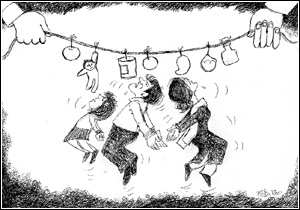 In this election year the focus of public debate has shifted from economics to politics. There is evidence that economic pressures on the poor and the middle classes have been increasing over the last five years. With the exception of clothing and telecommunication prices of most items have increased. The price of rice increased by about 200%, Ghee 110%, sugar 50%, wheat flour 40%, beef 150 and mutton 100%. Property value has escalated six folds. Health care has become so expensive that people are turning from doctors to soothsayers. The share of utilities in the family budget has also increased. If the inflation rate still hovers around 9 %, it seems to be reflective of the skills of price data managers. Shun the poor, even the middle class is finding it increasingly difficult to cope with
KARACHI: Fatima, 38, a teacher and wife of a teacher, looks 10 years older than her age. She told Dawn that besides work stress, the pressure of managing the family budget of six (the couple, three children aged 1, 3 and 6, and the mother-in-law) gave her many stress-related ailments such as ulcers, blood pressure and migraine.
Fatima says that after cutting corners to control family expenses, she has no option but to settle for less nutritional food, even for her children. Some time she has to add water to milk for she cannot afford to spend more than Rs50 that gets her one-and-a-half litres, that is, much less than her family's requirement.
---She plays family doctor by attending to the family's medical needs to the best of her ability and knowledge because taking children to a qualified paediatrician is a feat beyond her reach.
This is when Fatima's husband is a responsible person who gives tuition and work part time for 21 hours a week to supplement the family income. In fact, she is considered as an enterprising privileged lady in her lower middle class neighbourhood. Plight of most other families in Pak Colony is worse.
According to reports pooled by Dawn the price scenario is much worse than what formal data depicts. Helplessness of consumers in the face of price hike is depressing at the marketplace that seems to be under full control of profiteers, unscrupulous hoarders, manipulators and the administration that is said to be corrupt to the core.
Our findings show that imperfect competition (cartelisation etc.), absence or collusion of regulators (corruption in district price committees etc.) and non-existence of effective consumer protection groups have made market a tool to squeeze money from the vulnerable. This has led to wastage of national wealth which continues to sit in the coffers of the irresponsible instead of circulating in the economy. Its inappropriate allocation for 'quick big gains' mindset divert finances to speculative businesses instead of to avenues that may help in broadening the industrial base of the country or improving productivity of industrial processes.
Fractured democracy, in between prolonged dictatorships in the country, has not allowed the civil society to evolve institutions such as strong consumer bodies and rights groups to keep vested interests in check. Whereas the governments with narrow popular base have been dependent on the very element for political support who manipulate markets to amass wealth with little respect for the national interests or care for the people.
However, where the government did regulate and liberalise to ensure free competition, people benefited.
The telecommunication sector is an apt example. As it was opened up for the private sector, international companies entered to compete with the locals. With the result that rates have come down and the level connectivity among people today has changed the dynamics of society. Although rates have come down, providers by no means are suffering. In fact telecommunication companies are one of the most profit-making segments of the economy.
Consumers have reaped dividends of the liberal trade policy. Imports from China especially forced local manufacturers to review their profit margins or exit the market. This must also be a factor for keeping the cost of clothing within limits of ordinary Pakistanis.
Price variation in a market economy is normal. Interplay of demand and supply determines the commodities' price that tends to move both ways. Nowhere in the world prices are static but there is a plausible explanation for their rise or fall. Also, except for some extreme situations, the prices (especially of essentials) tend to move within a narrow band.
Why is the market, which acts neutral elsewhere, so heavily biased against people here? In developed economies, market mechanism seems to be catering well for consumers whereas the economy based on market is moving on to create welfare states, affording a minimum decent living standard for their citizen.
Basic economics tells that market can deliver only under free competition. There are certain conditions (such as access to market information, free mobility by market players, no restriction on entry or exit from market) necessary for the system to deliver. If market is allowed to function under perfect competition, it also relocates the country's resources in a gainful fashion.
The question is, who can ensure that preconditions are met for the market to function? It is the prime responsibility of the government to ensure availability of a level playing field to all market players for the system to function. Even in the citadel of free market, i.e. the US the regulators act swiftly against violators of the rules of the game that apply to all.
In Pakistan, people lose no matter how nature plays its hand. Take food products, irrespective of quality or quantity of the crop, working classes, in urban and rural Pakistan, are at the losing end. Fruit growers in northern Pakistan suffer because they do not have access to market or facilities to preserve their produce, and whatever little reaches cities is priced too high for poor in urban areas. The same is true for other perishables such as vegetables.
The Musharraf government set some new records. Never before had a five-year-span seen such steep price movements. Never before the government had so blatantly promoted and assisted market manipulators. The case in point is dropping of cases against those found involved in sugar, wheat, cement, property and capital market scams. Today, Pakistan's markets are marred by sudden erratic price fluctuations like never before. Ineffective price control mechanism works in favour of market manipulators. Laws and price control legislations are used by corrupt functionaries as an excuse for fleecing market providers (retailers, suppliers, brokers, transporters, and their bodies) who cover this hidden cost from customers by jacking up the price.
For the market to deliver in a disparity-riddled Pakistani society an effective and appropriate system to insure an even playing field for all players is crucial. Steep/sudden variation in prices is indicative of imperfection and needs to be treated as such. Imperfections in the market cannot be wished away. They have to be removed or minimised.
Unfettered democracy, for all its limitation is the best option available for running a country. Nobel laureate economist-philosopher Amartya Sen's thesis that democracy makes it easier to avert famine and overcome hunger is quite well-known. He says that freedom of choice is a crucial factor in resolving a food crisis and that democracy ensures this freedom. Famine and hunger, one would agree, are problems which, if intensified and stretched over time, may eventually involve questions of a country's security. A report on human development in South Asia, prepared by the Pakistan-based Mahbub ul Haq Development Centre, made the observation that democratic governance can directly advance human security in the South Asian region by ensuring access to public goods, efficient delivery of justice and 'by nurturing resilience against disruptive economic and political conflicts'.





























