0
0

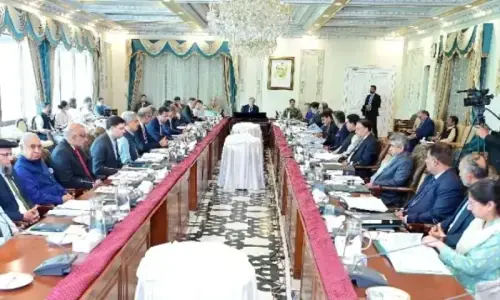
ISLAMABAD, March 12: Foreign secretaries of Pakistan and India will meet here on Tuesday to formally launch the fourth round of the Composite Dialogue with issues of Kashmir and peace and security high on the agenda.
The Composite Dialogue which started in February 2004 is an integral part of the ongoing Pakistan-India peace process and is aimed at confidence-building, normalisation of bilateral relations and dispute resolution.
“On Jammu and Kashmir it is important that we now move from CBMs to dispute resolution. We believe that an early resolution of the Jammu and Kashmir issue will pave the way for durable peace in this region and bring about greater cooperation in South Asia,” Foreign Office spokesperson Tasnim Aslam told a weekly news briefing here on Monday.
She said discussions on peace and security would cover nuclear and conventional issues. Pointing to a number of ideas that were on the table in this regard she specifically mentioned Pakistan’s proposal for strategic restraint which incorporated conventional balance, nuclear and missile restraint and conflict-resolution.
“We also hope that we will be able to finalise a number of agreements that have been under discussion for some time. These include speedy return of inadvertent Line crossers; visa relaxation regime; quarterly flag meetings of sector commanders,” the spokesperson said, while responding to a question.
She also expressed the hope that the two sides would be able to activate the committee on prisoners which was established on Pakistan’s proposal during the Indian foreign minister’s visit here in January.
“This remains an issue which is a high priority for us and we would like to see it addressed at the earliest,” she emphasised.
The spokesperson clarified that there were no Indian prisoners of war in Pakistan. However, she said since the Indians maintained that some of their soldiers were missing and had requested the government to allow their families to visit Pakistan, the government had agreed to it so it could allay their concerns and give them some sort of a closure.
Ms Aslam said the two sides would also work out the schedule of the meeting of the remaining six groups on Siachen, Sir Creek, Wullar Barrage; counterterrorism and narcotics; friendly exchanges and trade.
Indian Foreign secretary Shiv Shankar Menon arrived here on Monday night leading a five-member delegation for the two-day peace talks. He is accompanied by Joint Secretary (Pakistan) Dilip Sinha, spokesperson Navtej Sarna, director India Jiva Saagar and director foreign secretary’s office.
Mr Menon will call on Prime Minister Shaukat Aziz and foreign minister on Tuesday.
Foreign Secretary Riaz Mohammad Khan will be leading the Pakistan delegation which will include Tariq Osman Hyder, additional foreign secretary (UN & EC), Jalil Abbas Jilani, director-general (South Asia Division), Tasnim Aslam, spokesperson and director-general (UN), Irfan Ahmed, director (India) and Zaheer Janjua, director (Kashmir). Pakistan’s High Commissioner to India Mr Shahid Malik will also be present at the talks as would his Indian counterpart and Indian deputy high commissioner.
Pakistan’s thrust at the meeting would be to make the peace dialogue result-oriented by moving decisively towards resolution of longstanding disputes, particularly Kashmir and Siachen, officials here said.
Talking to Dawn on the eve of the meeting a senior diplomat said for Pakistan Jammu and Kashmir would be the central issue during the foreign secretary-level talks and the effort would be to build on convergences already achieved on this front.
Some forward movement but no major breakthrough was expected on Kashmir or on Siachen, sources said.
ANTI-TERROR MECHANISM: Responding to a question regarding the first meeting of Pakistan-India Joint Anti-Terror Mechanism, Ms Aslam said: “We are happy that this meeting took place and we were able to exchange some information. The two governments would hopefully be working on that and we will take it from there.”
She refused to go into details of the nature of evidence provided to India, underscoring that the mechanism ought to work away from the glare of publicity.
“Our understanding is not to do it through public.”
However, she expressed the hope that India would look into the evidence and do the needful.—Q.A.