0
0

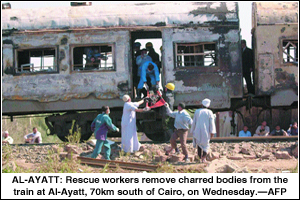 AL-AYATT (Egypt), Feb 20: Fire ripped through a crowded midnight train near Cairo early on Wednesday, killing 373 passengers in the deadliest disaster in more than 150 years of Egyptian rail history.
Many jumped from windows and doors to escape the flames and smoke, but others were trapped behind window-grilles as the train rolled on for several kilometres before coming to a stop, the wind fanning the blaze.
“I was being overwhelmed by the smoke and tongues of flame lashing out at me. So I jumped out of the window of the moving train,” 21-year-old Saleh Selim said.
“We pushed each other and we were suffocating from the smoke. We threw each other out the windows,” another survivor said from his hospital bed.
Charred bodies lay trapped in carriages and wedged between metal bars covering the windows, their features burned black beyond recognition.
It took firefighters several hours to put out the blaze, which raged through seven carriages of the train near the town of Al Ayatt, about 70kms south of Cairo.
“The death toll up to now is 373,” an official at the health ministry said.
One rescue worker standing by the burnt-out shell of the train said the toll could rise above 400, as body after body was pulled from the wreckage.
Mohammed Mokhtar, tears streaming down his cheeks, said he had saved himself and a woman from death by pushing her out of a window and jumping out behind her. But he said he had been too late to save her four-year-old son, whose little body had already been consumed by the flames.
“I don’t know how I can live with all this death,” he said.
Initial investigations indicated the fire had started when a passenger tried to light a small gas stove. Egyptians often use portable stoves to brew their own tea and coffee on train journeys.
One rescuer in a bloodied galabiya robe and plastic gloves worked his way through one of the compartments in search of survivors but found no one alive.
Other rescue workers wearing paper masks fought through the stench of burnt flesh to lift bodies from the train.
Scattered on the ground outside were the scorched remains of clothes and shoes, papers and notebooks.
The train had been heading from Cairo to Luxor, in the south, on the only rail link between the capital and Upper Egypt.
Security sources said all the dead were believed to be Egyptians. Witnesses said the train had been overcrowded with people heading for the countryside to spend the Eid-ul-Azha holiday with families.
“I thought I was going to spend a happy Eid with my family, whom I haven’t seen in a long time. But I found myself in hell...It is judgment day,” another survivor said.
Foreign tourists frequently travel on trains to visit ancient sites in the southern cities of Aswan and Luxor, but tend to use air-conditioned first-class or sleeper trains.
This train was an old, slow-moving model used mostly by the poor. It stopped at nearly every station because it also carried daily newspapers to towns and villages along the Nile.
Social Affairs Minister Amina el-Gindy, quoted by MENA, said the government would pay 650 dollars in emergency assistance to the families of the dead, and 200 dollars to the injured.
Train disasters occur almost yearly in Egypt.
Passengers are often packed into cramped compartments like cattle. In some very basic trains, people take livestock such as chickens or geese into the carriages. Compartments are also stuffed with luggage for long-haul journeys.—Reuters