0
0

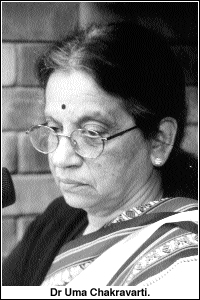 LAHORE, Feb 20: It is normal to avoid travelling to a country engaged in a war or at a risk of war. Travelling to a country that might get involved in an armed conflict with your own country is particularly not advised. People like Dr Uma Chakravarti, however, consider certain things too important to be deterred by wars. She arrived in Lahore in the second week of February to deliver a series of lectures at the Institute of Women Studies while armed forces of India and Pakistan remained in a state of high alert.
“I am not scared of the situation,” she says. “I have been to Lahore on a number of occasions and made a lot of friends. I know even the city roads.”
Dr Chakravarti is one of the founders of the Institute as well as a faculty member. She teaches women’s history. She has been visiting Pakistan since the establishment of the Institute in 1998. “You can imagine the importance of the lecture series to me. Instead of a routine 40-minute flight, I had to travel for more than 24 hours to reach Lahore.”
Besides Pakistanis, the current series of lectures is being attended by two students from India, four from Nepal and one each from Sri Lanka and Bangladesh. Dr Chakravarti and the two Indian students are among a handful of Indian nationals travelling to Pakistan since the suspension of road, rail and air travel between the two countries. “One does feel unfortunate,” Dr Chakravarti said about the border tension. “I believe that people, both in India and Pakistan, want to get on with their lives and do not want a war.”
Criticizing the media, she said: “I am not sure that the point of view of the common people is getting through. The media brings forward only selected views.” She said a rally was organized by leftist groups in New Delhi against the World Trade Organization and globalization. In the wake of Sept 11 attacks, it turned into a peace rally condemning all forms of terrorism. Surprisingly, the rally attended by over 50,000 people received very little coverage in the media. However, she said, the suspension of air, railway and road links with Pakistan was covered extensively.
Arguing that the Indo-Pak problems were not only an outcome of regional politics and that some international players, too, were involved, she said, sale of military hardware was one such factor. “Those who produce weapons, need us to continue using them. To that extent, they need to keep the conflicts on the boil.”
The multinationals, Dr Chakravarti said, played in a certain way and had their own agenda but “I cannot agree that they are manipulating us. Certain sections of our people have their own agenda which makes for willing cooperation.”
During the past four or five years, she said, there had been a constant effort by women’s movement and the students of Pakistan and India to sustain people-to-people contacts. “Students from various universities in India have visited Lahore, met the people, gone to Taxila and Peshawar and on their return talked to many more students about the heartwarming experience. Even in such a tense situation, students from four South Asian countries have come to attend the course. It’s a positive thing and it is important to keep it going.”
The Institute of Women’s Studies, she explained, was the only one of its kind consciously working to bring the younger generation in India, Pakistan and other South Asian countries closer. Dr Chakravarti, who did her doctorate in history and taught at the Miranda House College, New Delhi, from 1966 to 1998 before opting for early retirement. She believes that “we need to have more discussions with the politicians and decision makers and involve people beyond ex-generals and civil societies in matters of vital importance to the region.”
“We may have a slightly different version but the problems are similar,” she said.
“We should talk about everything, including Kashmir. We need to talk on every issue and make efforts for maintaining the crucial links and not allow ourselves to be overwhelmed by political events,” she concluded. — Azmat Abbas