0
0

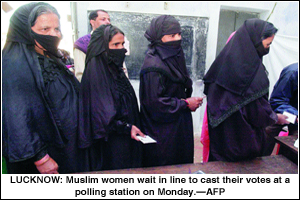 NEW DELHI, Feb 18: The ruling Bharatiya Janata Party (BJP) looked likely to lose its controlling position in Uttar Pradesh, exit polls showed on Monday after two rounds of voting.
The election for a new state assembly had been divided into three rounds in western, central and eastern Uttar Pradesh to allow police to be moved around the vast region.
The third round is on Thursday and counting is due on Sunday for Uttar Pradesh and three other states also holding state polls, East Punjab, Uttaranchal and Manipur.
Exit polls showed while the BJP, which dominates the ruling national coalition, had come out on top in the first round of voting in western Uttar Pradesh last week, it lost to the socialist regional Samajwadi Party in the second round.
Though analysts questioned the reliability of the exit polls, which gave mixed signals on the state of the parties when projections from both rounds were included, they said it looked unlikely that either party could muster enough seats in the third and final round to form a government alone.
The vote had been seen as a test of the popularity of the BJP, which looked to Uttar Pradesh as its traditional power base, during India’s military standoff with Pakistan.
State television Doordashan said adding both rounds together — representing 237 of the 403 seats up for election — gave the BJP just 72 seats compared to 87 for the Samajwadi Party.
Zee Television put the two parties neck-and-neck with 82 seats each, while Aaj Tak television put the BJP ahead at 83 compared to 73 for the Samajwadi Party after two rounds.
All reported a strong showing for the Bahujan Samaj Party (BSP), which represents the poorest people or Dalits, once known as “untouchables” in the Hindu caste hierarchy.
The exit polls gave the BSP, whose leader Mayawati may find herself propelled into the chief minister’s job in any post-poll coalition haggling, between 48 and 61 seats after two rounds.
The BJP had tried to capitalize on its tough stand against Pakistan to swing the result, which is determined by a first-past-the-post constituency-based system. On Monday it took out a series of prominent advertisements in local newspapers focusing on terrorism.
But voters have said they are more concerned about economic development than war with Pakistan.—Reuters