0
0

 MANGO fruit is consumed while its leaves are used for mulch and to feed cattle. The kernel from the mango seed is eaten as famine food when food is short. Oil pressed from the kernel is used in making soap.
The flowers, bark, gum, kernel oil and leaves are also used in medicines. Mango wood is utilised for house and office furniture, agricultural implements, boxes, plywood, charcoal boats, dugout canoes, carved and turned bowls, vases, jewellery cases, drums and toys. The tree itself is a useful windbreak. These characteristics make mango tree as one of the world's ‘outstanding multipurpose trees’.
As an outstanding multipurpose tree, the mango is also ‘a source of jobs for a lot of people’ associated with growing and managing orchards, picking, packing, the shipment and processing billions of mango fruits. One of the job opportunities for people in Africa, especially women, is in the production of solar dried mangoes. Similar practice is also common in Tando Qaisar, Hyderabad, Sindh.
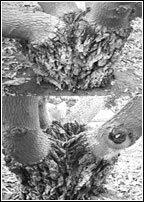
Cracks and scales on mango stem bark (picture) is a new recorded abnormality of unknown etiology (cause). This was not previously pointed out by any expert in entomology or plant pathology. This abnormality is easily characterised due to the appearance of longitudinal cracks in bark which initially are observed shallow but later on become deep and show scales also.
The scales look like scattered, raised and puffed up, similar to that of appearance just after moistening of any bark or wood. These longitudinal cracks and scattered scales make it easy to differentiate between normal and abnormal (Fig.), up to considerable distance. The outer layer of affected bark sometimes often curls up but there is no exudation of gum, stem bleeding, decline and wilt symptoms. The underlying wood is found uneven, without any other abnormality, except cracking and scaling of bark.
Defoliation, yellowing of leaves or other rotting and wilting symptoms are also not associated with the affected trees. Only the rootstock (mother tree) portion of different grafted varieties is found abnormal. No similar signs are observed above grafting points of daughter tree. Perhaps all rootstocks are not susceptible to this abnormality, hence only susceptible trees found not worth mentioning in scattered pattern.
Cracks and scales on bark of mango stem can not be considered as one of the symptoms of any of the already reported mango disease in Pakistan. These are present in some trees having few or no symptoms of decline and other pathogenic problems, including the most destructive disease complex problem in mango, commonly known as Quick Decline/Sudden Death/Mango Tree Mortality (MTM) or Mango Sudden Death Syndrome (MSDS). The cracks and scales do not appear due to any of the mango disease e.g., die back, anthracnose, necrosis, blotch, spots, mildew, rot, wilt, scab, gall or ball formation etc. The cracks and scales are also not common in trees infested with any of the beetles, reported as mango pests. These are different to those that are developed due to the attack of any other insect pest of mango.
This abnormality is observed in many orchards of different age, but no more serious incidence is seen in any of the affected trees at any of the orchards. It is not so common and does not damage the tree, except uneven appearance. What could be done if it is multiplied, spread and occurred on more trees? Or, if this is one of the primary symptoms then what will happen to mango trees when this abnormality will increase and may spread to adjacent trees?
Till the confirmation of origin, cause, other symptoms, mango growers and nursery developers or producers are advised to use only the seeds obtained from old-aged healthy mango trees of local/indigenous varieties for healthy and resistant rootstocks. They are also suggested to use the signs and buds for grafting, obtained only from those trees of required varieties in which the cracks and scales are not present. The researches and extension workers must investigate this abnormality in the interest of country and nation. The mango growers and contractors must be made aware of the abnormality. Otherwise, there will be no more excuses to prevent or protect mango orchards from the unexpected losses due to the cracks and scales observed on stem bark.