



 0
0

 THERE may be disagreement about “openness” to global trade in goods and services, over its impact on the current account deficit, but the big question arises: “Why does exports matter?” One answer may be that by exploiting trade and comparative advantage through exports and imports, an economy can achieve higher levels of well-being for its people. But all efforts in this direction seem to have become ineffective as development policy makers are facing a dilemma.
The economy is considered buoyant but with greater risk of balance of payments deficit. Pakistan's current account deficit has increased to $5.5 billion or 3.9 per cent of GDP. Trade deficit jumped to $2.844 billion during July-August 2006 from $2.075 billion in corresponding period of previous fiscal year. It was $12.112 billion in last fiscal year 2005-2006, almost 10 per cent of GDP. Experts believes that the soaring trade deficit would depreciate the rupee against dollar and other currencies. The demand by local importers for dollars in the coming months would increase to finance imports.
The following figures show the trend of trade openness and import export ratio comparatively of last three years:
Trade FY04 FY05 FY06
Exports/GDP 12.72 13.06 12.81
Imports/GDP 14.02 17.13 19.36
Trade openness 26.74 30.20 32.17
The rise in the trade gap has been attributed to high oil import bill, and rise in the prices of food items, machinery and automobiles. From July 2005 to April 2006, import bill was $22.95 billion while exports amounted to $13.52 billion of goods and services. This year, import of petroleum is going to cost the economy $2 billion more than last year. Exports are not moving as fast.. The economic structure is leading towards more consumption then production as present development of economy is demand-driven and not supply-driven.
The arguments of imports moderation and substitution may not help substantially in reducing the trade deficit because major import are, petroleum, petroleum products, machinery, plastics, transportation equipment, edible oils, paper and paperboard, iron steel and tea. There will be insignificant impact on reducing the imports only to the extent of edible oils, tea or cosmetics. Nevertheless the impact can be substantial and trade gap can be bridged if we are able to reduce import in petroleum, and encourage the LPG as import substitution and subsidise that sector.
According to a report from July 2005 to April 2006, the import bill was $22.95 billion while it exported $13.52 billion of goods and services. This year, import of petroleum is going to cost the economy $2 billion more than the last year. Since import contributes 37 per cent to the export, so a drastic reduction in import at this stage of development of manufacturing sector is not possible.
The other way out is to enhance the export in non-traditional items, Pakistan's exports are highly concentrated in few items: cotton, leather, rice, and synthetic textiles and sports goods. These five categories on average, accounted for about 83 per cent of total exports since 1990s. This is a time to focus more on enhancing the exports in non-traditional items, and to add value to the traditional exports.
This narrow export base must be broadened to include a variety of different products with high-value added contents. The value added commodity will make us more competitive in international market and fetch us better prices. The export policy should focus on selected non-traditional items such as skilled services, software, engineering goods, chemicals, fruits and vegetables etc.
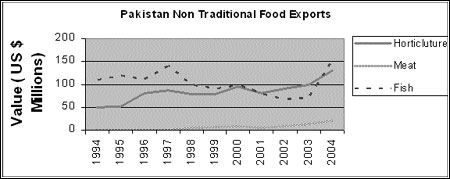
As shown in the following figure, Pakistan has developed a relatively modest growing trade in high-value perishable foods, the trade in meat is comparatively quite smaller. These three products primarily are directed to the Gulf countries, but can be diverted towards EU market on the broader scale of competitiveness, while managing the product quality and sanitary and phytosanitary standards (SPS). Pakistani exporters are facing quite serious problems in meeting the SPS standards in EU markets.
A dozen or more consignments of Pakistani products have been intercepted entering the EU market and put on the latter’s Rapid Alert Notification System. Though fish export has exceeded, Pakistan’s fish industry faces serious challenges in maintaining its access to the EU market due to poor hygienic condition through out the supply chain.
In non-traditional exports, export of defence-related products as well as the software items are a good beginning. According to the reports Pakistan registered a 50 per cent growth in software exports in 2005-06 at $72 million as more Western firms turned to it for IT services. The target for fiscal 2006-07 is $108 million. The training and skills in IT as well as other services can be enhanced on a priority basis as part of the export strategy to acquire comparative advantage in the international labour market.
The increase in number of international investors has also inspired local investors to explore new opportunities for services sector. In this context, setting up of the skill development council and commercial courts would be more effective in improving the standards and distinction in the export field.
Pakistan's exports are only 0.18 per cent of world exports, over 60 per cent is restricted to USA, Germany, Japan, UK, Hong Kong, and Dubai, Saudi Arabia. The narrow base of exports and inflexible imports and exports have the low elasticity. According to experts, the export strategy lacks a coherent strategy for quality and SPS management and it has to be is pursued independently at the business –to-business level. In the absence of coherent and well coordinated export strategy, Pakistani exporters are largely reacting to particular events to limit potential damage.
On the export of services sector, labour market efficiently ranks low by international standards with statutory requirement, causing “ hiring inflexibly” which prevents efficient resource allocation and impeding competitiveness. This is suppressing labour productivity and limiting Pakistan to low value-added activity.
Investment in worker’s skill would enhance the productivity in high value added products. Therefore, sufficient coordinated efforts are required for reforming the labour market reform as well as to widen the export base and diversify the products, particularly in the services sector to bridge the trade gap.




























