0
0

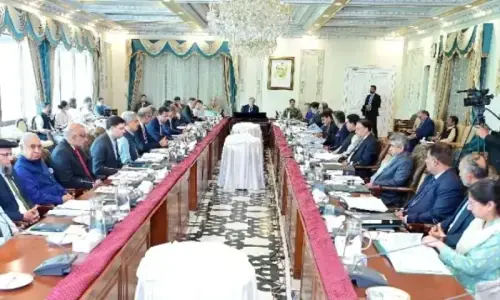
KARACHI, Feb 17: President Gen Pervez Musharraf will undertake a visit to Japan shortly, which is expected to make an investment of $300 million in Pakistan, said Commerce Minister Razzak Dawood on Sunday at the inaugural session of the two-day regional conference being held under the auspices of the International Chamber of Commerce (ICC).
“Pakistan has now become focus of world attention where the government is working full time to create an investor-friendly environment,” the minister remarked in his speech at the morning session of the conference entitled “An Emerging Crossroad for Trade and Investment”.
About 400 delegates, including an eight-member team representing the three USA agencies, Overseas Private Investment Corporation (OPIC), Trade Development Authority (TDA) and the EXIM (Export-Import) Bank, are attending the conference being organized by the Pakistan National Committee of the ICC.
Six speakers, including two federal ministers and Sindh Governor spoke at the morning session. The second session in afternoon, which was the first working session, was devoted to “Privatization and Deregulation” at which the Privatization Minister, Altaf Saleem, informed the participants about the privatization transactions coming up in the next few weeks.
In his presentation, Altaf Saleem informed the participants of the upcoming privatization programme, that included disinvestment of PTCL for which bidding for 26 per cent shareholding is targeted next May.
The second entity on the privatization agenda, he pointed out, was the Karachi Electric Supply Corporation which would be offered for disinvestment after debt-equity swap. Then Oil and Gas Development Corporation with a profit of $300 million will be put on sale to be followed by the Pakistan State Oil likely to be offered to the investors next month.
The privatization minister said two major banks were also being offered to investors. He explained the causes of delay which, he said, was because of the time taken to set in place regulatory frameworks, frame a comprehensive privatization law which should ensure a transparent process.
Altaf Saleem spoke of the litigation that the present government inherited because of the flaws in the privatization process, which, he said, had largely been removed.
By setting in place the regulatory frameworks for oil and gas, fertilizer, telecom and in other areas a level-playing field was now available for all the investors who wanted to participate in the privatization programme, he added.
Mrs Maria C. Cattaui of the ICC in her remarks spoke of the high social cost incurred on implementation of economic reforms programme.
She observed that investors’ confidence in Pakistan remains weak which should be addressed.
Ross Connely, Executive Vice President of OPIC, apprised the participants of the working of his corporation that primarily mobilizes American private sector investment in developing countries. It provides security cover on political and commercial risks.
James Lambright, special assistant to the chairman EXIM bank, spoke on his organization’s current negotiations with an American corporation on the issue of strengthening the PIA fleet.
Carl B. Kress, Chief of Staff, Trade Development Authority, said that his agency identified the public and private sector projects for financial assistance.
Razi-ur-Rehman of JP Morgan said that privatization and deregulation had now come to stay as part of the government’s main policy in days to come.
At the question-answer session, Altaf Saleem informed the participants that steps were being taken to reform the government agencies like the Central Board of Revenue. He appreciated the problem spelt out by a participant who spoke about harassment of the small size enterprises at the hands of CBR officials.
In the first session, the common theme of the speakers was Pakistan’s role after Sept 11, which had won powerful friends in the world. Tariq Rangoonwala, President ICC Pakistan and host of the conference called Sept 11 “a blessing for Pakistan”. Razzak Dawood said new opportunities had opened up for Pakistan after Sept 11. The USA Consul General in Karachi, John Bauman, also spoke of the many opportunities that had opened up for Pakistan “in the last five months”.
Razzak Dawood said that Pakistan had won over the confidence of international financial institutions from where a lot of financial assistance was coming. This has led to considerable improvement in Pakistan’s image abroad and the world is now looking with much more sympathy “to us in Pakistan then ever before”.
Federal Law Minister Shahida Jameel spoke of the government’s commitment at the highest level to reform and implement the measures for the revival of the economy.
Sindh Governor Mohammedmian Soomro listed areas where immense business opportunities existed for the investors. He mentioned the opening of food outlets by the international food retail networks in Karachi which had been drawing large crowds.
“This shows the immense business potential in Pakistan,” he said. The governor spoke of the measures taken to revive the confidence of the businessmen in Pakistan.
The USA Consul General in Karachi, John K. Bauman, expressed the views that Pakistan’s business environment had now become investor-friendly.
Richard McCormick, President of the ICC, termed the present situation “challenging times” for Pakistan. Tariq Rangoonwala, President ICC Pakistan, informed the participants that a similar international investment conference was organized by the ICC 42 years ago. He hoped that local investors would express their confidence in the government that should facilitate the flow of direct foreign investment in Pakistan.