



 0
0

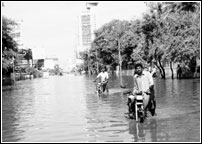 ALL hell broke loose in Karachi in the aftermath of just a few inches of rain. Till recently, we had power failures in many areas, with electricity off for hours and even days on end. Colossal economic losses took place as industries remained shut and commercial establishments were asked to close shop at sundown.
But the photographs of the flooded Clifton underpass were a pathetic sight indeed. The first monsoon downpour put the underpass out of action! Subsequent KPT statement blaming the city government and the city Nazim’s counter allegation that the underpass’s drainage system is still not in place does not help to mitigate the citizens’ suffering.
Now, we hear the alarming news that one of the main storm water drains that outfalls into Clifton’s Boat Basin (commonly known as Nehr-e-Khayyam) has been partially filled up. Sold to some builder? That explains the extraordinary accumulation of water in Clifton and adjoining areas! If true, the act of filling up this drain, for whatever reason, is nothing less than criminal. Numerous apartment and other buildings in the area had their basements flooded, causing tremendous loss to the occupants and to the economy.
About two decades back a storm water drainage study of Karachi was conducted under a World Bank loan. Almost all the civic agencies were involved, including KDA, KMC, KPT, ADA, Civil Aviation Authority, various cantonment boards, and so on to examine and upgrade the storm water drainage of the city and recommend construction of new drains where necessary.
One of the findings of the foreign consultants who carried out the study was that the flow of storm water in the final reaches of the main storm water drains or nallahs that outfall into the sea was extremely slow due to which water welled up in the upper reaches and flooded the inner city. They recommended that the end reaches be widened and provided with concrete lining in order to increase the flow and streamline the system. This work was duly carried out.
However, the act of partially blocking the drain or drains in the boat basin area shows that few ‘high-ups’ in the civic agencies are currently aware of the problem. Or if they are, they do not attach to technical studies the importance they deserve. This is not surprising in a milieu where even the Master Plan of the city is not followed.
Steady, progressive deterioration of the city’s water supply, sewerage, power and transport systems has taken place lately. It is explainable in part by population increase, but mainly it is due to apathy, malpractices, mismanagement, casual attitude, lack of technical expertise and foresight. The bane of our civic systems is inadequate attention to detail when projects are planned, and lack of maintenance after construction.
Decisions are often taken in haste to project the government’s ‘achievements,’ which sometimes backfire and do more harm than good. At other times, apathy prevents works being carried out in time.
Instead of properly maintaining the existing assets and upgrading them where possible, it has become customary with our civic agencies to build with undue haste new works of doubtful utility, based on half-baked designs, then abandon them half-way, or run them half-heartedly.
Ad hocism rules the roost. No system, whether it is water supply, sewerage, power or transport, works satisfactorily. How an infrastructure project would be subsequently maintained should be given due weight at the decision-making stage. The state of maintenance of our utilities and infrastructure, capability of relevant agencies are no secret, and the inadequacy of electric power in Karachi are also no secret.
The performance of KESC has gone down further after privatisation. In the longer term, the underpass drainage system, too, runs the risk of silting and choking. Hence, the decision to construct the underpass, whose continued functioning during rains is dependent on promptly pumping out rain water was ill-advised and hasty. It appears that the designers (NESPAK) were given inadequate time to attend to all aspects.
Besides drainage, there are other drawbacks, which have already been much discussed in these columns. A similar fate seems to await other underpasses under construction in Karachi.
Drainage is always a problem in underpasses, which are usually lower than surrounding drainage lines. The rain water has to be collected through a system of drains and pumped out from specially-built sumps. But where do you put the water so pumped out? Here lies the bug in the system.
Since most of the city lacks a proper storm water drainage system, it is inevitable that some water from surrounding areas would find its way into the underpass during heavy rains due to ‘choking of drainage lines,’ promptly and faithfully. In the current case, the problem is compounded by the partially closed drain that hinders the onward disposal of water into the sea.
Another question arises here. KPT’s job is to develop and maintain the port and port-related infrastructure. Why has it been dragged into the civic realm, presumably under pressure from above?
Under this kind of pressure, it has earned the dubious distinction of building monstrosities such as the Rs225-million fountain that has reportedly gone out of action within a year, and is currently in the process of building ‘food streets’ and a 1500-ft high Port Tower, reportedly on a ‘build-operate-transfer’ basis. For our Agencies a better description would be “build-operate half-heartedly-abandon.” An example of this attitude is the forsaking of KCR.
The city government, that generously places huge ads in newspaper at public expense advertising the ‘vision’ of the city nazim, is not lagging far behind, with plans for construction of a 46-story building with several floors reserved for parking! Plus the ‘Elevated Expressway’ from M.T. Khan road to Quaidabad (admittedly, to ‘facilitate VIP movement?’), and the ‘signal free’ roads from SITE to the Airport, and so on. (Almost ‘signal free’ Sharae Faisal has already made life hell for pedestrians and motorists alike!)
Had a few inches of rain not exposed the fragility of the city’s infrastructure, some gullible souls would perhaps have been quite impressed with this ‘high-profile’ vision!
But this is the bane of our civic life. We just do not attend to detail, and do not carry out preventive maintenance. Take the case of the Railway bridge on Karachi-Hyderabad section that was swept away, thereby causing severance of the railway link between Karachi and upcountry. It is reported that the dilapidated condition of the bridge had been pointed out in an inspection report but the concerned officials failed to take action.
In recent days we have about engine trouble in at least three planes on domestic routes that had to make an emergency landing. Luckily, the planes escaped disaster.
The government’s predilection for mega projects (a kind of megalomania) prevents them from attending to the ‘minor details.’ But the citizens are suffering not for lack of mega-structures but for official negligence in maintenance of existing infrastructure, for not attending to apparently small but important details, and failure to take remedial action in time. No exercise has perhaps been made to assess the recurring losses arising from this omission year after year. They run into billions, if not trillions, per annum.!
The least the people expect of civic bodies is to properly carry out the work for which they are paid. They can indulge in self-congratulation as much as they please, but it would impress no one. Good performance needs no advertisement. It speaks for itself.





























