



 0
0

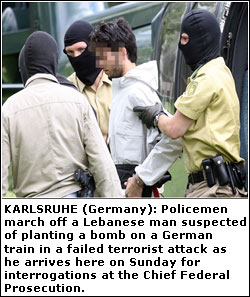 BERLIN, Aug 20: A Lebanese student suspected of planting bombs on German trains in a failed terrorist attack in July appeared in court on Sunday as a massive police hunt for a second suspect continued.
The 21-year-old man was remanded in custody by an investigating judge in Karlsruhe on charges of attempted murder, belonging to a terrorist organisation and attempting to cause an explosion.
The man, who was identified as Jussuf Mohammed E. H., was arrested on Saturday in a police swoop on the railway station in Kiel as he tried to flee the northern city, where he was a student.
He was flown from there to Karlsruhe by helicopter on Sunday, handcuffed and in overalls.
According to the federal prosecutor, the man’s fingerprints and DNA were found on one of the two suitcases in which homemade bombs were planted on trains travelling through Dortmund and Koblenz on July 31.
The bombs consisted of gas canisters, alarm clocks, wires, batteries and soft drink bottles filled with a flammable liquid and had been timed to detonate 10 minutes before the trains arrived at the stations.
The bombs failed to explode because of a technical error, but if they had, the trains could have turned into ‘balls of fire’, the federal prosecuting authorities in Karlsruhe said.
The judge heard that the two suspects met at the station in the southwestern city of Cologne three weeks ago, where they boarded trains respectively bound for Dortmund and Koblenz.
They left the suitcases on board and got off before the bombs were timed to explode simultaneously at 2:30pm.
German media on Sunday continued to run photographs of the suspects, both young men with dark hair, captured on closed circuit television cameras at Cologne station.
The pictures led to the arrest of the first suspect, and police hope they can also help them to snare the second.
Little is known about him, except that he is foreigner, about 20 years old and does not live in Kiel.
The prosecutor’s office on Sunday said police have searched the student dormitory in Kiel where the arrested suspect lived and a neighbouring property, but found no explosives.
A note in the case found in Koblenz contained Arabic writing and a Lebanese telephone number, and packets of starch with labels in Arabic and English were also found.
Bild am Sonntag newspaper said fellow students had told the investigators that the arrested suspect had recently visited Lebanon after his brother was killed in an air raid in the Israeli offensive on the country.
A student in Kiel, Sebastian Walter, told N-24 television news channel that the man was ‘very polite and friendly’. Another mentioned that he ‘very often spoke about religion’.
The head of the Federal Crime Office, Joerg Ziercke, has said the police have not ruled out that the planned attacks could have been motivated by the situation in the Middle East.
The train bomb case raised little interest when the devices were discovered on July 31.
But the country has been on edge since government officials on Friday said they believed it was the work of a terrorist organisation based on German soil that wanted to copy the deadly train bombings in Madrid and London.
“We are now working on the basis that this was the work of a terrorist group based in Germany and that it was an attempt to kill a large number of people,” Rainer Griesbaum, a federal prosecutor, told reporters.—AFP





























