1
1

FOR more than four decades, I worked across Pakistan’s most challenging and diverse industrial landscapes, including the national and multinational pharma- ceutical, textile, engineering and services sectors. My responsibilities in industrial relations, labour law compliance, social security affairs adjudication and employer advisory roles brought me into direct and continuous interaction with a lot of state institutions, such as the Employees’ Old-Age Benefits Institution (EOBI), federal and provincial social security bodies and labour authorities.
This lengthy exposure has revealed to me a rather unfortunate, but undeniable truth. Pakistan’s social security and labour protection systems are not collapsing because of lack of policy or resources. They are crumbling due to administrative negligence, habitual non-responsiveness and an institutional culture that I found indifferent to both law and humanity.
Today, at the age of 70, I find myself experiencing the same systemic failures that I once observed professionally. Despite having completed long, uninterrupted and insurable service with proper contributions deposited on my behalf, my pension under the EOBI has been arbitrarily fixed at the minimum level for nearly a decade On the ground, official formulas exist. contribution records exist. Legal provisions exist. Yet, my repeated written requests, reminders and documentary submissions have received no response.
However, this silence is not an accident. It is a symptom of a broader governance breakdown. In essence, during my long career in industrial relations, I had the opportunity to deal with hundreds of cases involving the same issues.
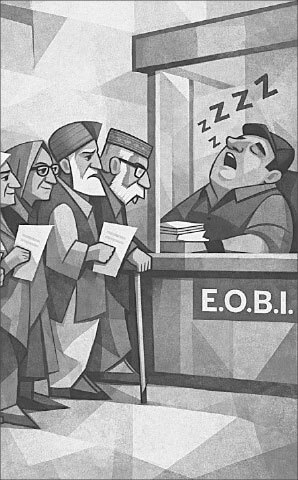
Employees retire with dignity in mind, employers deposit their contributions for decades, but EOBI officials exercise arbitrary discretion, ignore documented evidence and sometimes even disregard their own standard operating procedures (SOPs). Elderly pensioners are treated not as citizens, but as troublesome files.
The situation is no different in provincial social security institutions or labour departments. Whether one seeks medical coverage, employer record verification, contribution reconciliation or pension rights, the experience is the same. Phones remain unanswered. While letters are acknowledged, no action is taken on complaints. Emails go into utter silence. Decisions are almost always made on the basis of convenience, not on merit.
The recently issued EOBI SOPs for the 2026-27 peiod outline formula-based calculations, verification steps and internal checks. But without implementation, even the best policy becomes meaningless. Pensioners continue to suffer financial loss, mental distress and unnecessary delays. For individuals over 60, or 55 in case of female employees, this adminis-trative indifference is not just inefficient. It is inhumane.
Pakistan is in an immediate need of a modern, accountable and transparent social security governance system. This requires the critical element of digital integration with real accountability, publicly enforced response timelines, standardised audits, independent oversight and strict penalties for administrative negligence. Senior citizens should not be forced to beg for what is legally theirs.
My personal case is only one example of the rather crude ground realities. It is a national crisis. The failure is not of law. It is of will, ethics and governance.
If Pakistan cannot protect its senior citizens and pensioners, the official commitment to social protection is nothing but a hollow promise. The fact is that institutional reform is no longer a technical need. It is a moral obligation. Pakistan’s pensioners deserve dignity, responsiveness and justice, not silence.
Muhammad Fayyaz
Karachi
Published in Dawn, February 7th, 2026