0
0

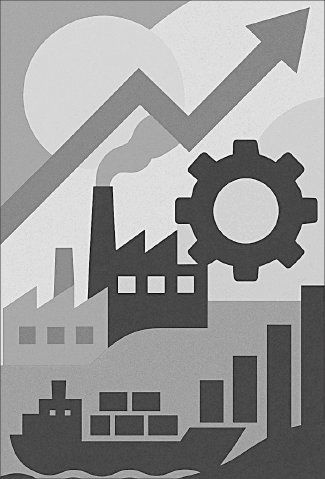
PAKISTAN has a weak economy, political instability, and a lot of governance issues. Massive public debt is also an old problem. We take loans to pay off earlier loans. In such a scenario, the loans acquired cannot be used for development purposes. There are low foreign exchange reserves and high poverty levels. The country surely needs economic reforms and the adoption of an export-led economic growth model.
The special economic zones (SEZs) and export promotion zones (EPZs) play an important role in economic revival and industrial growth, as they help in attracting foreign direct investment. Tax incentives should be given to them, and regulations governing them should be simplified. Besides, infrastructure must be developed. It is necessary to create more employment opportunities and put in place technology transfer pathways.
Industrial clusters must be set up to enhance productivity and competitiveness. There are several SEZs functional in Pakistan. What we need is to optimise their potential to revive industrial output and make the economy export-driven.
There is a need to strengthen Pakistan’s competitiveness in international supply chains through lower production costs. The EPZs in Karachi and Sialkot have shown how targeted incentives can create export hubs. They encourage value-added exports, leading to economic benefits at both micro and macro levels. The country earns precious foreign exchange, while individuals, including women and the young, acquire various skills and financial empowerment, making it a win-win case.
Naira Eshaal
Islamabad
Published in Dawn, December 9th, 2025