0
0

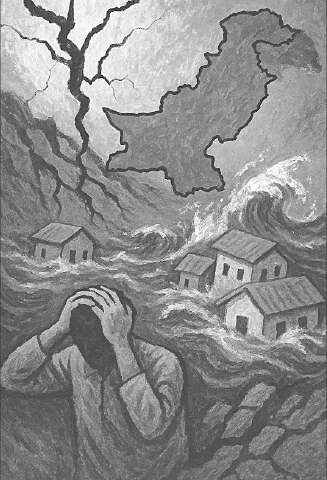
TIME and again, the world has warned us that climate change is having a signi-ficantly negative impact on the country, and that things are bound to go from bad to worse, but, unfortunately, we have continued to ignore all such warnings.
Despite repeated alerts, the government has failed to make adequate arrangements to face natural disasters. The recent monsoon season has once again exposed our vulnerabilities, especially in Punjab, Khyber Pakhtunkhwa (KP), and Gilgit-
Baltistan (GB), where devastating rains, floods and landslides have already claimed over 200 lives, and the monsoon is far from over yet.
This is a complete failure of the govern- ment at both national and provincial levels. Pakistan is a disaster-prone country, frequently affected by floods, earthquakes, droughts, and climate-induced emergen- cies. Managing these crises requires a coordinated response across different tiers of governance.
The responsibility primarily lies with three key institutions: the National Disaster Management Authority (NDMA), the Provincial Disaster Management Authorities (PDMAs), and the District Disaster Management Authorities (DDMAs). The NDMA is responsible for setting national policies, coordinating major disaster responses, and liaising with international agencies. On the other hand, the PDMAs implement strategies and manage resources at the provincial level. The DDMAs, however, happen to be the most crucial tier, as they are the first responders at the local level — tasked with preparedness, evacuation, relief and rehabilitation.
Despite their importance, the DDMAs often turn out to be the weakest link. They face chronic underfunding, seriously lack trained personnel, and have minimal access to modern equipment and early warning systems. They are typically limited to executing orders from above, rather than having the capacity to lead local initiatives.
They do not even have full-time staff and offices. They also lack machinery, supporting staff and networking with the local councils and elected representatives. There are no early warning systems installed at the local tier.
This approach undermines effective disaster response. In many cases, delays, confusion and poor coordination stem from the neglect and disempowerment of local authorities. A resilient disaster management system must start at the grassroots level.
One solution is to link the DDMAs with union councils (UCs). Unfortunately, despite the 18th Constitutional Amend-
ment mandating regular local bodies elections, transfer of financial and management powers, the provinces of KP, Punjab and Balochistan have not held these elections. Only Sindh has conducted elections consistently, and has some active local bodies. Besides, no Provincial Finance Commission, mandatory after the 18th Amendment, has been announced.
Our neighbouring countries, like Bangladesh and India, as well as many disaster-prone countries in other regions have demonstrated how empowering local councils, and transferring resources and authority to them enhances disaster preparedness and response mechanism. In Pakistan, however, local governments have remained neglected.
The federal and provincial governments should seriously consider empowering the local government system and strengthening the DDMAs. Working together with UC representatives, the DDMAs must be empowered to prepare evacuation and disaster response plans for every village and locality.
Pakistan must build resilient institu- tions, engage civil society, and prepare communities to save lives and livelihoods.
Aijaz Ali Khuwaja
Karachi
Published in Dawn, September 2nd, 2025