0
0

BAKU (Azerbaijan), May 5: Pakistan and Turkey on Friday joined voice against use of force against Iran, saying they favoured a negotiated, peaceful settlement of the nuclear issue.
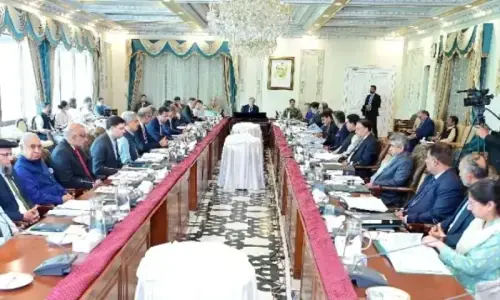
Prime Minister Shaukat Aziz and his Turkish counterpart Recep Tayyip Erdogan said after a detailed meeting, including an extended exclusive session, on the sidelines of the ECO Summit, they were opposed to use of force against Iran.
In a brief chat with journalists after the meeting, the Turkish premier said his country was for a peaceful resolution of the issue. Prime Minister Aziz said “we share a similar point of view.”
The two leaders said use of force would aggravate the situation in the region.
Earlier, Mr Aziz said at the ECO Summit that Pakistan respected Iran’s legitimate rights under the NPT, including use of nuclear technology under IAEA safeguards.
He also appreciated Turkey’s role in the rehabilitation and reconstruction work in Pakistan’s earthquake-affected areas. He said Pakistan was also seeking assistance from its seismic experts to build safer buildings.
He said the Turkish prime minister had taken personal interest in the rescue and rehabilitation operations in AJK and the NWFP and the people of Pakistan deeply appreciated this gesture.
“Both the countries have stood by each other and have a long history of sharing and caring,” he added.
Mr Aziz said their discussions also focused on boosting economic, political, defence and security relations between the two countries.
He said the relations between the two countries would be further strengthened with stronger economic bonds and more people-to-people contacts.
IRANIAN PRESIDENT: President Mahmoud Ahmadinejad vowed on Friday that Iran would pursue fuel production for its nuclear programme and branded those trying to stop this “bullies.”
“We intend to continue our activity ... until we manage industrial-scale production of nuclear fuel for our atomic power stations,” Mr Ahmadinejad said, according to the text of a speech he gave at the ECO Summit in Azerbaijan.
The Iranian president’s comments in the Azerbaijani capital of Baku came as Western powers, which fear Tehran secretly plans to build atomic weapons, pushed for a UN resolution requiring an end to uranium enrichment.
Mr Ahmadinejad told leaders from the Economic Cooperation Organisation, which includes five of Iran’s neighbours, that “bullies were insolently trying to interfere in internal affairs of other countries.”
At a later press conference, he said “two or three” countries dominated international institutions that were meant to be serving the world.
“They have nuclear weapons and they say that you can’t even have nuclear fuel for civilian purposes. If it’s bad, why do they have it? If it’s good, why do they not allow us to?” he asked.
Accusing his Western opponents of mounting a “psychological war” to “laugh at Iran,” he warned: “Let them look at where (Iran) is on the map and how big it is.”
Mr Ahmadinejad hailed his country’s nuclear power project as “a great achievement for the whole region and the Islamic world.”
But he also stressed Iran’s desire to work under the scrutiny of the UN’s International Atomic Energy Agency, which last week reported that Tehran had failed to comply with a demand to suspend uranium enrichment.
The Iranian president called for support from the ECO group, which comprises 10 overwhelmingly Muslim countries, including Iran’s neighbours Afghanistan, Azerbaijan, Pakistan, Turkey and Turkmenistan.
“The constructive cooperation of the ECO is a very important step,” he said.
However, at a separate meeting, Turkish Prime Minister Recep Tayyip Erdogan warned Mr Ahmadinejad that the international community was resolute against the spread of atomic weapons.
“No country in the world will approve the proliferation of nuclear weapons,” he was quoted as saying by the Anatolia news agency.
The United States and Europe allege that Iran is using the Russian-backed construction of a civilian nuclear power network as cover for a plan to acquire nuclear weaponry.
The draft UN Security Council resolution backed by Britain and France will oblige Iran to suspend uranium enrichment, the process creating fuel for reactors and – potentially – the core of an atomic bomb.—APP