0
0

 CAIRO, April 9: Egyptian President Hosni Mubarak, a major broker in Middle East politics, sparked Shia fury across the region on Sunday after suggesting that Iraq’s majority community was under the sway of Iran. Speaking to Dubai-based Al-Arabiya television channel on Saturday, Mubarak warned Iraq was in the middle of a civil war that threatened the Middle East and expressed alarm about Iran’s influence in Arab countries.
“There are Shias in all these countries (of the region), significant percentages, and Shias are mostly always loyal to Iran and not the countries where they live,” he said.
“Naturally Iran has an influence over Shias who make up 65 per cent of Iraq’s population.”
Ibrahim Jaafari, Iraq’s incumbent premier and a devout Shia, unequivocally condemned Mubarak’s remarks.
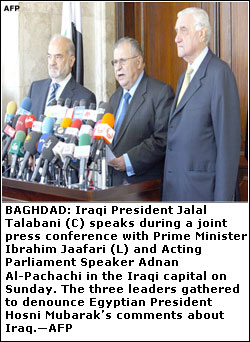
“The comments have upset Iraqi people who come from different religious and ethnic backgrounds and have astonished and discontented the Iraqi government,” he told reportersm on Sunday. As Jaafari spoke, he was flanked by President Jalal Talabani, a Kurd, and Adnan al-Pachachi, a Sunni and the parliament’s acting speaker.
Jaafari’s government has come under repeated accusations of collusion with Tehran from Sunni Arab factions in Iraq.
Egypt had been one of the main driving forces behind an attempt at uniting Iraqi ranks by sponsoring a national reconciliation conference, still due to take place in the near future.
Expressing his anguish at Mubarak’s statements, Iraqi President Jalal Talabani, a Kurd, said: “These accusations against our Shia brothers are baseless and we have asked our foreign minister to talk to Egypt about this.”
In nearby Kuwait, whose population is one third Shia, Shia MPs and clerics lashed out at Egypt’s veteran leader.
“We are not begging for certificates of loyalty to our countries from Mubarak or others. These are irresponsible statements... and only serve to incite sectarian rifts,” MP Hassan Jowhar said. “Nothing can satisfy Shias except a clear, official apology from President Mubarak.”
Iran, with its 95 per cent Shia population, many of whom make frequent pilgrimages to the shrines of revered Shia imams in Iraq, did not take kindly to Mubarak’s comments.
“It is evident that the Islamic Republic of Iran is only interested in seeking security and stability in Iraq and the region,” Foreign Ministry spokesman Hamid Reza Asefi told reporters in Tehran.
“We have a lot of influence in Iraq, and in no way have we used it to interfere in Iraq’s affairs. Our influence is a spiritual one,” he added.
Tehran cut diplomatic ties with Cairo after then Egyptian President Anwar Sadat made peace with Israel in 1979. The Islamic Republic named a street in Tehran after Sadat’s assassin.
Sheikh Mohammed Yazbek, a leader of Lebanon’s Shia Hezbollah movement, described Mubarak’s remarks as dangerous and false words that reveal fanaticism and sectarianism aimed at sowing discord wished for by America.”
Meanwhile, Saudi Foreign Minister Saud al-Faisal appeared to back Mubarak when he told reporters that the violence in Iraq could only be described as a civil war.
“The definition of civil war is that the people (of a country) are fighting each other ... I don’t know what we can call (what is happening) in Iraq except a civil war,” he said.
Prince Saud said he hoped Arab states could help quell the unrest but added only Iraqis themselves can stop this fighting.
Analysts voiced their surprise at Mubarak’s comments, which they considered to be a diplomatic blunder.
“Shias may be loyal to Iran emotionally but not politically. Comments that Shias are manipulated by Iran is a huge exaggeration,” said Bahgat Korany, Professor of Political Science at the American University in Cairo.
“It was completely uncalled for,” said Mohammed Sayed Said, political analyst with the Al-Ahram Center for Political and Strategic Studies.
“He is giving an impression that there is a Sunni-Shia divide in the Arab world. This way he is condemning half the population.
“Mr Mubarak used to be a man who calculated his words carefully, but I think age makes a difference,” said the Cairo-based analyst.
The Egyptian presidency sought to defuse the tension engendered by Mubarak’s interview and assured he was not pointing an accusatory finger at Tehran.
“The president’s words reflected his great concern over the deterioration of the situation and his commitment to the unity of Iraq,” spokesman Suleiman Awad said in a statement.
“What the president meant was that Shias have brotherly relations with Iran because it hosts Shia holy sites,” he said, stressing that Egypt “did not distinguish or discriminate between (Iraq’s) groups and communities.”
COMMITTE FORMED: Shia United Iraqi Alliance (UIA), the largest bloc in parliament, formed a three-member committee on Sunday to deliver a “final opinion” on Prime Minister Ibrahim Jaafari’s bid to keep his job.
“A three-member committee of UIA members has been formed by the leaders and this committee will talk to the Kurds, the Sunnis and the secularists to get their view on Jaafari and then suggest a final opinion,” a source close to the political negotiations told AFP.