



 0
0

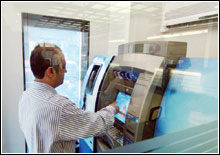 BANKS in Pakistan are enjoying their biggest boom ever, while the depositors with whose cash the boom is fuelled are enduring the rawest deal ever. Fear of robbery at home makes many people seek the safety of banks with their cash rather than the lure of a good rate of return on the deposit.
The banks themselves are at times looted by their staff, particularly bank guards who get way with large sums. But even there the losers are not really the banks robbed, but the insurance companies with whom the money is insured.
The profits of banks are so high that a 90 per cent increase in a year –2005- is a routine event and so the bank shares are selling at peak prices and are rising ever so constantly.
Most of the large bank profits come from the increasing spread, which is the difference between the low deposit rate and high lending rates, plus the high bank charges.
But the bank officials want us to believe their large profits are the result of more efficient management and effective economy measures.
In the banks themselves, there is a wide gap between the old pay scales of the regular staff and the very high salaries and perquisites of the new senior staff, employed from foreign banks.
The Habib Bank which has been taken over by the Agha Khan group, tried to get rid of the lower level staff by outsourcing their work, but has run into legal problems. If that move had been an instant success, other banks might have followed suit and got rid of much of their non-banking staff.
The weighted average rate of private bank lending is now 10.18 percent and the weighted average of return on the deposits is 3.06 per cent- a large difference of 7.12 per cent- that is the gain of the bankers. Worldwide, the bank efficiency is judged by narrowing of spread between lending and deposit rates.
In just one month –January- the banking spread rose by 167 basis points. In December last, the banking spread was 5.54 per cent, but is now 10.18 per cent. And that means the banks are getting almost 250 per cent of what a depositor gets.
Economists stress the need for developing countries to save more and more and invest and speed up the development of the country. That is all the more necessary in heavily populated countries with large unemployment and under employment. Hence, in the earlier years the banks wanted to make themselves popular with the students by asking them to open an account with just one rupee. But now Rs1000 is needed to open a Basic Account with very restricted transactions, recently introduced by the State Bank of Pakistan.
So much money is afloat in the country that banks including foreign banks are wooing the new borrowers. It is a new experience for many middle-income persons to be rung up by top class foreign banks and asked whether they would like a personal loan on easy terms. As a result of such developments, the ratio of advances to deposits has risen to 77 per cent and there is the fear of default in some cases.
At the same time, foreign banks are offering the highest average deposit rate of 3.90 per cent, while the public banks are offering deposit rate at 3.62 per cent and the private banks at 3.06 per cent.
There is so much money afloat in the country that all the monetary targets for the financial year have been exceeded in eight and a half months.
Bank credit for the whole year of Rs3,300 billion was crossed by March 18th in spite of the rising interest rates. The average growth in credit is Rs38.8 billion a month and so by the end of the year another Rs135 billion more loans would be out of the banks.
Normally, the State Bank of Pakistan should be interested in such monetary growth that would keep low the inflation rate low, which had earlier touched 11.5 per cent. But the SBP does not want to do anything to hinder the rapid economic growth.
After the economic growth has reached 8.4 percent last year, the central bank does not want to see a lower growth of under seven per cent this year. And that is the official policy too, despite the government’s commitment to hold down the rate on inflation, which is now 8.5 per cent officially and far higher actually. Easy credit is supposed to fuel the high economic growth, although beyond a certain level, it will hurt the economic growth. IMF‘s Mohsin Khan has also rung the alarm bells.
But the government itself is not only not interested in reducing the bank credit, but itself is a heavy borrower. It has so far borrowed Rs156 billion for budgetary support against the ceiling of Rs98 billion. As a result of such factors, the monetary growth this year is expected to be far higher than the ceiling of 12.8 per cent.
In such conditions, the fight against inflation has to take a back seat, despite the governments concern for the misery of the common man. President Musharraf says that manufacturing, marketing and advertising sub standard products are serious crimes.
That means the common man has to fight the inflation of 8.5 per cent with an interest income of less than three per cent from his savings after paying the 10 per cent withholding tax on interest income and Zakat and put up with sub- standard and spurious products and services.
A country like Pakistan should do all it canto promote larger savings, invest and develop. That is how a large exportable surplus could be built up to raise the exports above $18 billion and achieve a balance in external payments.
If instead, more and more is consumed at home as large bank credit is readily available, the exportable surplus will be small and make the employment avenues scarce.
Opportunities for rewarding and risk free investment are getting to be too few. The Karachi Stock Exchange has become saturated after its index high the peak of 11710 points this week. Real estate prices have become too high.
New companies are not coming up with shares for the public and the shares of the privatized companies available to the public are small in number compared to the demand. So some business houses are being bought and sold instead of far more business ventures coming up. Workers remittances alone exceed $4 billion and that is Rs240 billion liquidity in a small market.
So much money is afloat and so little is available for sale, that the prices are shooting up all round and all kinds of irrational transactions are to be expected.
In the process the small savers, widows, pensioners and fixed income groups are left with too few options if they do not prefer long term investment with all its hazards. While the government, the businessmen and banks have an identity of interest, the poor suffer endlessly.




























