



 0
0

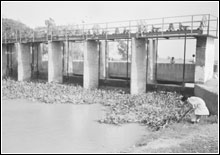 THE government of Punjab has recently launched an ambitious programme for development of a network of small low head hydroelectric power projects on canals/barrages and streams/rivers.
The province has water resources to generate additional electricity, at lower cost, even less than a rupee per kWh, for which as many as 316 feasible sites have already been identified to create a total of 600-MW power generation capacity.
The province evolved a power policy in September 2005, in pursuance of the federal government’s Power Policy 2002 that allows all the provinces to develop small and medium power projects up to 50-mw capacity each.
The Punjab policy covers development and implementation of such projects in public or private sector and under public-private partnership. A number of facilities and incentives are being offered to the private sector for the projects, while in the first phase the provincial government plans to establish a few projects on its own.
According to the government estimates, electricity demand is increasing at national level at the rate of about 1,000 MW per year, and projected total demand stands at 21,500 by the year 2010 and 36,358 MW by 2025.
The demand forecast for Punjab alone will be 11,500 MW by 2025. The proposed small hydro network will thus complement and supplement present installed power generation capacity to meet future power demand. These projects may also provide an alternate solution for rural electrification, as all the projects may not be connected to the national grid for economic reasons.
Pakistan has one of the largest and advanced irrigation systems in the world. While canal network in Punjab, as in other parts of the country, is primarily for irrigation purposes, it has significant hydropower potential that mostly has remained un-exploited so far.
In 1992, Water and Power Development Authority (Wapda) had assessed the potential of hydro power generation, having carried out pre-feasibility/feasibility studies at various sites. Subsequently, the government of Punjab had issued Letter of Interest (LOI) to the private sector for setting up these small hydro power stations at 22 sites during the period 1994 to 1997. Sadly, not a single project could materialize.
These run-of-river type projects are available once again, among others, for investment by the private sector on Build, Own, Operate and Transfer (BOOT) basis. These power stations will be transferred to the government free of charge at the end of concession period of 25-30 years from the commercial operation.
Proposals will be invited from private sector as solicited proposals, that is, for the projects for which feasibility studies have been conducted, and selection would be on the basis of minimum levelized tariff through competitive bidding.
Raw-site proposals would be invited for projects for which feasibility studies are not available and that require preparation of feasibility studies by the investors, and finalized on the basis of tariff negotiations after approval of the respective feasibility report.
These sites are on canal falls and most of the projects are likely to be constructed on the land owned by the provincial government. The policy, therefore, provides option to the sponsors of either having the land on lease based on market rates or accept proportionate equity participation by the government in the project. WAPDA has already assured purchase of power generated by these projects on standard terms.
The policy highlights promotion of maximum indigenisation. Nonetheless, the government of Punjab itself has ignored the manifestation as it has issued international tenders for the EPC (Engineering, Procurement and Construction) contract that specifies procurement of machinery and equipment from the western sources only, required for its first small low-head project of 3.2 MW capacity Khokhra hydropower project.
The fact is that local engineering industry, notably Heavy Mechanical Complex at Taxila, has installed a number of small hydro power plants in the Northern Areas and the NWFP, which are operating satisfactorily.
Also, the Pakistan Council for Renewable Energy Technologies has developed various modules of small hydro power plants. These efforts towards achieving indigenisation need to be availed fully by the provincial government, without the involvement of foreign assistance and encouraged for further transfer of advanced technology. Else, the private sector will follow in the footsteps of the government and prefer to import plant machinery, which obviously suites the interest of investors more.
An important feature of these potential sites is that the majority of projects have a head in the range of three meters plus/minus one meter, and as such similar site characteristics. For this reason, there is no need of installing conventional custom-made generating units at each site that is an expensive proposition in terms of money and time.
Instead, standardization can be achieved by determining optimum size and technical parameters for a common generating unit. Installing the required number of units based on specific site conditions that have already been established can then attain the required output.
The concept of standardization offers various benefits such as achieving high efficiency, lowering capital cost, developing operation and maintenance facilities and promoting domestic manufacturing.
In view of a large number of proposed projects-it may be repeated, there are over 300 sites identified spread all over the province—-the modality will result in creating additional job opportunities and improving socio-economic conditions of the area.
However, the response to the government’s recent international tender for the 3.2 MW Khokhra project has been lukewarm as only one proposal was received on due date. It is from the German source that had been considered an unsuccessful experience in installing these units in the Northern Areas in the past.
The government of Punjab will therefore be well advised, under the circumstances, to adopt the suggested methodology of standardization through local engineering industry, instead of re-inviting international bids for the said project.




























