0
0

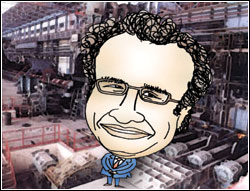 PAKISTAN Steel Mills — the country’s steel producing giant was drummed up to go under the hammer on March 10. The deadline passed without the event taking place. No one expressed dismay, for that was the fourth time that the mills could dodge the auction block.
The Privatisation Commission (PC), some say, has an unsavoury record of missing deadlines. That could be true in many cases, but not all. So has the government put the plans for privatising PSM on the hold?
The outgoing Minister for Investment and Privatization Dr Hafiz Sheikh brushed aside the impression that the sell-off of PSM has been deferred. “We have not missed any deadlines for the simple reason that we had never given any”, Dr Sheikh told this scribe. “The date of auction that you mention (March 10), was not declared by us”, he says, adding that the PC gave out a time frame and it would be its endeavour to conclude the transaction within that period.
The market, nonetheless, was pinning on March 10 as the date of bidding for both Pakistan Steel Mills and the Pakistan State Oil (PSO). A few things that went haywire are clear.
President Bush came calling last week and the visit-unexpectedly—threw many of the plans in the doldrums. All of the past week, the media was preoccupied in reporting and interpreting fallouts of the US President’s visit to South Asia and more specifically its impact on Pakistan’s new geo-political positioning.
The economy was meanwhile struggling to absorb the impact of violent protests and shutter down strikes. A terrorist strike on March 3 near the US Consulate in Karachi shook the investors’ confidence (local and foreign) represented by about a thousand points decline in the stock market index, beginning with a fall of 480 points on March 6.
Even if the auction shop was kept open, it is doubtful if the PC would have seen many bidders or fetched bargain price, for what clearly are the country’s strategic assets.
Uncertainty is, however, causing a good deal of damage. Many knowledgeable people think so. And so does the chairman, Pakistan Steel, Lt Gen. Abdul Qayyum.
In an exclusive interview to this scribe last week, he expressed anxiety over the situation, for he thought it was crippling the mill. “Either the government should go ahead and privatize PSM or remove it from the privatization list altogether”, he suggested.
That would give management the much-needed space to go ahead with its plans of improving the efficiency of the mills through investment in expansions and automation besides maintenance”, he said.
And he went on to explain that the Privatization Act 2005 prohibits projects that are to go on the auction block, from making capital expenditure beyond a certain limit. The head of the Pakistan Steel Mills thought that the law was inappropriate for public assets in the manufacturing sector. “I have requested the government to take a final decision soon because keeping things in a limbo can prove harmful,”, he said.
But looking back, any one can see that PSM, unfortunately, has a bleak history. Experts could go on and on in identifying factors that made the mills what some termed “the white elephant”.
Among others, product imbalance was a reason that went against the PSM. Many supporting plants of PSM were either producing more than requirement compelling the PSM to sell excess production at cheaper prices. Raw material was acquired at higher than market price. For example, specific power required to run the plant was provided by the electric supply company at the market price although the excess produce of a different quality of electricity from PSM was acquired by the power producer at much cheaper rates.
A subsidiary fertilizer plant was not allowed subsidy that the government provided to commercial producers rendering its produce uncompetitive in the market. The oxygen plant was of a capacity 100 times larger than the requirement.
So what did the mills do with the excess oxygen? A PSM source confided that unable to make a viable arrangement for its commercial sale, the gas was let off in the air. And who does not know of the massive overstaffing on political pressures.
To cut a long story short, all the jubilations at the start of the gigantic mill, set up with Russian assistance, were later drowned in depression as it turned to be a perennial drag on national kitty. But it would not be fair to accuse past managements of PSM alone. The role of past governments in this regard is also questionable.
Forever in the red, the balance sheet of the sole public sector steel plant that caters to 25 per cent of the country’s needs, has now managed to make profit of a billion rupees on the back of booming international steel prices.
Experts agree that without the past neglect, Pakistan Steel could have been a thoroughly profitable venture, just like such units in Turkey, Italy, Ukraine and Russia, where equivalent mills were rolling out steel at over full capacity.
The mill is now no more a liability but is in fact paying taxes to the government. Much has been said, written and debated on whether the government should give a second thought to the sell-off of money minting strategic assets. And it would be fruitless to argue the case, either way. But the interesting aspect of the privatization of Pakistan Steel is not if, but how should it be done. There are varying opinions on it.
Dilating on the issue, a major stock broker, Aqeel Karim Dhedhi suggested in a TV talk show that the government should float a portion of PSM shares and the other oil marketing giant-Pakistan State Oil, now awaiting sale—through the capital market.
Chairman Pakistan Steel in his interview enthusiastically supported the idea of phased privatization instead of selling the giant mill in one block. He felt that off-loading say 10 per cent shares in stock market would give the government a fair idea of its worth in the open market. It would also increase the credibility of the project with prospective buyers.
Another stock market expert Arif Habib, was all for privatisation. He recalled that if PSM had made profits last year, it was the dividends that it had reaped of soaring international steel market. Habib felt that a portion of mills’ shares should be offered for public subscription, only after the sale of strategic holdings, because that would increase chances of fetching higher price and larger public participation.