0
0

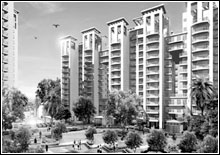 THE Indian Supreme Court last week came out with a significant judgement, clearing the sale of land owned by textile mills in the city to developers, who plan to put up sprawling shopping malls, office towers and high-rises containing plush apartments.
But the judgement deepened the rift between city planners and business houses on one side, and environmentalists and some NGOs on the other, bringing the spotlight on the question of the city’s future development.
The city’s textile mills, including state-owned National Textile Corporation (NTC), had filed a petition in the Supreme Court, challenging a Bombay High Court ruling that had struck down a state government order allowing more concessions to the textile mills.
Mumbai’s 60-odd textile mills own about 600 acres of land. The industry, which in the first half of the 20th century, dominated the Indian economy, was crippled following a long-drawn strike organized by a militant trade union leader. About 200,000 workers lost their jobs in the mid-1980s following the strike, and most of the mills stopped production.
The government then came out with a scheme, allowing mills to sell their land to developers and builders. One-third of the land was to be sold to developers, another third was to be given over to the Bombay Municipal Corporation for developing parks and gardens, and the rest was to be given to the government for development of low-cost houses for workers.
However, the textile industry’s response to the scheme was lukewarm, so the government in 2001 amended the rules, and said the statutory surrendering of two-thirds of the land (to the BMC and to the state government) would be applicable only to vacant land within the mill premises, and not to the built-up space. The industry responded enthusiastically, and many deals were signed with developers.
NTC, which owns about 25 mills in Mumbai, auctioned five mills for about $500 million, and other private mills also began negotiations with developers. NTC fetched record prices for the land, which developers were hoping to sell for around Rs15,000 to Rs20,000 a sq ft after development.
Property prices in central Mumbai – where the 600 acres of mill land is located – began heading northwards, and the real estate market also perked up. The last few years have seen many glitzy towers come up in the former labour district of central Mumbai, and developers had started putting up shopping malls, entertainment centres and office towers.
But when the sentiments in the real estate market had started improving, an NGO, the Bombay Environmental Action Group, filed a public interest litigation, challenging the state government’s decision. The high court struck down the government order, leading to the Supreme Court case.
India’s apex court, however, found nothing wrong with the government decision and reversed the high court order. The landmark judgement is expected to boost the property business in the city, and also lead to a revival of once drab neighbourhoods.
MUMBAI’S economic profile has undergone dramatic changes over the past few years. As happened in cities like New York and London, industrial units have relocated to other parts of the country, because of the high wages prevalent here.
The textile industry itself collapsed as mills – which were paying relatively high wages to the organised and unionised workforce – began losing heavily following the entry of cheaper fabrics and garments from the unorganised sector. Powerlooms, which do not pay most of the taxes and duties that composite mills contribute – and pay a pittance of wages – were able to sell fabrics at a fraction of the cost.
Cheap imports from South East Asia and China also depressed demand from domestic producers. Most of the Mumbai’s 60-odd mills shut down operations, and workers were deprived of wages. With the sale of mills, the bankrupt firms will get substantial funds, enabling them to clear off their workers’ dues.
NTC expects to raise nearly a billion dollars through the sale of its remaining mills to developers. This would enable the public sector entity to clear off its all dues to its employees, and also help in rehabilitating some of the mills in other parts of India.
Similarly, the construction boom in the textile district will result in the generation of thousands of new jobs, especially in the services sector. New shopping malls and entertainment centres, office blocks and residential buildings will also lead to job creation, reviving the city’s economy.
Real estate industry analysts estimate nearly 15 million sq ft of additional real estate will be developed in the 600 acres of mill land.
Both the BMC and the Maharashtra government have a miserable track record of developing land earmarked for parks, gardens and other public use. The more land is reserved for such public facilities, more the scope for corruption. Corrupt officials virtually auction the land to slumlords, who then put up shanty towns, and extort rents from the poor.
In Mumbai, a majority of public land – owned by the airports department, the railways, and the BMC – have been encroached upon illegally by slumlords, developed as slum colonies, and rented off to new migrants.
Private developers, however, have a much better track record of redeveloping land, even putting up parks and gardens. The Maharashtra government is determined to transform Mumbai, and has launched an ambitious programme to improve its infrastructure.
Strapped for funds, it is in no position to build low-cost housing, or maintain parks and gardens. Courts in India – including the Supreme Court and the Bombay High court – have lambasted the state government several times in the past for the terrible misuse of public land.
ONE of the biggest disasters to strike India’s financial and commercial capital was the heavy flooding that occurred last July, when a record 1,000 mm of rainfall was recorded in a 24-hour period.
The consequent floods inundated most of the suburbs, stranding millions of residents, and leading to hundreds of deaths. The main cause for the disaster was not the heavy rains, but the massive encroachments in the suburbs, that had choked up the Mithi river.
The Bombay High Court ordered the government to clean up the mess, widen and deepen the river, and ensure that there were no encroachments. Last week, Maharashtra chief minister Vilasrao Deshmukh launched the ambitious programme to clean-up the river, reduced to a gutter.
However, within hours of Deshmukh inaugurating the clean-up drive, virtually all work stopped, as the labourers disappeared along with their equipment. The project has been taken up by the Bombay Municipal Corporation, not known for its efficiency.
The high court has warned the authorities several times, and set a deadline of May 31 for executing the job. But the way things are proceeding, it appears unlikely that the BMC or the state government agencies will be able to meet the deadline.
Once the monsoon sets in by June 10, work would have to stop. Thousands of industrial units, scrapyards, recycling units and chemical and leather works have come up illegally along the banks of the 15-km-long river.
The Mithi is a natural channel that was supposed to take in the overflowing waters from Mumbai’s lakes and empty it into the Arabian Sea. However, because of the illegal encroachments, there is no place for the excess water to flow, leading to floods in low-lying suburbs.
Many of the local politicians in the western suburbs are opposed to the demolition of illegal constructions, as most of the unauthorized constructions occurred under their patronage.
The Maharashtra government is now in a dilemma, as the high court has warned that inaction would not be tolerated. With the courts – and even the federal government –breathing down its neck, the Deshmukh government is struggling to clean-up the river.
The federal government is reluctant to release funds for the improvement of Mumbai – under an ambitious new urban renewal scheme – unless the state government shows some results on the ground. The state government has also been directed to liberalise its land laws, by scrapping the antiquated Urban Land Ceiling Act, which is effective only in Mumbai.