



 0
0

 Baffling is the word for many current policies of the government. Policies in most Third World countries are outside the realm of the populace and right now, Pakistan is a quasi-democratic set-up headed by a military man. Policy declarations in contradiction with ground conditions are therefore not rare.
Little independence is expected of a country inheriting spineless traditions in foreign relations, particularly as it had remained tied to coat tails of one super power. But there must be cogent and concrete reason to cave in on every front before vague pressures and surrender to insignificant inroads.
Pakistan may have lost advantage in many areas of life but one presumes there would be some explanation to back its positions by logic - admittedly hollow versions - but in the case of food imports from India even a fig leaf does not exist.
To be precise, there was a see-through fig leaf of an argument to begin with. The governments showed concern for rising prices of some food items and felt that the market could be stabilized by imports. Policy makers ostensibly wished to create balance between supply and demand for certain items and all they could come up with as solution was imports from India. The proposition was visibly faked when it was laid down. Nevertheless, it could be presented as a proposition.
The first move was made hurriedly and in quite a clumsy manner; it was made public almost after all ends had been tied, items identified, importers selected, contacts with exporters from India established and rates agreed.
Interestingly, while the idea of using imports to stabilize prices is half-baked, the only way the manoeuvre can succeed is by flooding the market with concerned commodities. In this case, quantity of imports seemed to have been determined to ensure that prices stuck to their level in the local market. The idea was presumably ensuring good rates for inexpensively imported stuff.
Needless to reiterate that all items imported in the middle of the last year were quality products of the local farming sector. They were not being sold at exorbitant rates and there was no reportable shortage of any item. The provocation for sudden imports was inexplicable, unless one realized that many deals contain more than what meets the eye.
If the purpose was honest bridging of gaps in the market and protecting consumer’s interests, the move should have been followed by strict monitoring of the sale of imported items. That was not done. Under the circumstances, drawing the conclusion that the policy had been devised for some specific end became inevitable. That end could only be tied with an overall India policy of the government.
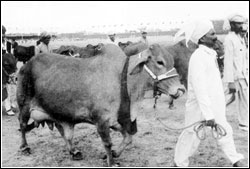
The list of imports was continuously expanded after the first imports were held. The most surprising inclusion in this inventory was livestock, a sector that provides great economic strength to Pakistan and offers livelihood to a very large segment of rural population as also middle and lower middle economic level urban workers.
Pakistan’s agriculture is not always financially rewarding for farmers, particularly small farmers who constitute a large percentage of the segment. Animals are the farmer’s insurance against difficult times - they keep knocking at the farmer’s doors almost the year round. They manage their affairs through routine reliance on livestock and make a survival bargain from bad deals because they have animals to fill income gaps.
Two types of people breed livestock. Not all of them are to be called breeders because maintaining one or two, a maximum of three animals hardly conforms to requirements of breeding. There are landless breeders and farmers with small, barely economically feasible tracts of land. The second group can manage its stock relatively better because of the availability of residual fodder from the agricultural crops. The first has to fight for survival for its animals and for itself all the time. Both these groups are adversely hit by the import of meat or live animals because this means shrinking of the small market available to them.
The dispensation for these breeders is tough because they have no means for direct access to the market and middlemen preside over their affairs. Needless to say that the middleman extracts more than his pound of flesh in profits’; breeders are left with bare minimum, often with even less than that. A portion of their small market going to foreign animals means tougher life for them; it may be the push beyond the line of poverty.
Two years back there was great hue and cry over the wheat imported from Australia; it was rated as wanting in quality; consignments from Australia were rejected. One admired the stand taken by the government because it reflected on the authorities concern for public health. Considering what is happening about the quality of food imports, one wonders what must have been the reasons behind the rejection of Australian wheat.
The government removed quarantine condition on import of meat from India. This is an unheard of measure when the need for imports is not a matter of life and death. Such extreme facilities may be offered when conditions are acute but they are certainly surprising in normal circumstances.
Meat imported through Wagah border was exempted not only from quarantine condition but the number of certificates required for quality was also cut down to increase the purchase of beef from the neighbouring country.
India is not a great meat producing country and, for obvious reasons, beef is certainly not its prime product in this sector. So the beef from across the border represents such animals that had become redundant but could not be disposed off for religious reasons. India was thus given an opportunity to get rid of unneeded material and make profit from it too, while Pakistani consumers were offered a commodity that smacked of being low and wanting in quality.
What is being done in the name of consolidating prices and stabilizing the market is incomprehensible because it is, from every conceivable angle, against the interests of local producers of various agricultural and livestock products and from the look of things, even injurious to public health in some cases. Why the government is persisting with this policy it is mystery involving national interests and public health.





























