0
0

 THE World Consumers’ Rights Day is observed on March 15, every year to highlight the need for protection of consumers as provided under UN guidelines.
And Consumers International is the federation of consumer organizations dedicated to protection and promotion of consumers’ rights worldwide through empowering national consumer groups and campaigning at the international level. It currently represents over 250 organizations in 115 countries.
The principles adopted by the United Nations’ Assembly on April 9,1955.Together they provide a framework for strengthening national consumer protection policies around the world.
Right to safety: To be protected against products, processes and services which are hazardous to health or life.
Right to be informed: To be given facts needed to make an informed choice, and to be protected against dishonest or misleading advertising and labelling.
Right to choose: Ability to select from a range of products and services, offered at competitive prices with an assurance of satisfactory quality.
Right to be heard: To have consumer interests represented in the making and execution of government policy, and in the development of products and services.
Right to satisfaction of basic needs: To have access to basic essential goods and services, adequate food, clothing, shelter, health care, education and sanitation.
Right to redress: To receive a fair settlement of just claims, including compensation for misrepresentation, shoddy goods or unsatisfactory services.
Right to consumer education: To acquire knowledge and skills needed to make informed, confident choices about goods and services while being aware of basic consumer rights and responsibilities and how to act on them.
Right to a healthy environment: To live and work in an environment which is not threatening to the well-being of present and future generations.
In Pakistan, because of its enormous population and a high-level poverty, unemployment, and poor literacy levels, consumer awareness remains low. The ordinary citizens are still the victims of bad governance and are being denied their basic rights.
There are no consumer protection laws in Pakistan in line with international conventions. Laws such as the Pakistan Penal Code, the Contract Act, the Sale of Goods Act, the Drug Act, the Standard of Weight and Measurement Act are not sufficient to protect consumers. The general publics have no awareness about the Law of Torts.
Although there are laws dealing with adulterated foods and substandard drugs, their enforcement is quite poor. As a result, the markets are flooded with substandard and poor quality goods and products. The markets are served with defective, over-priced and expired products, but there is no place where complaints can be lodged.
In the absence of regulatory controls and quality checks, citizens are at the mercy of callous manufacturers and the government’s apathy has led to a situation of extreme suffering for low-income groups.
There are many factors responsible for the presence of sub-standard food products in the market but the major factor is unchecked corruption in government organizations including the quality monitoring and enforcement agencies. Consumers have no representation in the policy-making process.
Consumer rights are a neglected area because the consumers do not have organized movement to voice their concerns. There are only a few private forums and organizations including multinationals working for consumer empowerment. They keep on voicing the consumers’ rights and demanding enforcement of trademarks and copyright laws.
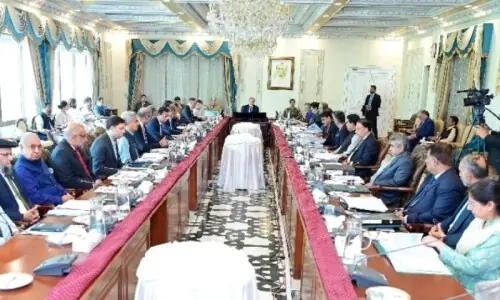
Now a consumers’ rights council (CRC) is being set up in Sindh to monitor the production, import, supply and demand of all essential items in the province and to keep the people informed about these goods on day-to-day basis.
The representation of consumer is essential to make effective policies. The government should involve consumers in matters that have a direct or indirect bearing on them. Consumer protection courts are also necessary to provide easy, inexpensive and immediate solutions to consumers’ complaints.
The private sector has little concern for consumer protection due to monopolistic and under-developed nature of our markets. “Awareness-raising among consumers needs to be ensured and media could be employed for this purpose.
In a competitive economic environment, the consumer has to exercise his choice either in favour of or against the goods and services. His choice is going to be final.
Advertisements and promotion activities are no doubt an important source of information as they help to inform consumers about the availability of different products before making their choice. Today’s extraordinary market is full of substitutes not only with local items/products but with foreign goods and items also.
If imports are not controlled by well-enforced quality standards, benefits of competition are lost. Producers must be forced to respect the rights of consumers, especially in terms of safety and health, before they can earn the right to sell anything in the market.
Consumers can benefit from the best possible quality, price and service from the fair practices of the market. Better competition must continue to find its way into our economy to ensure that the consumers are getting best of the suppliers, which would automatically weed out the inferior products from the market.