0
0

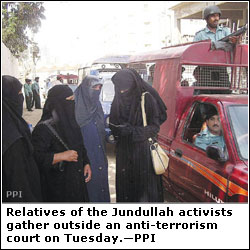 KARACHI, Feb 21: An anti-terrorism court sentenced on Tuesday 11 activists of the banned Jundullah to death in the corps commander convoy attack case. The court also awarded them multiple terms of rigorous imprisonment on other charges.
The Jundullah men stood calm, with unruffled smile on their faces, as Judge Feroze Mehmood announced the verdict around 3:35pm.
Ataur Rehman alias Ibrahim, Shahzad Ahmed Bajwah, Yaqoob Saeed, Uzair Ahmed, Shoiab Siddiqui, Danish Inam, Najeebullah, Khurrum Saifullah, Shahzad Mukhtar, Khalid Rao and Adnan Shah were formally indicted on Sept 23, 2004, for a series of offences, including attack on the motorcade of the then corps commander of Sindh, Lt-Gen Ahsan Saleem Hayat, on June 10, 2004, on the old Clifton bridge, which resulted in the death of six army personnel, three policemen and a passer-by.
They chanted slogans of Allah-o-Akbar as the judge left the courtroom.
“Such convictions cannot put us down,” Ata ur Rehman told the newsmen, adding he was not surprised at the judgment.
“Such decisions will not stop us from Jihad,” he said, adding “the death penalty is an honour for us. If one Ata dies, another will be born in this way of Jihad”.
The Jundullah men, who were arrested a couple of days after the incident, were charged with the offences under Sections 302, 324, 404 and 34 of PPC, Section 7 of the Anti-terrorist Act, 1997, and Section 3, 4 and 5 of the Explosives Act. Mohammed Qasim, Maaz, Shahab, Bilal, Tayyeb, Hammad and Fasih have been declared absconders.
Besides condemning them to death, the judge also sentenced the 11 accused to suffer life imprisonment for planting two bombs at the bridge. The judge also ordered confiscation of their properties.
Another 14-year term was awarded to the Jundullah men for injuring 10 people during the attack under Section 324 of the Pakistan Penal Code. They were also fined Rs50,000 each for the offence and the judge ordered that the defaulter would have to undergo an additional six-month term.
The Jundullah men were also sentenced to a 10-year term for causing damage to the vehicles during the attack. A fine of Rs50,000 each was imposed on them and the defaulter on the payment would have to suffer an additional six-month term.
The judge also ordered the convicts to pay Rs100,000 each to each deceased as compensation.
The prosecution, represented by Iqtidar Ali Hashmi and Maula Bux Bhatti, examined in all 32 prosecution witnesses, who also included eye-witnesses to the attack on the convoy and arrest of the Jundullah men.
The driver of the van, which was used in the attack on the convoy, identified Uzair Ahmed, Shahzad Ahmed Bajwah and Najeebullah as snatchers of his vehicle (EE-9255).
According to prosecution, accused Najeebullah had booked the vehicle from its owner for taking it to Kalri for picnic and he had asked the owner to send the vehicle to a house in Federal B. Area.
Driver Ghulam Rasool stated that he, along with conductor Bakhtiar Khan, reached the designated place at 6am. However, he said, no one was available and the three accused were standing there.
He said the accused held him and the conductor hostage at gunpoint and accused Uzair started driving the van. He said on their way, accused Najeebullah injected a syringe to the conductor and got him off the van a little before Jauhar Chowrangi in Gulishtan-i-Jauhar. He said that the Najeebullah then injected drug to him and got him off the van.
Another prime witness for the prosecution was a rent-a-car dealer Ghulam Abbas, who recognised accused Najeebullah. According to his testimony, Najeebullah came to his office on June 9, 2004, to book a Hiace for picnic at Kalri for June 10.
Capt Salman Masood, who was present in the corps commander’s vehicle, identified accused Shahzad Mukhtar as one of the attackers.
Havildar Abdur Rasheed, who was in one of the vehicles escorting the corps commander’s car, also appeared as an eye-witness. He said he saw accused Mohammed Shoaib Siddiqui and Shahzad Mukhtar opening fire on the corps commander’s convoy.
Lance Naik Mohammed Safdar, another member of the corps commander’s motorcade, identified accused Khurrum Saifullah as one of the attackers.
Havildar Zafar Abbas, a member of the convoy, also appeared as an eye-witness to the incident.
Mohammed Akram, a passer-by, appeared as eye-witness to the arrest of accused Ataur Rehman, Shahzad Bajwah, Shoaib and Najeeb. He stated that he was passing near Model Colony graveyard on June 13, 2004, around 5:30pm when he heard gun-shots.
He said the police told him that they had arrested four activists after a shootout and they asked him to become mashir (witness) of the incident.
Another passer-by, Abdullah, was also produced by the prosecution as an eye-witness to the arrest of the four accused near Model Colony graveyard.
The investigation of the case was conducted under the supervision of DIG, Investigation, Manzoor Mughul.
The Jundullah men were represented by M R Syed and Mushtaq Ahmed. The defence counsel said they would file an appeal against the trial court judgment in the Sindh High Court very shortly.