



 0
0

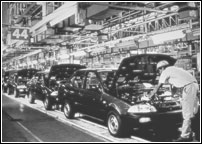 THE automobile components industry in India continues to ride the fast lane, as demand for its products — both domestically and internationally — soars. The industry saw phenomenal growth in 2005, with total production leaping from $6.7 billion to $8.7 billion.
Exports jumped by 40 per cent to touch $1.4 billion, even as Indian auto component giants went on an aggressive acquisition spree abroad. The industry aims to ratchet up exports to a whopping $20 billion in another 10 years.
The auto components industry in India has been growing by a brisk 16-plus per cent (compounded) over the past seven years. Exports have grown even faster, recording a nearly 23 per cent compounded growth rate during the same period. Of course, exports of $1.4 billion are still insignificant, compared to the global size of the industry — about $1.2 trillion.
Several international auto firms have realised the advantages of sourcing their components from India. In fact, many American and European auto majors — including General Motors and Volvo — have been buying components from leading companies in the country.
Besides a dozen major players, the sector is dominated by medium- and small manufacturers. It is estimated that there are about 500 companies in the organized sector and about 5,000 in the unorganized sector. The main advantage that the Indian auto component industry offers is low cost, thanks to lower wages.
The Automotive Component Manufacturers Association of India (ACMA), in a study with international consultancy McKinsey, has estimated that the industry can account for nearly four per cent of the $700 billion global auto components outsourcing business in about 10 years.
India is itself emerging as a major automobile production centre, with all the leading international producers — from the US, Europe, Japan and Korea — having their presence here. Half-a-dozen international firms — including BMW, DaimlerChrysler, Toyota, Honda, Hyundai and Ford — announced investments in manufacturing plants in India in 2005. Other auto giants, including Nissan, Renault and Citroen, are also expected to finalise their manufacturing plans shortly.
Car sales — amounting to almost 600,000 — have shot up by over 12 per cent, while sales of two-wheelers and three-wheelers (nearly 15 per cent each), and light commercial vehicles (20 per cent) grew much faster. The auto industry has expanded by over 25 per cent (compounded annual growth rate) over the past three years.
This year will see the launch of at least 30 new models, including luxury vehicles. The top-end would see the launch of the Rs100 million two-seater model from Bugatti. Audi plans to launch its A4 (for Rs2 million), while GM, Honda, Hyundai and Skoda also plan to launch new models in the rupees half a million to one million range.
Most of the auto components manufacturers have plants in proximity to those of the automobile producers. They have also gone in for tie-ups with international partners, ensuring they are able to provide components for newer models. Recent years have also seen a dramatic improvement in the quality of components produced in India.
According to ACMA-McKinsey, about 80 per cent of auto ancillary producers have ISO certification.
EMBOLDENED by the growing international demand for their products, leading auto component producers in India have been venturing abroad, acquiring other firms. The latest to do so is Mumbai-based Mahindra & Mahindra (M&M), an automobile giant that has also diversified into the ancillaries business.
Last week, M&M acquired a 98.6 per cent stake in UK-based automotive forging firm, Stokes Group Ltd. The group includes three companies, with two manufacturing units near Birmingham. Anand Mahindra, vice-chairman and managing director, M&M (which has a turnover of around $2.6 billion), points out that the acquisition demonstrates the company’s “commitment to build a world-class business that serves its global customers and enhances stakeholders’ value.”
Stokes (annual turnover of about pounds 25 million), which was established about a hundred years ago, caters to the needs of leading auto firms, including Land Rover, Ford, Jaguar, and also General Motors, Toyota and DaimlerChrysler.
Last month, Pune-based forging giant Bharat Forge Ltd — which is the second largest forging company in the world — picked up a 52 per cent stake in FAW Forging of China and formed a new joint venture.
The new company would cater to the requirements of Chinese auto major FAW Automotives, which produces over a million vehicles annually. As in the case of the M&M acquisition, Bharat Forge has refused to divulge the cost of the acquisition.
Bharat Forge had earlier made acquisitions in the US, Germany, Sweden and Scotland. Its total forgings capacity has now shot up to 600,000 tonnes, a little below the world’s largest forge maker, ThyssenKrupp.
According to Baba Kalyani, chairman and managing director, Bharat Forge, the new acquisition will form part of its low-cost sourcing base for supplies around the globe. “It will be part of our dual shoring model for the manufacture and supply of components for local and export markets,” he adds.
The south India-based auto components major Sundaram Fasteners had also recently acquired a German company, while Continental Engines based near Delhi, acquired a Dutch firm.
Fortunately, for the Indian companies, many international auto ancillary firms are not doing too well, and are available relatively cheaply.
AUTO component firms were not the only ones acquiring foreign companies. With the government liberalising foreign exchange laws, allowing Indian companies to make overseas acquisitions, several firms have been busy with their shopping lists.
Indian companies have acquired nearly 100 foreign firms during 2005, for about $4.5 billion. This is more than double the previous year’s level of $2 billion. Most of these acquisitions have been in Europe.
One of the biggest acquisitions was by the Videocon group of Maharashtra, which paid $289 million for the picture tube business of Thomsons. Matrix, a pharmaceutical company, paid $263 million for a Belgian firm.
The Tatas have been extremely active this year, acquiring firms in Asia, Africa and Europe. Tata Steel bought a company in Thailand for $130 million, while Tata Chemicals paid $112 million recently for a 63.5 per cent stake in UK-based Brunner Mond group. The country’s largest soda ash maker now ranks among the top-five producers in the world.
TCS, the infotech giant from the Tata stable, recently paid $26 million for FNS, an Australian financial software developer. It followed it up with a $23 million acquisition of Comircrom, a Chilean financial services business process outsourcing unit. TCS also acquired the BPO division of UK-based Pearl group.
The Tatas are also aggressively acquiring companies around the globe, including South Africa and in Europe. The Tatas are in the race for acquiring the hydropower business of German giant Siemens in Austria. The Tata group has hydropower units in Maharashtra, and is eager to grow its energy business. Siemens wants to exit the business in Austria and is expecting about $350 million for the unit.
The infotech industry — which earns billions of dollars through exports — has been hunting around the globe for targets. Bangalore-based Wipro, however, went in for technology companies, acquiring three firms last month. They include NewLogic, an Austrian R&D design company (for a whopping $56 million), and two smaller firms for $28 million.
Other leading IT companies, including Satyam Computers, Mphasis and Four Soft also acquired firms abroad. Hyderabad-based Satyam paid $39 million for Citisoft, while Mphasis paid $14 million for London-based Princeton Consulting and Four Soft paid $20 million for DCS group.
While Indian companies have been gobbling up firms around the globe in 2005, they have made acquisitions worth over $300 million in the UK alone. Other major Indian acquisitions in the UK include the one by Godrej Consumer Products of Keyline Brands (amount not disclosed), and Apeejay Surrendra group’s $140 million purchase of the Typhoo brand from Premier Foods.
Of course, international firms have also been actively buying up Indian companies during the year. One of the most significant deals was the acquisition of a stake in Bharti Tele-Ventures by Britain’s Vodafone for $1.5 billion.
Swiss cement giant Holcim — which is the world’s second-largest cement company — is also eager to raise its stake in the Indian cement industry. The company is seriously eyeing Gujarat Ambuja Cements — the third largest Indian cement producer — and last year acquired a nearly 35 per cent stake in ACC, a leading cement producer.





























