0
0

 KARACHI, Nov 29: Federal Health Minister Mohammad Nasir Khan said on Tuesday that the country would soon have its own cadaver organ donation laws, which were imperative to ensure more transplantation and check the commercial transactions of human body parts.
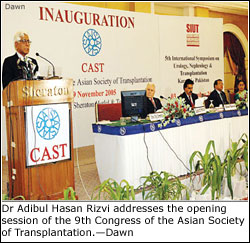
Speaking as chief guest at the 9th Congress of the Asian Society of Transplantation hosted by Sindh Institute of Urology and Transplantation at a local hotel, Nasir Khan said that the draft of the bill pertaining to organ donation would be finalized by the Senate’s standing committee on health soon for its presentation before the National Assembly.
Underlining the need of the set of legislations, the minister said that there were a lot of pressure and lobbying against the move for cadaver donation laws, but, he would not succumb to those as he personally felt that those were necessary from human, ethical as well as medical point of view.
In the absence of legal provisions, no meaningful progress in the filed of organ transplants could be made despite availability of expertise and infrastructure, he added.
He said that there was need to check organ trade as it was a source of exploitation of poor and vulnerable population of the country. Some of the doctors are making profits in the name of serving humanity ignoring the human and ethical aspects, he said.
The minister, however, lauded the role of SIUT and its chief Prof Adibul Hasan Rizvi in the development of transplantation which was proving a source of relief and benefit to ailing humanity free of cost. He and the participants of the congress also paid a standing ovation to Prof Adib for his and his team members dedicated and selfless medical relief works in the earthquake affected areas in northern parts of the country and Azad Kashmir.
Talking about the government’s support in the health sector, he said that the federal health budget had been increased up to Rs10.5 billion during the last three years. “At present, we are spending 0.98 per cent of the GDP, which should go up by two per cent with the passage of time,” he added.
He also stressed the need of promoting the culture of research and quality training in the filed of medical science across the country. “At least we can go at par with those produced by the country in 1960s and 1970s,” he added.
Dr Zaki Morad, President Asian Society of Transplantation, highlighting the significance of such meetings said that they were a tool for disseminating knowledge and making advancement of transplantation in the Asian continent.
In his key-note address, Prof Carl Groth from Sweden, spoke about the global alliance for advancement of safe, effective and ethical practice of transplantation for patients in need.
Prof Adib, the director of SIUT, expressed hope that the congress would prove a stimulating exchange of thoughts and experiences between professionals both from Asia and worldwide. He urged the health minister to introduce the law for organ donation and transplantation and not be misguided with slogans of commercial elements.
Prof S.G. Vathsalla, Secretary-General of the Congress of the Asian Society of Transplantation, read out the annual report of the society’s activities.
Prof Mehmet Haberal of Baskent University, Turkey, who was also the Guest of Honour at the ceremony praised Prof Adib Rizvi and his team for organizing the CAST and getting together large number of experts in the field of transplantation sciences.
The conference will continue on Wednesday, wherein experts from different countries including those from Boston, London, India and Singapore would make presentations.
In the meantime, the Sindh Institute of Urology and Transplantation is holding a ceremony to mark the launching of its project “Institute of Transplant Sciences and Biotechnology” at Kathore on Wednesday.