



 0
0

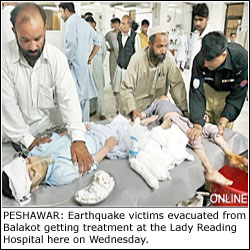 BALAKOT, Oct 12: Balakot, popular with tourists on their way to the picturesque Kaghan and Naran valleys in Mansehra district, has become a city of the dead after Saturday’s earthquake and its aftershocks.
The town presents a scene of total devastation where chaos and confusion reign with decomposing bodies buried under the collapsed structures.
“Only God knows if this place will ever get back to life. There is hardly any building which has not collapsed or anybody who has not suffered,” said Miskeen, a bearded old man who lost 10 of his family members.
Abdul Rehman, a taxi-driver, lost seven relatives, four nephews and three sisters-in-law. “Two of my nieces are still buried under the rubble of our house,” said Rehman.
Israr Ahmed, a student of the Government Degree College, Balakot, lost three brothers, four aunts and two cousins.
There is barely any survivor who has not lost family members in the calamity. All those who were interviewed by this reporter during a visit on Tuesday came up with high casualty figures.
“The number of people who died in Balakot has gone beyond 2,500,” said Balakot deputy superintendent of police Mohammed Khalid. He said that the number was likely to rise in the days to come as the administration had not yet been able to assess the situation in remote villages which have also suffered a massive blow.
Except for a couple of buildings, none of the structures in Balakot bazaar and its suburbs appears to be in its original shape. Most of those inside must have perished. At several places people were seen hammering away at concrete slabs above the debris to make their way in to find missing relatives.
At one such place, a group of army soldiers took over the job of breaking a caved-in ceiling after an elderly man lost all hope of getting into the fallen structure by digging a hole with a hammer.
The search led to the discovery of two decomposed bodies trapped under a pillar.
“Breaking the pillar with a hammer is not possible as it can only be done with the help of a cutter,” said Basharat, a soldier of the Pakistan Army. He conceded that the soldiers involved in the rescue operation were not trained and lacked proper equipment to retrieve people from the rubble.
Teams of trained rescue staff from France, Japan, China and the United Arab Emirates launched operations at the sites of the collapsed buildings of the Government Higher School for Girls and the Shaheen Public School and College — a private sector institution.
More than 500 students were believed to be trapped inside the fallen structures. Hopes for any survivors appeared to be fading among the locals of the area who described the rescue work as only an operation to recover bodies.
A resident Akbar Hussain said that many people could have been saved had rescue work started on the first or even the second day when the area was hit.
“My sister could have been saved if she was airlifted to Abbottabad on Saturday,” said Mohammed Shamrez, a tailor. He lost his mother, wife, a daughter and two sisters after the roof of their house caved in.
“At least one of my sisters could have survived had she been taken to a hospital in Mansehra in a helicopter on Saturday,” said Shamrez, with a broken right hand. He had to travel to Mansehra to get his fractured arm bandaged as medical camps in Balakot became operational only on Monday.
Neelum, who lost her father, a brother, three uncles, two aunts and four cousins, was one of the very few survivors when the roof of the Government Higher School for Girls collapsed. A student of Class VII, she was helped out of the debris by a class fellow. With tears in her eyes and still wearing her school uniform, Neelum was looking for her brother trapped under the debris of his shop.
Official buildings, especially educational institutions, are the worst hit. For many, this has brought into question the quality of construction material used in government buildings.
The building of the Balakot Government Degree College and its recently-constructed hostel fell within no time, according to its staff members.
“The moment I stepped out of the hostel after feeling the tremors, its structure collapsed as did the building of the academic block and the science block,” said Mushtaq Tanoli, an Urdu lecturer at the college.
The degree of damage has made rescue work difficult. “Rescue work in Balakot is far more difficult in comparison to similar operations conducted by us in Indonesia and Baam (Iran),” said a member of the rescue team from the UAE.
“In Indonesia we had to remove floating bodies following the tsunami whereas in Baam the operation was not very difficult as only 40 to 45 per cent of the structures were damaged. In Balakot, more than 90 per cent of the buildings have collapsed.”





























