



 0
0

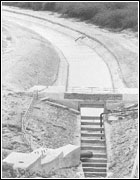 WATER is one of the two most basic resources for agriculture-land is the other and of course the other and obviously the first, and Pakistan has been facing increasing shortage of water due to many reasons.
Construction of reservoirs is suggested as a way out of the water crisis gripping the country but that has become a contentious issue due to opposition by certain segments of population.
The problem of water, however, can not be ignored. The government has come up with a national programme for improvement of water courses as short term measure for improving water availability. The project has other benefits for farmers too and the agriculture sector would hopefully gain from the programme.
Announced by the President of Pakistan himself, the project has been planned as a joint undertaking by farmers and the government (GoP) with the GoP contributing the major share of the total bill of Rs66 billion. The theme of the project is increasing agriculture productivity and farmer’s income through effective utilization of available water resources and drainage system improvement.
Strictly speaking, there is nothing extraordinary about the project because it is based on a concept and practice followed by farmers of our region since ages. This is in fact an upgraded, chiselled and technologically refined form of canal cleaning generally known as ‘bhal safai’ but considering prevailing political constraints on the construction of reservoirs, this was possibly the only option for the government to increase depleting water resources for a country with a large irrigated system.
Such an effort was, in any case needed otherwise too to reduce the amount of seepage through water channels that provide water to farms.
Agriculture contributes 23 per cent of GDP and is the biggest source of employment as it employs about 70 per cent of the work force. Pakistan’s agriculture is irrigation based with the largest ‘contiguous gravity flow irrigation system in the world’ that has been in operation for centuries and has been organized with an intricate system of reservoirs, barrages, head works inter-river link canals, canal systems and over 140, 000 water courses. In addition, there are farm channels and field ditches that run across the agricultural landscape of the country.
These water courses and farm channels render a vital service but they have been clogged over the years with the result that their efficiency has been severely impaired. A serious handicap of the system is the amount of water seeping through canals, water courses and field channels. The quantity is assessed as substantial.
It has been estimated that out of the 56 MAF diversions to the canal system in the Punjab province, 11 MAF water is lost in canals. Sindh has similar seepage losses but the larger size of Punjab obviously involves higher water losses. In addition to seepage in canals, approximately 10 MAF released to water courses. All in all water losses in Punjab’s irrigated lands are placed at 21 MAF.
The province also has the biggest network of tube wells extracting ground water to bridge the shortfall from irrigation water. According to official figures, the number of tube wells stands at around 600,000. They pump out about 33 MAF water from underground sources. Of the surface and groundwater available at the farm gate, about 14 MAF losses take place in the fields. This is serious loss for any agricultural economy. This is a grim situation.
In addition to creating further shortage, these result in water logging and salinity, further undermining productivity of land and availability of land for agriculture as many areas are surrendered to the twin menace of water logging and salinity. This needs to be tackled on war footing.
The On-Farm Water Management (OFWM) setup of the Punjab government has been trying to tackle this issue for some years and had undertaken numerous projects for this purpose with funding from the World Bank, the USaid, the International Fund for Agricultural Development (IFAD), the Overseas Economic Cooperation Fund (OECF), the Japan Bank for International Cooperation (JBIC) and the Asian Development Bank (ADB).
With funding support from these organizations, about 24, 000 water courses spread over more than 120,000km of total length have been remodelled and reconstructed; about 24,000km of lining of water channels has been completed and about 1, 000, 000 water control structures have been installed. These initiatives have been undertaken with direct participation of beneficiaries, that is, farmers in concerned areas.
This, participation of farmers is a notable component of the programme as they are required to contribute the entire labour cost that comes to about 36 per cent of the project. This includes demolishing and reconstruction of kutcha water courses, conducting excavations for portions earmarked for lining, contributing masons and unskilled labour for the project. Work undertaken in the past as well as the latest efforts informs that farmers enthusiastically underwrite their part of the bargain because they can identify benefits accruing to them. The government is bearing the material cost of water courses lining that comes to 64 per cent of the total cost.
But the programme would only have a sustainable impact on the agriculture sector if farmer’s are empowered to manage water resources and they have strong democratically established organizations that are answerable to farmers of all levels and ways and means are devised to eliminate, at least reduce the influence of politically powerful land lords and retired government and military officials who have been gifted lands at throw away rates. Freeing average farmers of these negatives is imperative.
While reducing seepage losses is essential, it has to be remembered that a certain percentage of seepage is required for replenishing the aquifer and in its zest to control water losses, the project blocks the possibility with brick lining of channels. If this is not done carefully and in a scientific manner, the positive aspects of the plan could well be undermined by negative implications.





























