0
0

 TEHRAN, Aug 7: Iran insisted on Sunday it would resume uranium conversion this week after rejecting EU incentives to end its nuclear fuel work, and said it was not worried about being referred to the UN for possible sanctions. “Although we think referral of Iran’s case to the Security Council would be unlawful and politically motivated, if one day they refer Iran’s case...we won’t be worried in the least,” said Foreign Ministry spokesman Hamid Reza Asefi.
Britain, Germany and France, heading nuclear negotiations with Iran for the European Union, have called an
emergency meeting of the International Atomic Energy Agency’s (IAEA) board of governors on Tuesday to discuss Iran’s case.
The EU trio say they will recommend referring Iran to the Security Council if it goes ahead with plans to break UN seals and resume work at the Isfahan uranium conversion plant. Iran says it will restart the Isfahan plant as soon as IAEA surveillance equipment is in place.
“The European proposal has no value,” state television quoted Foreign Minister Kamal Kharrazi as saying.
“We will insist on our rights and have decided to resume Isfahan activities as the first step of our measures. This does not mean we will stop negotiations with Europe.”
German Chancellor Gerhard Schroeder said Iran faced economic sanctions if it refused to accept the EU proposals.
“I don’t think anyone at the moment is thinking about a military confrontation,” he told ARD television.
“If Iran doesn’t back down, one has to expect it will be referred to the Security Council. If that happens we will be talking about possible sanctions. This would not be good for either side. Therefore I have to say I am very worried by Iran’s apparent decision to choose a course of confrontation.”
Asefi, speaking at a weekly news conference, said IAEA technicians would be at the Isfahan plant on Monday to install additional cameras.
He said the EU proposal, which contained an offer of help with developing a civilian nuclear programme, was rejected because it did not recognise Iran’s right to enrich uranium. Iran’s official reply will be delivered to the EU on Monday. “I suggest that the Europeans avoid the language of threat,” Asefi said. “The only way is to encourage Iran and respect its rights.”
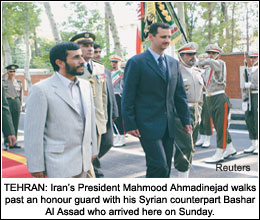
Assad arrives: Syrian President Bashar Al Assad arrived in Iran on Sunday, where he will become the first foreign leader to visit the state’s President Mahmood Ahmadinejad.
“Ways to ensure calm and stability in the crisis-ridden Middle East region will be discussed during Assad’s visit,” Foreign Ministry spokesman Hamid Reza Asefi said.
—Reuters