



 0
0

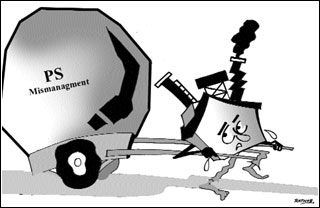 WHEN in the mid-fifties, Pakistan Steel was being conceptualized, the proponents had to wrestle incessantly with the basic questions relating to economics and acquisition of technology on the one hand, and scantiness of technical and managerial talent on the other.
Bureaucracy and leaders of industry were more or less evenly divided on the feasibility. Vested business interests actively opposed the idea. In the press, there was the lone though powerful voice of Professor Ashfaque Ali Khan (Al Hamza) that kept the cause alive. The realistic school seriously doubted if the steel mill would ever be constructed.
It was after a decade of debate that President Ayub gave a go-ahead signal for the establishment of steel-making plant in the country. The planners found the incipient problems to be of such mind-boggling proportions and divisive nature that they could make little progress for years together. The questions of size, location, technology, sources of finance were debated endlessly. So when these were finally resolved, the protagonists had little time or taste for engaging in other rounds of debates on issues that were vital but essentially pertained to post construction period.
Other than perhaps the academia led by the fiery Al Hamza few had clear perception of economic, social and human dimensions of steel industry. Questions of strategic thrust, research and expansion of logistical and technological base to fire and feed the industrial revolution that founding fathers had dreamed of, were with good reason kept under the carpet; partly because of the order of priorities and partly, one suspects, to prevent the donors from focussing on our inadequacies.
Grapevine has it that the Germans did at one point comment on this aspect and advanced it as a restraining factor against investment. In retrospect it appears that public debate on those issues was necessary. If the strategic thrust had been defined in unequivocal terms, the Steel Mills would not have found itself in the yo-yo syndrome that it has been suffering ever since it went into production. Based on agreed concepts, details related to organisation, operations, marketing, human resource could have been concretized and put in place. Whereas construction of Pakistan Steel against bewildering odds bears testimony to the vision and will of the founding fathers, failure to articulate to date, the objectives of the Steel Mills in the context of national dream certifies the drift that followed.
Lest any one forget, the establishment of the mill in the country was not merely an act of setting up of another industrial unit. It was an act of politics to affirm the commitment of people of Pakistan to achieve economic independence through acquisition of modern technology that will cause an industrial revolution and bring about prosperity for all. The Pakistan Steel was not the whole dream— it was its foundation.
Unfortunately this basic fact was forgotten as soon as the mill became operational. This actual or feigned amnesia manifested itself in many ways. To continue on the visualised path, the Pakistan Steel required leaders with social conscience and intellectual integrity who could initiate a debate on the objectives, articulate the consensus and follow through by enunciating a mission statement that would balance its economic, human and social purpose.
Within the organisation they had to set up administrative and instructional institutions that would create a culture perfecting and perpetuating its work philosophy and ethics. There is evidence to suggest that there were indeed a few among the crowd, who could have footed the bill, had they been allowed time. In the archives of the Pakistan Steel there are manuscripts of strategies that aimed to integrate the mill operations with requirements of an expanding economy. Their ideas fitted well into the original philosophical framework and if put in practice would have effectively checked the reduction of the Pakistan Steel to a producer of construction bars. Besides, it would not find itself in competition with scrap based foundries and depend for staying afloat on preferential treatment from government.
With the benefit of hindsight it can be said that as soon as construction work was completed the battle for booty was joined. That necessitated elimination of elements that could possibly prove a hindrance. Regimes of accommodation to the powerful and subjugation of the conscientious followed and have continued ever since. Managerial initiatives became minimal and status quo the watchword. In the vacuum, trade unions gained ascendancy and in good time their musclemen virtually replaced the managers. By 1989-90 utter lawlessness had come to prevail that was undoubtedly fanned and compounded by the law and order situation in the city.
Some stern measures and determined leadership during 1991-4 stemmed the rot and turned the mill around. When the time came for tackling the strategic questions and framing a permanent management model the helmsman and his team were thrown to the wolves. The period 1995-6 shook the organisation to the foundation. It was followed by four years of slow and painful recovery. In year 2000 PSM saw the exit of 6000 odd workers. This exodus included many who were trained in Russia and Turkey and made up the core of production personnel. Their sudden departure was bound to and perhaps did affect safety and efficiency of operations. That fact apart, the PSM did gain a leaner profile and an opportunity for restating its purpose, reorienting production and reforming management structure particularly with reference to manpower, production, marketing and research. But that opportunity flew off in the wee hours of 6th June 2001.
The Pakistan Steel was back in a crisis of management. Death of nine employees at work place signified the failure of a number of its systems. It is difficult to class it as a normal industrial accident. An accident by definition is caused by an isolated instance of misjudgment on the part of a particular individual. Where more than one person are involved it is at best failure of the system and at worst a conspiracy. Some people are heard saying that the supplier had moulded the aluminium that caused the accident from hazardous scrapped material. If there is even an iota of substance in that how would one class the cause of mishap?
Equally important was the inability of the mills to cope with the fallout of the budgetary proposals. It showed lack of liaison, poor information and weak analysis of market forces on the one hand and lack of flexibility in marketing plans on the other. Then there are on-going investigations against a dozen senior management personnel. In case the issues involved are substantial then the system of training and promotion would seem to be suspect. If however the cases are insubstantial and are meant to keep people in line then it points towards the constant threat of blackmail that managers have to work under. Either way the situation affects the credibility of the management.
The controlling ministry will in due course take notice and refurbish the management of the Pakistan Steel but from public point of view they need to reflect on another recurring phenomenon that has gained worrisome proportions. A good number of top managers at the Pakistan Steel have ended up with a stigma. Why? Is there something in the organizational system that destroys men of enough merit that qualifies them for top jobs in the first place? Is its Rs.30 billion annual turnover without strong checks and balances the only reason? Or is it due to the weakness of the single tier model of management where not only are the strategic and operational functions concentrated in one office but also the task of accountability is heaped up on top?
Another model that could be tried would separate top administration from the operational management. Top layer should embody the personality of the organisation and articulate its vision, values and principles. Its responsibilities will include general direction, strategic planning, design and research. It will interface with main allies, associates, trade unions and government agencies. It ought to have full power over personnel and finance and be constantly engaged in the evaluation of organisation’s performance, structure and intra-corporation relationships. The second layer should be responsible for all operational functions, production, logistics, marketing, and administration.
The previous arrangement of having chairman and managing director with overlapping powers and responsibilities was dichotomous and had proved unworkable. But equally the era of CEO as the superman is gone. In the past ten years a large proportion of CEOs in big US companies were fired as failures within a year or two. History of the Pakistan Steel (eight changes in five years-1994-9) has not been much different.
The government may like to institute a commission that should delve deeply into the continuing management failures at the mills and recommend a permanent administrative solution to the woes of the hapless organisation. Privatization is not an option in the case of the Pakistan Steel. The country is destined to retain the model of mixed economy for a very long time to come and in that model rejuvenated, expanded Pakistan Steel has a pivotal role.





























