



 0
0

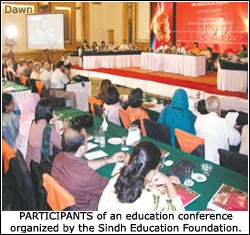 KARACHI, June 30: Participants of an education conference on Thursday stressed the need of developing a monitoring and evaluation system which focussed on problems and achievements of students and teachers at schools. The conference on “Re-envisioning Quality in Education” was organized by the Sindh Education Foundation (SEF) at a hotel, wherein experts in education, managers and teachers of schools exchanged thoughts and placed recommendations for an acceptable framework in the case of public, private and community or NGO schools.
They stressed the need for improving educational quality in the country, as it had been the objective of every society, but, at the same time they noted that the social and economic differences between various segments of population had not been helping the society or the government to evolve any collective mindset on the problematic state of education.
Making a presentation on the types of schools in Sindh, both in public and the private sectors, Zulifqar Bachani and Mashhood Rizvi of SEF, discussed in details on the basis of their survey about the process, contents, environment and learners and teachers and policies adopted by those schools.
Mr Bachani underlined the importance of gender sensitivity in all elements of schools, and also emphasized for developing a teacher development package.
He maintained that there was a lot of room for improving the process of teachers’ selection, curriculum, and physical and psycho-social environment at schools.
Mashhood Rizvi referred to the social stratification and said that divisions between the elite, rich, middle class, poor were becoming stronger and more defined.
He called for creating a public system that addressed the challenge of manifestation in types and levels of schooling and socio-economic divisions.
One of the panelists, the Additional Secretary of the Sindh Education Department, Dr Mehboob A Sheikh, said that social contradictions were also prevalent in the education sector all over the province, while the schools of the elite were radically different from the schools that the poor children attended, particularly in the rural areas.
Talking about the problems of the schools in the government sector, he said that a ban of ten years on teachers’ recruitment had cast negative impact on those schools due to phasing out of the then teachers and non-availability of new ones. Due to social barriers, despite incentives like scholarships, supply of free books, the enrolment of girl students was not appreciable.
Referring to the high fee structure of the government established cadet colleges, Dr Sheikh remarked that those had become the education place for elite children throughout the province and that was why now the Sindh government had allocated funds for giving financial support to the poor students seeking admissions to these cadet colleges.
He said that there was dire need of establishing and promoting a system of monitoring and evaluation so that not only the good performers, students or teachers, could be appreciated timely, but the deficiencies of educational institutions could be identified and removed.
Dr Usha Nayar said that schools had been disconnected from real life, while on the other hand there was a need to ensure a mechanism addressing the gender inequality, lack of cooperation in the process of teaching and learning, and for value addition in public schools.
She said that the social setup and the attitude of the peoples had to be changed so that the efforts made for policies envisaging favourable conditions for girl students became effective.
A former minister in the federal government, Shahnaz Wazir Ali, said that schools would draw the attention of people and attract students only when they were turned into a place of education in the real sense.
She stressed the need for in-service training of teachers, freedom to educators, removing of classroom regimentation and decentralization of curriculum for schools.
Ghazala Kazi of the Sindh government said that without addressing the poverty issue, which had mainly haunted the rural population, any meaningful achievement in the education sector was not possible.
Sadiqa Salahuddin and Dr Mohammad Memon also spoke.






























