



 0
0

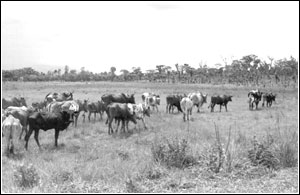 Javed Khan rears five to six buffaloes every year. He buys them for about Rs5,000 and spends nearly Rs10,000 on rearing them. Every year, he goes to Tharparker district market and sells his animals through an “arthi”,(middleman) After paying the commission to the middle man and excluding the rearing expenses, he earns Rs1500-2500 only for his entire years labour.
“Most of my profit goes to the middleman, complains Javed. “If the middle man was to be removed, I could earn much better profit!”, he says.
The livestock farming is an important sub-sector of the agriculture and it contributes 9.4 per cent to the gross domestic product (GDP).
This sector represents about 12.3 per cent of the total export and contributes a considerable amount to our daily protein requirements in the form of milk and meant. Animal by-products such as, skins, hides, bones and wool also earn a lot of money for the country.
In Sindh alone, annually 2.35 million hides and 11.59 million skins are produced which contribute 28 per cent to the country’s production. In short, livestock farming is generating enough profit and holds a potential to turn into a more profitable industry, if provided with enough technical and financial support from the government.
Despite of the profit this sector earns and the potential it holds, it remains neglected by the government and is looked after by a small section in federal ministry of food, agriculture and livestock whereas a separate ministry is required to focus on it.
The lack of support and interest on part of the government is costing fortune to this sector. The main victims of this negligence are private farmers. Marketing of animals in Pakistan is still disorganized and no proper market exits as such.
Livestock owners are at the mercy of middlemen. A flock is sold, considerable amount goes to the commission agent or the interest charged by the financier or money lender. As a result, the take home price for a farmer is low. Moreover, the structure of livestock markets is unstable and improper with no proper arrangements for shelter, drinking water and feeds available for animals.
In Sindh, there are more than 100 markets which are dealing with the livestock without any facility or provision.
These markets are in dire need to weighing machines, sheds, fodder and water facilities. It is said that the marketing of meat starts after slaughtering. Right now, majority of slaughter houses are located in thickly populated areas, where the existing facilities are highly insufficient.
For instance, there is a shortage of various equipments such as pulley hoists and hooks for hanging carcasses, chemical laboratories, water supply and drainage system. In Sindh, there are 100 slaughter houses at the moment, out of which only three are mechanized, therefore, a large proportion of by-products such as blood, glands and bones are either wasted or poorly processed.
The crude slaughtering methods with careless handling during marketing produce low quality skins and hides, which have hampered exports from Pakistan. There is a need to establish slaughter houses with a capacity of 100 cattle/ large animal 500 sheep and goats.
Under the existing conditions, it is very difficult to assure the quality of meat. To ensure the production of animal products under by hygienic conditions, there is a need to incorporate in our processing system the requisite standards. Slaughtering and packaging operations need to comply with government sanitation regulations and government inspection.
To ensure the best quality meat and to increase its preservation power, there is a dire need to establish meat processing plants, which will lead to the supply of hygienic meat products. For this purpose, Chinese-style processing is suggested,as it increase the preservation power of product and can be kept for six months.
Bringing in such measures by government in live stock farming will surely generate considerable revenue for the country. Live stock farmers are now looking for enough technical and financial support of government.
Bringing in such measures by government in live stock farming will surely generate good revenue for the country. Livestock farming is now looking for enough technical and financial support from the government.




























