0
0

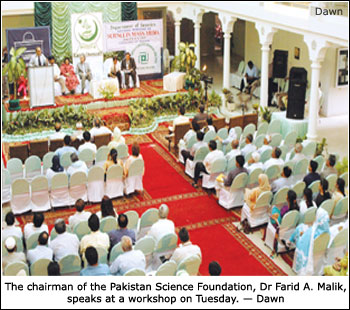 KARACHI, June 7: An improved collaboration between scientists and media persons will not only help make science understandable to the masses but would result in the business application of science and technology potentials of the country. This was observed at a workshop on “Science in Mass Media” meant for the scientists, journalists, television producers. The workshop was inaugurated by the vice-chancellor of the University of Karachi at the campus on Tuesday.
Besides the inaugural session, two technical sessions were held on the first day of the workshop, which would conclude on Thursday. The workshop is jointly being organized by the Karachi University’s Genetics Department, Pakistan Scientific and Technological Information Centre (PASTIC) and Pakistan Science Foundation (PSF).
In his presidential remarks, KU vice-chancellor Dr Pirzada Qasim said that institutions of media and sciences which were already delivering the good could excel further by coming closer to each other. A meaningful interaction and understanding about each other’s working was bound to popularize the science and research activities in the country, he added.
He said that media could also help reduce the gap between the academics and the industry as well by making conscious efforts towards creating awareness about science and related developments.
He said that the workshop, which had got a unique theme and topics, would surely conclude with guidelines on how to promote science through print and electronic media.
PSF chairman Dr Farid A. Malik, who was the chief guest, said that the country was not short of science and technology potential, but it appeared lagging behind in the socio-economic development sectors only because it had been failing to commercialize its scientific applications and achievements.
In his deliberation later during the technical session, he said that technology-based development could not be accelerated in the country as the required “connection” between the industry and technology was missing. “Technology needs a complete structure for its transfer from laboratory to industry and finally to end users,” he added, saying that Pakistani technologists and researchers should be given a market access and an environment leading to their cooperation with the public or private sector organizations.
He made a detailed presentation on the workings of the PSF and discussed proposed sectors for technology-based developments in the country. The sectors, he identified were energy, textile, leather, agriculture and livestock, metals and minerals, industrial chemicals, engineering, telecommunication and information technology.
Dr Farid Malik informed the participants of the workshop that the PSF was acquiring three pieces of land in Azad Kashmir for tea-plantation and the MoUs in this regard would be signed by the parties concerned soon. The foundation was persuading tea blenders and marketers to use local tea in order to save foreign exchange, he mentioned.
In his welcome address, Dr Shakeel Farooqi emphasized on media and science relationship and noted that there had been a vacuum between the two sectors. Universities which conduct researches in addition to teaching may be able to perform need fully and in line with the national aspirations only when their works were disseminated to the outer world precisely and in time, he added. He further said that media persons and scientists should understand each others’ problems and work in a way that science could be presented before the masses appropriately and in an easier language.
The acting director of the HEJ Research Institute of Chemistry, Dr Mohammad Iqbal Choudhary, said that the current gap between the developed and developing countries was likely to widen as the former were mastering the tools of science and inventions.
Talking about science and technology in the prospective of Pakistan, he called for increase in qualified faculty, sufficient autonomy to and within universities, adequate funding for R&D and development of infrastructure. He also talked about the fragment management of science and technology and noted that the ministry of science and technology had very little to do with the main research establishments of the country.
The Director-General of PASTIC, Dr Rafiq Hasan Baqri, said that the situation related to scientific works and research papers was not very much encouraging. The maximum papers pertained to health science and the minimum papers were published in physics, while no paper was available in material science for the last some years. He maintained that planning for proper use of the resources was needed in order to avoid further sufferings caused due to mismanagement in the sector.
The KU Genetics Department chairperson, Dr Farzana Naqvi, and Dr Hamayun Rathor also spoke at the workshop.
On the second day of the workshop, the technical session will be presided over by Prof Zakriya Sajid, while Prof Nisar A. Zuberi, Dr Tahir Masood, Dr Abdul Ghaffar, Dr Shabbir Ahsan and Dr Shakeel Farooqi are likely to deliver lectures. A technical session on television production would also be conducted by Iqbal Haider and Afifa Soofia Al-Hussaini on Wednesday, said one of the organizers.