0
0

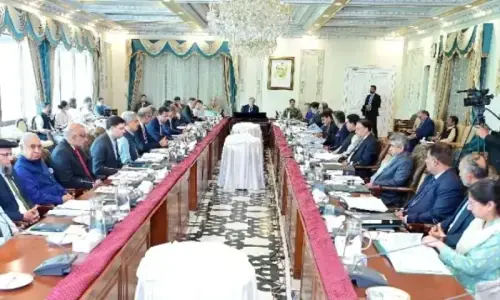
ISLAMABAD, May 15: Parliamentarians from South Asian countries on Sunday sounded optimistic about greater regional cooperation in the future at the start of a six-day conference that will discuss some pivotal issues ranging from security to forming a South Asian parliament. While there was only a loud thinking about forming a South Asian parliament on the lines of the European Parliament in speeches, some suggestions were made to start with something less like a regional parliamentary union.
The issue is due to be discussed in detail on Wednesday at Bhurban where the conference will hold eight sessions on May 16 to 20 on various topics, including economic cooperation, water issues and energy grid, a South Asian human rights code, and right to know and independence of media.
As is usual with South Asian gatherings, talk of ways to scale down the traditional rivalry between India and Pakistan dominated the inaugural session of the first such regional parliamentary conference, organized by a regional organization of journalists, South Asian Free Media Association (Safma).
There was general acclaim for the progress of the ongoing India-Pakistan peace process, with MPs from almost all the ruling and opposition parties supporting moves by the two government to settle bilateral disputes through dialogue.
National Assembly speaker Chaudhry Amir Hussain was the chief guest at the inaugural meeting, attended by MPs from about 30 ruling and opposition parties from India, Pakistan, Bangladesh and Sri Lanka.
A delegation of former MPs from four parties of the strife- torn Nepal refused to travel to Pakistan in protest after one of their colleagues was reportedly arrested before he could board a plane for Pakistan at Kathmandu airport.
“The disputes such as Jammu and Kashmir must be resolved according to the wishes of Kashmiri people,” Amir Hussain said in his inaugural address. One parliamentarian from occupied Kashmir, Abdul Rashid Shaheen of the National Conference was in the Indian delegation of more than 30 MPs.
The National Assembly speaker said the idea of forming a South Asian parliament was good but “premature at this stage”, as he stressed the need for solid foundations to build a durable and lasting edifice. Mr Hussain also said he would host the next meeting of Saarc parliamentary speakers in Islamabad.
Opposition leader in the National Assembly Maulana Fazlur Rehman said though a South Asian parliament did not appear to be near yet owing to “many difficulties”, the Saarc countries should identify their common interests and ways to achieve them in the face of perceived threats from globalization and what he called “one global tiger” seeking to dominate the world in the name of war on terrorism.
Leader of the house in the Senate Wasim Sajjad, representing the ruling Pakistan Muslim League, said the goal of forming a South Asian parliament would be easier to achieve because of more commonality in the region compared to Europe.
Chaudhry Aitzaz Ahsan of the People’s Party Parliamentarians described geographical contiguity of South Asian countries as “a great rationale” for cooperation among them.
Earlier, Indian Congress party’s Lok Sabha member Nikhil Kumar called for more people-to-people contacts in the region. Bharatiya Janata Party’s Rajya Sabha member Mukhtar Abbas Naqvi, speaking in Urdu, congratulated both President Pervez Musharraf and Indian Prime Minister Manmohan Singh for sticking to the “difficult” peace process.