0
0

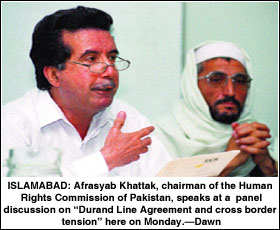 ISLAMABAD, Aug 25: Pakistan and Afghanistan have more commonalities than those among the European countries, and there is no reason why in this age of globalization the two brotherly countries should not help in building up a close alliance in the region.
Afrasyab Khattak, the Awami National Party leader and chairman of the Human Rights Commission of Pakistan stated this at a panel discussion on “Durand Line Agreement and cross border tension”, organized by the Sustainable Development Policy Institute here on Monday.
He criticized those who are still ensconced in the cocoon of the Cold War era, and said that we should recognize the realities of post 9/11 Afghanistan and should stop talking of concepts like ‘strategic depth’ and ‘military depth’, which, according to him, have not benefited us. He also criticized a kind of imperial attitude bequeathed to us by the British in the very early days of our independence when we did not try to have a dialogue in the new situation with our neighbour on an issue that it felt strongly about. He said those who ransacked our embassy in Kabul (he said he was himself in Kabul on that day, went to the embassy and stayed there for many hours) were friends neither of Pakistan nor of Afghanistan. He felt that we should refrain from making strong statements from our side. Forces, which want to create schism between the two countries, could easily exploit these, he said.
Mr Khattak thought that proper “decolonization” of areas, as tribal areas has not taken place, and spoke of the charge that some of the present troubles may have been due to our not even following the boundary line between Afghanistan and Pakistan according to the Durand Line. He quoted Habib Jalib to emphasise his view of some of our shortcomings.
He also spoke of the referendum in the NWFP that brought it into Pakistan and felt that the late Ghaffar Khan and his party boycotted it because it did not give any option other than joining India or Pakistan. This was refuted by a gentleman from the NWFP, Shamsul Huda, who said he was 14 when the referendum was held and thought the party in power boycotted it as a escape route, because no Pukhtun could have ever imagined joining the province with India.
Asif Samim, an Afghan scholar, who spoke in Pushto, and whose speech Afrasiyab Khattak translated into Urdu, warned of the danger looming large on the horizon where, according to him Americans were heard talking of redrawing of maps. He also explained at length various phases in Pakistan-Afghan relations with the changes in government in Afghanistan right from the day of our independence.—Mufti Jamiluddin Ahmad