0
0

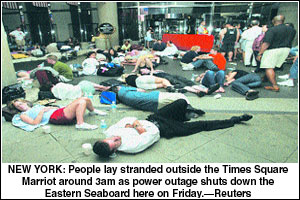 NEW YORK, Aug 15: Millions of people in the United States and Canada rose on Friday from a sticky sleep after the worst power failure in North American history blacked out New York and other major Canadian and US cities the previous day.
Power grid operators said they had restored power to parts of the region, but for many people the day began as it ended — hot, humid and without electricity to run computers, subways, televisions, air conditioners and trading systems.
The power was back on in parts of Ontario, Canada’s most populous province, where the blackout cut juice to about 10 million people. The premier of Ontario, in a statement, asked citizens to remain home and conserve energy.
It was the biggest blackout in North American history, according to US power grid operators, eclipsing the 1965 blackout that affected about 30 million people.
The failure spread in a matter of seconds on Thursday, tripping circuit breakers from the Great Lakes to New England to protect costly electrical equipment from a sudden voltage jolt.
Authorities were unsure what caused the breakdown, which spread across 9,300 square kilometres to Detroit and Cleveland, and across the Canadian border to Toronto and Ottawa, except to say it was not the work of saboteurs.
“The one thing I can say for certain is that this was not a terrorist act,” US President George Bush told reporters in California.
The office of Canadian Prime Minister Jean Chretien said a severe breakdown at a Pennsylvania nuclear power plant may have caused the massive power blackout.
Some officials said a fire or perhaps lightning had hit a power plant near Niagara Falls, in New York state. Power grid operators said there appeared to have been a failure on the high-voltage transmission lines connecting the United States and Canada.
But some blamed the failure on North America’s aging electricity transmission grid, which saw its greatest expansion in the years following World War Two.
“We’re a superpower with a third-world grid. We need a new grid,” New Mexico Governor and former energy secretary Bill Richardson told the CNN television network. “The problem is that nobody is building enough transmission capacity.”
In New York, the blackout trapped thousands in crowded subways, forced millions of office workers onto the streets, darkened Broadway and hit trading on US financial markets.
In Detroit, headquarters of the largest US automakers, many workers went home after the lights went out, creating traffic gridlock in the city. General Motors said several of its auto plants were closed by the outages.
It briefly closed New York’s three main airports and jangled nerves among New Yorkers, whose memories of the airliner hijacking attacks of Sept 11, 2001, are still raw.
“I urge all Ontarians to refrain from using highways and fuel and to stay home when possible as we work towards a solution,” Eves said.
A spokesman for one of the companies managing the national grid said the firm had restored electricity in upstate New York, where approximately 1.25 million of the company’s 1.5 million customers were affected.
Another firm said it “has made significant progress in restoring service to its 1.4 million customers”.
About 450,000 customers in the greater Cleveland area were without electricity.
TIMES SQUARE DARK: Pockets of power turned on lights here and there in New York’s streets, where thousands of stranded commuters and tourists slept the night on beds of newspaper, cardboard, or clothing.
But Times Square remained dark; traffic lights did not work in many places and the subways were not expected to run until several hours after power was fully restored.
The New York Stock Exchange said it would open on time for regular trading using back-up power but transportation hitches raised questions about whether market players could get to their jobs.
On his way into City Hall, Mayor Michael Bloomberg told CBS television that “it took a little longer than we thought,” but power is coming back. “If you have to take a Friday off in the summer, it isn’t the worst thing.”
“We hope people will heed the mayor’s advice and stay home,” said Paul Fleuranges, vice president of public affairs at New York City Transit, which operates the city’s subways and buses.—Reuters