0
0

KARACHI, Aug 7: President Pervez Musharraf has called for carrying out planning for the development of Karachi’s infrastructure on a massive scale, and not in piecemeal manner.
He held out the assurance that he would involve the other stake-holders, like the KPT and Railways, in this task as they, according to City Nazim Naimatullah Khan, had claim on the city’s lands.
“It will be no problem to involve them in the infrastructure building plan of the city,” the President remarked during a briefing on the rain and flood ravages in Karachi and the interior of Sindh.
Also present at the briefing were Governor Dr Ishratul Ibad, Chief Minister Ali Mohammed Mahar, Corps Commander Lt-Gen Tariq Waseem Ghazi, provincial ministers Mohammed Hussain and Arif Jatoi, Adviser Home Aftab Shaikh, City Nazim Naimatullah Khan, Chief Secretary Dr Mutawakkil Qazi and provincial secretaries.
After the briefing, the president along with the governor, CM and City Nazim visited some areas of the city.
During the visit, the city Nazim briefed the president on the situation during and after the rains.
They paid a visit to various areas of the city and reviewed the damage to the city’s infrastructure during the rains.
The President drove through Queens Road, Jinnah Bridge, Mauripur Road, ICI Bridge, Mai Kolachi Road, Boating Basin, Korangi Road, Hino Chowk, Qayyumabad, Shaheed-i-Millat Expressway, Sharea Faisal, Rashid Minhas Road, Jauhar Morr, NIPA Chowrangi, University Road, Gulshan-i-Iqbal, Hasan Square, Old Sabzi Mandi, Jail Road, Mazar-i-Quaid, Shahrah-i-Quaideen and other areas for about one-and-a-half hours.
The Nazim told the president that during the rains, the Jam Sadiq Bridge was left as the only link between the city and Landhi/Korangi.
President Musharraf said that he had asked Commerce Minister Humayun Akhtar to use Export Development Fund for effluent treatment so as to supply treated water to industries.
He suggested that in Karachi, the sanitation sector be assigned to private sector on contract basis.
He said while the city government should spend money on maintaining sanitary conditions in poor localities from its own resources, the amount spent in rich localities could be recovered from the residents.
On pointation by Naimatullah Khan that the city government was not the sole authority in Karachi and that there were some 16/17 other stake-holders, the President observed that these stake-holders had billions of rupees and that they should contribute to the rebuilding and development of the city.
He reiterated that any planning worked out, should be on massive scale so that it could yield the desired results. He underlined the imperative need for prudent utilization of funds.
He quoted the example of the RBOD and recalled that at the first briefing on this project, he was told that it would cost Rs116 billion and when he called for revision of the cost, the authorities showing their magnanimity reduced it to Rs75 billion. Now, the same project is being carried out by the army at a cost of just Rs16 billion.
He also referred to the Quaid-i-Azam Park at the Quaid’s Mausoleum and said that it was completed by the Army Engineering Corps at a very affordable cost and completed in just six months.
“Our administrators and financial managers must think of the nation and ensure that maximum transparency and prudence is maintained in the utilization of funds,” he remarked.
Referring to the devastation caused by rains and floods in Sindh, the president observed that whatever resources to be provided to compensate the losses, would not be enough. He announced that he would provide Rs50 million to the Sindh government’s relief fund. There is no doubt that problems are manifold and resources are limited, he said.
Mr Aftab Shaikh pointed out that Hyderabad had suffered major losses in recent rains with Qasimabad, Latifabad and Old city areas being worst-hit where now roads had become almost non-existent. The president said that he would again be visiting Sindh on Aug 23 and meeting students, mediamen and other people.
He once again pointed out that the (federal) government was short of resources and the Sindh government should have a realization about this.
“You must have learnt lesson from the havoc played by rains and flood and should do planning for the future with emphasis on an effective drainage system,” he stressed.
Gen Musharraf said that Hyderabad was the second biggest city of the province but it was unfortunate that no planning was done for the city. He noted that if high-rises would be constructed on drains, it would certainly cause losses.
“Since Gawadar is in the stage of development, and in order to check recurrence of such conditions there, I have asked for the establishment of an authority for its development under a well-conceived planning. These things should be done in time, otherwise you will keep crying.”
Replying to a suggestion by the Sindh Local Government Minister, Mohammed Hussain, that an Infrastructure Development Authority be set up for Karachi instead of carrying out development activities in piecemeal through towns and union councils, the President said: “We want to reduce the number of government departments to the minimum. However, a temporary committee can be constituted to prepare a master plan for Karachi.”
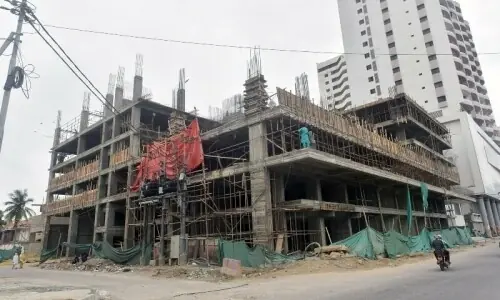
President Musharraf observed that ills had increased to such an extent that it had become difficult to undo them. In this regard, he cited the example of 268 buildings raised illegally in Karachi. He said that he was told that if these buildings were regularized, billions of rupees could be generated. “These buildings are one of the ills which cannot be undone and the most can be done is to regularize them and funds so generated be used for the development of Karachi’s infrastructure.”
He said that instead of seeking funds from the Centre, which has its own constraints, the provinces should generate their own resources.
The Centre, he added, had already given Rs20 billion worth mega projects for Karachi, work on which was under way.
Earlier, in a detailed briefing, Chief Secretary Dr Mutawakkil Qazi informed the president about rainfall, its impact, relief provided and the measures taken in hand.
Dr Qazi briefed the meeting about the relief work and said that an amount of Rs87 million had been placed at the disposal of the DCOs.
City Nazim Naimatullah Khan informed the President Musharraf that there are some parties in Karachi who were prepared to use the waste, produced in the city, in power generation.
He said the city government planned to recycle sewage water for supply to industries. He said that at present, untreated water was being disposed of into the sea and Malir and Lyari rivers.
Mr Khan said that the city government was rehabilitating the two rivers. In the recent rains, he added, the drains connected with the sewerage system overflowed and the sewage entered into houses due to illegal connections.
He informed that for the first time, the KPT, one of the stake-holders, offered to repair the roads and streets in its jurisdiction.
He said that one of the reason of losses caused by the rains, was kutchi abadis while the city was in dire need of an effective solid waste management system. He recalled that in 2001, during a meeting between the president and Nazims, he (Mr Khan) had pin-pointed the problems pertaining to water and sewerage in Karachi.
The city Nazim said that Karachi needed special preference in view of its peculiar situation. He pointed out that in the past, three master plans had been prepared for the city at an enormous cost but none of them could be implemented. He observed that drains in the city had been encroached upon and high-rises raised thereon.
He informed the President that among the 18 towns, Lyari was the worst-affected.
He maintained that in order to rehabilitate and develop the devastated infrastructure, the city government required Rs20 billion to be spent over the next five years.—APP