0
0
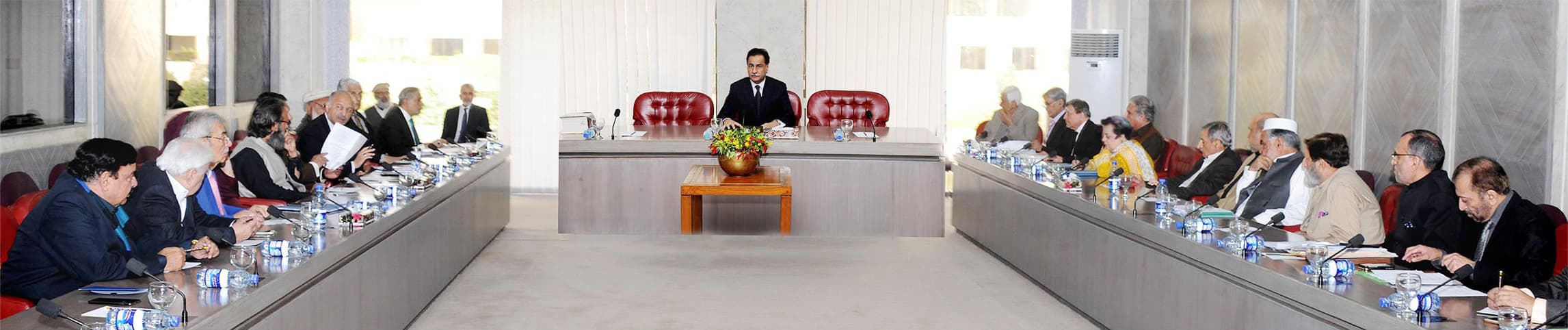
ISLAMABAD: The government on Thursday claimed that all parliamentary parties had reached a consensus on the question of reviving military courts for a period of two years, but the Pakistan Peoples Party (PPP) rejected the government’s claim, saying it had agreed to no such thing.
According to the agreement reached in a meeting of all parliamentary parties’ heads, chaired by National Assembly Speaker Sardar Ayaz Sadiq, the 23rd constitution amendment bill would be laid before the National Assembly today (Friday).
However, in a statement issued after the meeting, the PPP said there was no agreement over the life of the military courts and the appointment of sessions and additional sessions judges. The PPP said it also rejected the government’s draft proposals for the revival of the courts.
It decided that military courts would not receive any further extensions and the government would introduce the long-awaited judicial reforms to improve the judicial system by May 2018.
The meeting also decided that the same parliamentary committee would meet once a month or once in two months to oversee the government’s efforts for judicial reform, monitor national security issues and examine the implementation of the National Action Plan (NAP).
“All parties have reached a consensus on a two-year term for military courts,” Finance Minister Ishaq Dar told reporters after the marathon meeting of parliamentary leaders.
However, he said that if any party wanted to make amendments to the bill, it could present them in the lower house.
When asked about the PPP’s demand for a one-year term, Mr Dar said: “The PPP has agreed to a two-year term for the military courts.”
He claimed the party had also withdrawn its demand that military courts be presided over by a sessions judge, to be assisted by an additional judge who will be appointed by the chief justice of the relevant high court.
The finance minister said Law Minister Zahid Hamid would put the finishing touches to the draft bill, which would be presented in the National Assembly today (Friday).
The ruling Pakistan Muslim League-Nawaz (PML-N) requires a two-thirds majority in the National Assembly and Senate to ensure the passage of the constitutional amendment bill, which will provide legal cover to military courts until Jan 7, 2019.
While the PML-N won’t have any problem getting the bill through the 342-member National Assembly, it will not be in a position to secure its passage from the Senate without the support of either the PPP or the MQM.
In the 104-member Senate, the government requires a minimum of 70 votes for the passage of the constitutional amendment. Even if full attendance is ensured, the party will only be able to get a maximum of 69 votes. The PPP with its 27 senators and the MQM with its eight may well prove to be the deciding factor in the upper house.
PPP stance
After the meeting, the PPP announced that it had not agreed to the draft legislative proposals prepared by the government for the revival of military courts.
Party spokesperson Farhatullah Babar said that media reports about the PPP having agreed to the proposal were not correct.
“The PPP totally and roundly rejects any statement purportedly issued by any official agency creating a false and erroneous impression of the PPP having agreed to the draft proposals of the government,” he said.
Talking to Dawn after the meeting, PTI’s Shah Mehmood Qureshi said the PPP had conceded its two main demands, but three other demands had been accepted by the committee. These include: according the accused the right of access to a counsel of their choice, the application of the Qanoon-i-Shahadat 1984 (Law of Evidence) and the right of judicial review by high courts under Article 199 of the Constitution.
The committee, he said will not oversee the decisions and working of military courts. “It does not come under the purview of the committee,” he added.
Published in Dawn, March 10th, 2017