0
0

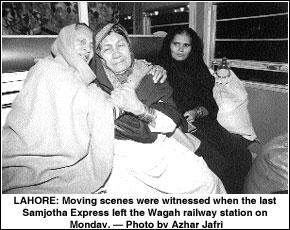 LAHORE, Dec 31: The Samjhota Express began its operation between Lahore and Atari on July 22, 1976.
Until May 3, 2000, the train was a regular service when Pakistan and India decided that each country would run its train on the route for six months. Under this agreement, the Pakistan Railways was to operate its coaches up to May 3, 2002, but the Indian authorities unilaterally cancelled the accord.
The Indian officials were not even responding to queries of their Pakistani counterparts as no formal information had been exchanged about the suspension of the special train operations.
Pakistan Railways general manager Iqbal Samad Khan told this reporter on Monday that there had never been a single complaint from any passenger during the 25-year operation of the Samjhota Express.
On Monday, a total of 771 passengers were on board the Samjhota Express that left the Lahore railway station for Atari at 7:30 in the morning. Among the passengers 30 were Pakistanis (13 men and 17 women), 733 were Indians (402 men, 316 women, and 15 children). Eight foreigners were also on board.
It had as many as 960 passengers on board when it returned to the Wagah railway station at 4:00 in the evening.
Talking to Dawn, most of the Pakistanis who returned from India by the Samjhota Express said that officials of Indian police and secret services had forced them to leave the country by the last train. Most of them were also critical of the role of the Indian media in the present crisis.
Saleem, a resident of Haiderabad, said he and his family went to India by the friendship bus 11 days ago to meet his in-laws and for his treatment.
He said they had to rush back after New Delhi’s sudden announcement of suspension of all road, rail and air links with Islamabad.
He said though there was a lot of troop movement, the Indian people did not want war with Pakistan and they termed the present situation a BJP government stunt to win forthcoming elections in the UP.
He said he and his family had to face problems while travelling back home as the Indian authorities rejected all their appeals for increase in the number of reserved coaches. “We have to bribe the collie to have a berth.”
Dr Fazle Haq, a former professor of the Government College, Haiderabad, said he and his family were in Saker, Rajisthan, for over a month ago. Expressing his annoyance over his return in an unusual haste, he said that the Indian people were being convinced by their government through a hostile media that Pakistan was an aggressive country.
He said he tried his level best to dispel this impression during his stay there, but the impact of the Indian media was very strong. He said the Indian police directed them to remain indoors after New Delhi announced the suspension of all road and rail links with Islamabad.
Manohar Lal, a resident of Rohri, said he and his family members were very much disturbed over the sudden Indian announcement, declaring it an unjustified step.
Shoaib Khan, a resident of Karachi, said his most of the stay was in Ahmadabad. Declaring the present crisis as a creation of the Indian media, he said it had been giving an impression that a war might break out any moment.
He said the Indian public believed that the attack on parliament was masterminded by the BJP government.
He said Indian pressmen who were on board the train up to Atari were also convinced that the attack was an Indian government ploy.
Iqbal Ahmad Siddiqui, a resident of Karachi, said there was a calm tense in New Delhi after the attack on parliament. Civil and paramilitary forces blocked traffic on roads and searched vehicles.
He said there was a rumour that the Pakistanis who would not return by Dec 31 would be sent to jail.
Suresh Kumar of Tharparkar said he and his family left for Bhopal just 10 days ago. He said they had to cancel all their engagements to catch the last Samjhota Express.
He said that the Indian police had forced foreigners, Pakistanis and Afghans to leave India before the closure of its border with Pakistan.