



 0
0

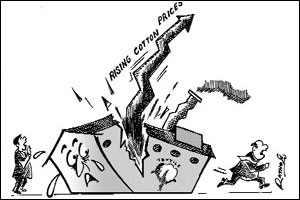 Lint cotton prices have never been so expensive as they are in the current season. This probably would go into the country’s trading history as a ‘record year’ in more than one ways.
No one could possibly think a couple of months back that phutti and lint cotton prices would soar to an all-time peak level of Rs1,750 per 40kg and 3,600 per maund respectively, sending shock waves among the spinners and textile mills alike.
The government is still stuck to its revised crop figure of 10.5 million bales, after taking into account five per cent damage to the standing crop owing to late pest attack in the Punjab cotton belt.
Official crop figures are apparently based on the Crop Assessment Committee surveys and the fortnightly arrival figures of phutti into the ginneries in the last two months — which have shown persistent increase of nine to 33 per cent over the last year’s corresponding figures during the current month.
However, surveys carried out by some private agencies, including those of the textile industry show an extensive damage to the standing crop, notably in the southern Punjab cotton belt which alone produces about four million bales of fine variety of contamination-free lint.
The crop figures of both these agencies are put between 9.2 and 9.5 million bales on the higher side, which could well mean a gap of about 2 million to 2.5 million bales in supply and demand.
The fears of spinners about the supply gap in the backdrop of rising world prices worried the textile tycoons and those who could spend an enormous amount of money to meet their export targets irrespective of higher prices. This caused the flare-up which was well-sustained by the shrewd ginners.
No one could possibly dispute the fact that the demand of the textile industry has, over the last couple of years, soared to above 12 million bales each year owing to massive expansion programme carried out by most of the owners, and the resumption of operations by over 100 sick textile units.
How to meet a wide supply gap without having the facility of a buffer stock and higher world prices took its toll in the form of the prevailing flare-up, thoroughly enjoyed by the grower being the chief beneficiary after many lean years. Both, the ginners and the spinners remained at the receiving end during the crisis. In an identical development, a massive price flare-up was also witnessed on the New York Cotton Exchange on the rumours of a short crop in China and India — the two major world producers of cotton.
Having enormous funds at their disposal, the leading cotton speculators made massive buying of the New York future contracts, pushing their prices well over at 15-year peak level of 84 cents per pound.
The local ginners, who were watching the world markets trend, also raised their asking prices in sympathy, but none among them tried to breach the barrier of Rs3,100 per maund up to early October.
However, in late October and early November the cotton market went into the tight grip of speculators who manipulated the prices beyond the export level of the spinners of the end-product uses.
Leading spinners, including the big cartel, must share the blame for the price flare-up as most of them had purchased a substantial quantity of lint at Rs3,600 per maund. After supplementing their stock positions, they clamoured for the official help to keep them competitive on world textile markets.
Trading in lint during the new season resumed around an average rate of Rs2,000 per maund in the backdrop of a bumper crop based on the initial farmer planting intentions.
Prices remained stable below Rs2,600 per maund up to early September when the picking operations in some of the early sown areas of the Punjab cotton belt was resumed.
Then there was free-for-all after that as prices remained stable around Rs3,000 to 3,300 per maund till the end of November and what is next, only final crop figure or further decline in New York cotton futures would tell. But one thing is clear that a short crop will have a chain impact on the entire economy, including the growth rate as its contribution to the GDP is calculated at around 28 per cent.





























