0
0

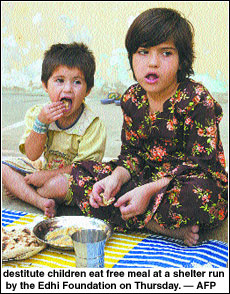 KARACHI, Nov 20: Not much activity was witnessed on the Universal Children’s Day as only a few events were held to observe it at the city’s schools and other venues.
The Children’s Day is observed every year on Nov 20 in memory of the “Declaration of the Rights of the Child” and “Convention on the Rights of the Child”, which were adopted by the UN General Assembly in 1959 and 1989 respectively.
However, a seminar, and also the launching ceremony of Madadgaar Docudramas, was held on Thursday. President of the Lawyers for Human Rights and Legal Aid (LHRLA), Zia Ahmed Awan, briefed the participants about the importance of the day and spoke about rights of the child.
The dramas and skits presented on the occasion were based on the stories of kidnapped and missing children. Mr Awan also spoke at length about the establishment of the clubs in Karachi’s 26 schools which will endeavour to create awareness among children about the potential dangers faced by them.
He said Pakistan’s population was estimated to be 141 million, with an annual growth rate of 2.6 per cent. The percentage of Pakistanis aged 18 or less stood at 55 per cent.
The Declaration of the Rights of the Child — adopted on Nov 20, 1959 — says that the child should enjoy special protection. It also declares that every child should enjoy the benefits social security. The physically, mentally and socially handicapped children are entitled to special care and treatment for their condition.
In all circumstances, children should be among the first to receive protection and relief, says the declaration. Also, the child should be protected from all forms of neglect, cruelty and exploitation, besides all kinds of discrimination.
The Convention on the Rights of the Child was adopted by the UN on Nov 20, 1989. Pakistan signed the convention on Sept 20, 1990, and ratified it on Nov 12, 1990. However, not much progress has so far been made by Pakistanis in this important area.
According to a recent Unicef document, Pakistan ranks 43rd in the world in terms of mortality among children of five years or less. Every year at least 5.3 million children are born every year. The life expectancy at birth, according to the document, stands at 60.
However, 21 per cent of the babies have low weights. And as many as 13 per cent of the infants are severely undernourished. This indicates that an overwhelming number of mothers, at the time of pregnancy, suffer from malnourishment. This also shows that after birth the babies are largely not fed adequately.
Only 19 per cent of the households use iodized salt, says the Unicef report. Only 43 per cent of the Pakistanis living in the rural areas have access to adequate sanitation facilities, it adds. And 87 per cent of the rural population uses “improved” water.
This, according to health professionals, is one major reason why the health indicators have not improved much since the ratification of the convention on children. Another is the failure to achieve universal immunization against diseases such as polio, measles and hepatitis B.
According to the report, only 58 per cent of the Pakistani children were vaccinated against polio and 54 per cent against measles in 2001. Vaccination against Hepatitis B began only recently, so there is no data on it.
The federal government on an average spends roughly 1 per cent of its total expenditure on health, claims the report. On education, too, it spends only 1 per cent. In contrast, 18 per cent is spent on defence, says the Unicef report.