



 0
0

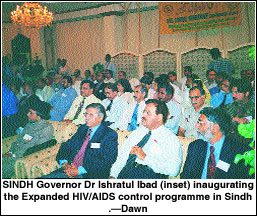 KARACHI, Oct 27: The Enhanced HIV/AIDS Control Programme was launched in Sindh by the governor on Monday.
Under the programme, Rs516.6 million is slated to be spent in the province for prevention of and awareness about HIV/AIDS.
Speaking on the occasion, Sindh Governor Dr Ishratul Ibad urged the religious leaders to join the struggle against HIV and AIDS.
“Religious leaders can really play very important role in bringing a change in the risky behaviour of young people to save the new generation from this plague of modern world,” he said.
AIDS killed the ignorant people, said the governor, highlighting the need for awareness about prevention.
“Pakistan, being a developing country, simply cannot afford to ignore the consequences of this comparatively new disease.
“We are already facing very serious challenges to meet the health needs of the province. TB has become a common public health problem, Hepatitis B and C have affected the general population.
“We have one of the highest rate of infant mortality in the world. We have to launch efforts on an urgent basis to prevent spread of HIV/AIDS in the province to save our meagre resources to fight the already common health problems.”
Pakistan had a window of opportunity because the prevalence of HIV/AIDS was still low in the country and confined to certain segments of the population, he said. “This is the right time to prevent HIV/AIDS without further delay because once it becomes a visible problem, it is not possible to control it.”
On the occasion, the Chief Minister’s Adviser on Health, Noman Saigal, said: “although the reported number of cases in Pakistan is still low (2,020 up to March 2003), there are numerous risk factors which could lead to rapid spread of the disease in the country, if serious efforts are not made on an urgent basis.”
The authorities viewed HIV/AIDS as serious threat to population, he said. Under the programme launched on Monday, the prevention activities were being scaled up. “Financial resources have been increased considerably and a multi-sectoral approach had been adopted to address this issue.”
Dr Sharaf Ali Shah, chief of the Sindh AIDS Control Programme, said the project that was launched on Monday was a five-year one. The World Bank and International Development Association would be providing $27 million for the programme. The CIDA and DFID would also be contributing funds.
The newly-launched project would be enlisting the support of the government organizations, NGOs, private sector bodies, media, religious leaders and academic institutions in the battle against HIV/AIDS, said Dr Shah. The governmental organizations to be involved were education, labour, social welfare, information, police and prisons departments.
Dr Shah said the CM’s adviser on health would be heading an AIDS Task Force which would be monitoring the implementation of the Enhanced Programme. “Members of the task force include representatives from government organizations, civil society, academic institutions and media.”
At the launching ceremony a person having AIDS, introduced simply as Mr T, demanded of the authorities that medicines be provided to the affected people.
Speaking of his ordeal, he said a host of social and financial problems were being faced by him.
“The cost of retroviral drugs is between Rs30,000 to Rs40,000. I don’t have this kind of money,” he said. He was deported from Abu Dhabi in 1997 after he had tested positive for AIDS.
“I was in Abu Dhabi from 1992 to 1997. In 1997 I applied for an extension of my visa. As per requirements my blood was tested for HIV and AIDS and my status was revealed.”
In his emotional speech, he repeatedly appealed to the government to take all the measures needed to stop HIV/AIDS in their tracks.
Meanwhile, the UNAIDS Country Coordinator for Pakistan, Dr Dayanath Jayasuria, suggested that the political parties include a statement in their respective platforms that supported prevention efforts against HIV/AIDS, adds APP.
He said this step could be in line with the measures taken for the establishment of a “Parliamentarians Forums on HIV/AIDS”, to be established at the national and provincial levels.
Reiterating the need for strong political will and commitment, he said the measures were particularly required in a country, like Pakistan, where high risk factors had to be countered.
Appreciative of the fact that Expanded HIV/AIDS Programme had been launched, the UNAID’s country representative said given the high level of political commitment in Sindh, he was in little doubt that the proposed forum would be established in due course.
“The momentum generated today needs to be sustained,” he said, seeking permission to term a few items unfinished agenda for HIV prevention in many low prevalence countries.
Elaborating, he said the planning commission and finance ministry officials must also ensure that every ministry allocated a certain amount of their annual budgets for the preventive work.
Dr Jayasuria underscored the need to engage people living with HIV/AIDS, religious and community leaders and civil society in planning, implementation and evaluation of the prevention programme.
“Commitments and plans have to be translated into action,” he stressed, reiterating that the real work must begin now.






























