0
0
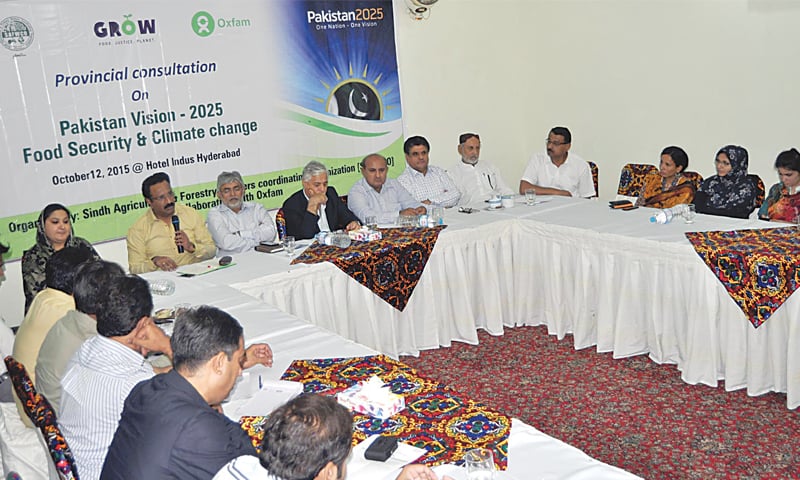

HYDERABAD: Speakers at a consultative programme here on Monday urged people to understand objectives of food security and issues of climate change that are part of Pakistan Vision 2025.
The consultative session was aimed at having better suggestions in terms of viable approach towards reducing negative impacts of climate change and food security.
Dr Sono Khangarani from the Hisar Foundation said two-thirds geographical area of Sindh was prone to drought and policy should be introduced with local context.
He added that special focus and provision for drought-hit areas should be introduced for implementation of vision 2025.
Dr Aijaz Ahmed Wassan from Sindh University, Dr Shahabuddin Mughal, Punhal Sario, Waheed Jamali, Qurban Ali Shah, Kulsoom Bhand, Ishaque Mangrio, Nadeem Korai and Muhammad Khan Jamali made comments and suggestion on vision 2025.
The programme was organised by the Sindh Agricultural and Forestry Workers Coordinating Organisation (Safwco) in collaboration with Oxfam on Pakistan vision 2025 at a local hotel. Teachers and representatives of different non-governmental organisations (NGOs) attended the event.
Safwco president Suleman G.Abro said that since coastal areas of Sindh were vulnerable to climate change which was pushing coastal communities towards food insecurity and malnourishment.
Shahbaz Bukhari presented vision 2025 to create understanding among participants about the issue. He explained objectives of food security and climate change in the vision.
Suggestions and critical review would be documented and shared at the global level and with government departments.
He said that as a matter of fact, civil society always played role for development of society and international community cooperated for better results.
Dr Bakhshal Lashari of the Mehran University of Engineering & Technology (MUET) said water scarcity and water-logging had serious impact on agriculture.
He said proper water management was vital for growth in agriculture and food productivity would be enhanced as 55 per cent of water was wasted in Sindh. He said that civil society organisations and stockholders with close coordination could establish short term and long term strategies for proper interventions under food security and climate change.
Dr Lashari said that in terms of productivity of wheat, agriculture land had potential to have better yield but practices and resource utilisations was a major issue.
Zulfiqar Ali Halepoto said presentation of Oxfam had provided better understanding and said that all provinces should be on board for achievement of this goal.
Prof Ismail Kumbhar of the Sindh Agriculture University Tandojam stated that agriculture in Sindh was divided into ecological and geographical regions with every region had a different climate and seasonal patron for agriculture productivity. He said purpose of this vision was to have sustainable outcomes.
Published in Dawn, October 13th, 2015
On a mobile phone? Get the Dawn Mobile App: Apple Store | Google Play