0
0

 The way in which dietary patterns are changing in the world as economic growth and development proceeds is now well-documented.
Due to the factors such as income growth, urbanization and modernization of marketing infrastructure, consumption patterns are switching from an emphasis on traditional foods such as cereals to non-traditional foods like value-added processed and high-protein foods derived from animal products.
In other words, we can say that an emphasis on a balanced diet is increasing with the passage of time. Livestock contribute in many diverse ways to rural livelihoods through provision of food, generation of income and employment, and as suppliers of inputs and services for crop production.
Livestock is an important sector of agriculture in Pakistan, second largest contributor in agricultural GDP after crop husbandry, which accounts for 39 per cent of agricultural value added and about 9.4 per cent of the GDP. Its net foreign exchange earnings were to the tune of Rs51.5 billion in 2001-02, which is almost 11.4 per cent of the export earning of the country. The role of livestock in the rural economy may be realized from the fact that 30-35 million rural population is engaged in the livestock raising, having household holdings of 2-3 cattle/buffalo and 5-6 sheep and goat per family deriving 30-40 per cent of their income from it.
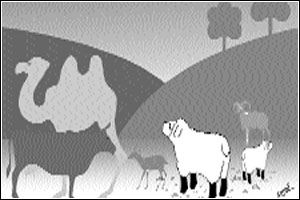
It has been observed that in the developing countries buffalo/cattle rearing have shielded the poor against dire poverty by ensuring them reasonable livelihood. The livestock include cattle, buffalo, sheep, goats, camels, horses, asses and mules. The major livestock products include milk and meat whereas livestock byproducts include wool, hair, skins, hides, blood and bones.
The World Trade Organization (WTO) came into being with the profound slogan of free and fair trade but since eight years of its birth, the dream of free and fair trade is yet to be materialized. The real problem behind this is the discriminatory response from the North because patterns of global trade are distorted by subsidy provisions and imposition of other barriers in developed countries for the protection of their domestic agricultural producers.
Such supports for domestic producers are the highest in the European Union, followed by North America. They have contributed to the decline in world agricultural prices. In the livestock sector producers, particularly those of milk and beef,have received and are still receiving high level subsidies, despite pressures from the WTO to reduce all such barriers. The impact on developing countries, as net importers, is low meat and milk prices, which may benefit consumers, but which acts as a disincentive for producers and a brake on development.
In this scenario, to face the highly subsidized exports from the developed countries, the developing countries like Pakistan are forced to give support to their agriculture sector. Under the provision of domestic support in ‘agreement on agriculture’, de minimis payments are the domestic agricultural support payments representing only a small percentage of transfer to producers. This is 5 per cent for developed and 10 per cent of production value (GDP) for developing countries.
These payments are allowed to be paid in addition to the green, amber and blue boxes. These payments are exempted from reduction commitments even if the effects of such support are potentially production or trade distorting. Pakistan’s Gross Domestic Product (GDP) is Rs4018.1 billion. The share of agriculture sector in total GDP is 24 per cent (Rs964.34 billion); ten percent of it i.e. about Rs96.43 billion is allowed to be given as domestic support to agriculture sector. So we are legally allowed to give support to our agriculture sector in coming days of WTO regime but for this we need to prioritize our policy sectors. Keeping in view the importance of livestock sector, we should give technical and financial support to livestock holders.
In the coming regime of the WTO, the countries need to get their specialities patented under Agreement on Trade Related Intellectual Property Rights (TRIPS). So the species, which are considered to be the special privilege of Pakistan, should be documented with the World Intellectual Property Organization (WIPO). For this purpose, firstly we have to register these species with the Pakistan Intellectual Property Rights Organization (PIPRO) and then with the WIPO. Different important breeds of buffaloes (Nili,Ravi and Kundi), cattle (Sahiwal, Red Sindhi), goats (Beetal, Nichi and Kamori), sheep (Lohi, Keghani, Damani and Salt Range) etc. are assets for Pakistan and need to be registered.
There is less processing involved in the marketing of livestock than in grains. For the most part, processing involves slaughter, butchering and refrigeration. The processing of livestock into meat is subject to sanitary considerations and quality standards. Slaughter and packing house operations need to comply with government sanitation regulations and government inspection. Regulations concerning cleanliness of facilities and disease control are essential in providing the consumer with a desired product.
However in the existing setup, the only criterion for the fitness of animals for slaughtering is their physical examination. Our available slaughter houses are deficient in requisite facilities i.e. chemical laboratories, proper water and sanitation facilities and other infrastructural support. Although the medical staff at the slaughter houses try to assure the quality but it is very difficult under the existing conditions with limited facilities.
The International Office of Epizootics (OIE) has been working since 1924 for the coordination and harmonization of trade in animals and their products. They are also working for the control of animal diseases injurious for the consumer’s health. For this, they have established SPS standards for the trade of animals and their products. So in order to ensure the production of animal products under hygienic conditions we should incorporate in our production system the requisite standards.
There are two other bilateral agreements, which can have implications in future for the animal products. Those include the International Dairy Agreement and the International Bovine Meat Agreement. These two agreements aim at expanding, liberalizing and stabilizing trade in livestock, meat, milk and their products. These agreements will become obligatory for those countries, which will agree to sign these.
There are signs of market development for processed and ground meat in developing countries. Ground meat can include parts of the carcass not used in the cut meat market or meats that are tough or of inferior quality. Processed meats can be made to satisfy the tastes of local clientele by using selected additives. Codex Alimentarius has a list of approved additives used for the plant and animals’ processed products. So in order to expand the processing industry, we will have to comply with the international standards set by the international organizations.
We are deficient in the production of milk.. Fifty-five per cent of the total milk is consumed as fresh milk whereas we have to import the dry milk to fulfil the needs. With a little change in our attitudes we can improve the productivity of the existing stock and can avoid losses. For this purpose the department of agriculture should give training to the livestock holders in better management techniques with proper methods for getting milk under hygienic conditions. In the coming years, investment in dairy sector should be directed towards export-oriented joint ventures. It will reduce import of milk products and encourage production of competitive value added quality milk products for exporting to the Gulf States and Middle Eastern countries along with meeting the local demand of milk products.
Being a Muslim country, Pakistan has a great scope for exporting livestock on the Hajj occasion. According to agricultural statistics, Pakistan exported live animals worth Rs 420.8 million in 2001-02. In order to increase the exportable surplus from Pakistan we need to be very careful about the prevention of diseases in animals through effective vaccination programme because the livestock or their products with disease residual effects would not be allowed to enter in the international market.
Another important event in Pakistan is Eid-ul-Azha. Although meat from this occasion does not enter the market yet there remains an opportunity for proper utilization of animal byproducts. After the Eid we see these byproducts being wasted on the roads or street corners. Industry can be developed to transform these by products into value added and the country can earn valuable foreign exchange by expanding its product base.
Animal byproducts, such as skins, hides, blood, bones, hair, lard, tallow and various animal organs, can be processed into products of value. Hides and skins can be preserved and transported to tanneries. Lard and tallow can be used in ground meat products and cooking or sold to industrial markets. Empirical exercise should be carried out to check the feasibility for exporting those animal organs which we do not consume locally to other cultures.
In the year 2001-02, according to Agricultural Statistics, Pakistan exported 18,300 tons of bones the value of which was estimated as Rs218.9 million whereas the exports of animal casings were estimated as 0,700 tons, the value of which was Rs528.1 million. So in order to survive under the WTO regime, we will have to change our attitude towards the animal products i.e. to export the products, which we do not consume or utilize locally.
Wool is an important byproduct of our animals, which is used in the carpet industry but due to the faulty and careless handling during weaving has developed an inferior image for Pakistani products. We need to undertake these activities on scientific lines by adopting international standards because skins, hides, leather and leather products are good sources of income not only for the country but also for the farmers. If properly cured, the value of the hide is often equal to one quarter of the value of the whole animal.
Crude slaughtering methods with careless handling during marketing produce low quality skins and hides, which have hampered the exports from Pakistan. The leather products from Pakistan have a great demand in the international market but in the coming days we should be very careful about those diseases which affect the quality of leather.
In order to promote the livestock and its related industries, the government has rightly exempted the machinery not manufactured locally from sales tax and has reduced custom duty (10 per cent only) on the import of breeding stock. Besides these, special steps have been taken by the government to cope with the coming WTO regime which includes the establishment of abattoirs in the private sector, the construction of national veterinary laboratory for drug residue testing in the livestock products and steps to improve the sanitary and hygiene conditions of the animal casing processing units.
The government has also launched a project about strengthening of the veterinary services in Pakistan. In addition to these, a number of technical and socio economic constraints like animal genotype, feed resources, animal diseases, infrastructure, marketing, credit and institutional issues will have to be addressed by farmers, scientists, extension personnel and policy-makers.