



 0
0

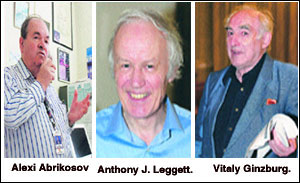 STOCKHOLM, Oct 7: Two Russians and a Briton who explained the nature of matter at extremely low temperatures won the Nobel Prize for Physics on Tuesday.
Alexei Abrikosov and Anthony Leggett, now U.S. citizens, and Russian Vitaly Ginzburg worked on theories explaining phenomena that lead to the development of magnetic imaging scanners, which won the designers the Nobel medicine prize on Monday.
The Royal Swedish Academy of Sciences said in a statement it was recognizing the trio’s theories concerning two areas of quantum physics — superconductivity and superfluidity.
Mr Ginzburg, 87, was head of the theory group at the P.N. Lebedev Physical Institute in Moscow and Abrikosov, 75, now works at the Argonne National Laboratory in Illinois. Briton Leggett, 65, is at the University of Illinois, Urbana-Champaign.
Mr Abrikosov said he had begun his work over half a century ago in the Soviet Union in a scientific world that was almost unrecognizable and virtually without computers.
“All three of us have something in common — our discoveries ...were done many years ago. We are pretty old people,” he said from Lemont, Illinois, on learning of the award.
“We worked mostly in a world without computers.”
A self-deprecating Ginzburg said his share of the 1.3 million dollars prize money, a fortune to him, would be lavished on his family.
“I have great-grandchildren and at least I can give it to them,” he said.
“A tennis player can earn this amount for just one game. For me, of course, it’s a huge amount of money, as it is for anyone in Russia who isn’t a crook or a business tycoon.”
Scientists said that the laureate’s work on superconductivity in particular still had potentially revolutionary applications.
Leggett said he was very surprised by the pre-dawn telephone call informing him of the award and said he knows his co-winners quite well.
“I’m pleased to be sharing the prize with them.”
REVOLUTIONARY POTENTIAL: “Superconductivity holds the promise of a new class of electronics device which can save big energy and lead to levitating trains and improved medical imaging,” Phil Schewe, chief science writer at the American Institute of Physics, said.
The theories developed by the Russian laureates had laid the groundwork for Monday’s medical prize, which recognized discoveries on magnetic resonance imaging (MRI), the now familiar painless diagnostic method used by doctors to look inside the bodies of millions of patients every year.
“They developed a theory which laid the groundwork for MRI techniques,” said academy member Professor Erik Karlsson.
“The Nobel prize on Monday was partly thanks to the development of this theoretical work. They made it possible to have excellent pictures of the human body.”
Leggett formulated “a decisive theory” explaining how atoms interact and are ordered in the superfluid state, the Academy said.
The Nobel committee at the 264-year-old Swedish Academy proposed the names which were endorsed on Tuesday morning by the 350 Academy members meeting in closed session in Stockholm.
The prize includes a cheque for more than 10 million Swedish crowns (1.3 million dollars) to be shared among the three. The winners join an illustrious pantheon which includes Albert Einstein.
The Nobel prizes, first awarded in 1901, were created in the will of Swedish industrialist Alfred Nobel, inventor of dynamite, who died in 1896. They are presented in glittering ceremonies in Stockholm and Oslo on Dec 10, the anniversary of his death.—Reuters




























