



 0
0

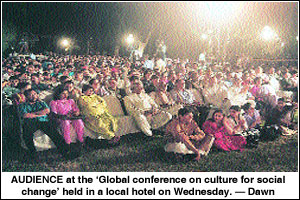 KARACHI, Sept 10: Speakers at a workshop, on Wednesday, said that cultural interventions had been used in different parts of the world to bring about social change and in certain cases even revolutions.
They were speaking at the international workshop on “Cultural Action for Change”, organized by a non-governmental organization, Actionaid. The workshop was participated by writers, poets, historians, social activists, and foreign delegates from eight countries.
An Indian delegate, who belonged to Tamil Nadu, said that his region had been dominated by upper caste people and Hindi was the dominant language while people of lower caste used to speak local language Tamil and were out of power till 1960s. However, people afterwards started using literature, poetry, theatre, and films to propagate their ideas to the masses and almost the entire power structure changed by 1970s. He said that everyone had to learn Hindi earlier, but as the low caste writers, actors and artists came to power Tamil was declared the first language and Hindi was taught as a second language.
Referring to the art of story-telling, he said that there were many folk stories based on the lives of outlaws — like Sultana Daku (robber) and Paru Chandio. Such stories were popular among the villagers because people used to see these characters as symbols of resistance against the status quo and oppressors, he added.
He said that renaissance in Europe gave birth to industrial revolution. The revolutions in Russia and China were also preceded by wide spread activities relating to culture, he added. He said that poetry had always played a leading part in social change.
A delegate from Nepal said that street theatre and dramas — highlighting various issues like gender sensitization, rights of the girl child, and peace etc — were being used by her organization to create awareness among the masses.
She said that such dramas and theatre were very popular among the masses particularly among rural people, where entertainment facilities were very limited. A few hours before the start of any show, leaflets were distributed and announcements were made from the vehicles having mounted speakers, she added.
A delegate from Afghanistan said that his country, which had been a battlefield of two super powers, had suffered the most in the last 25 years. The culture of Afghanistan suffered the most during Taliban rule, who had banned music, plays, theatres, films and festivals while terming all these arts against the teachings of religion, he added. He said that all these activities were being revived and sports activities were being promoted.
The delegate said that the poets and writers, who had migrated to Europe and North America, had not returned so far. However, he said that those migrated to the neighbouring countries were returning gradually. He expressed hope that the cultural activities would soon be revived fully.
A delegate from Kenya said that HIV/AIDS was one of the serious issues being faced by his country and hundreds of people died daily due to the disease. He said that there was a tradition in many tribes of Kenya about marrying the widow of brother. He said that it was believed there that the person had died due to bad spirits, so the widow had to be “cleanse” first for which she was sent to a “cleanser” for a few days before being handed over to her brother-in-law.
He said that efforts were being made to change such beliefs so that people could review this tradition, which could be a source of spreading HIV/AIDS. He said that his organization was also offering free medical treatment to the people, who declared that they had HIV/AIDS.
Dr Mubarrak Ali, Kishwar Naheed, Dr Fauzia Saeed, Khalid Ahmad, Archana Aryal, Shibesh C. Regmi, Munoo Bhai, Masud Takhi, Isaiah Kyengo, Samina Ahmad, and others spoke. A 21-member Indian delegation had planned to participate in the workshop, but only one could get the visa.
Bangkok-based Parasuraman, an Indian, arrived here late on Tuesday evening — when three days of the workshop had already gone by — and on Thursday also had to report to the police about his arrival during the workshop.
In the second session of the workshop, the Manganhars played their traditional music.






























