0
0

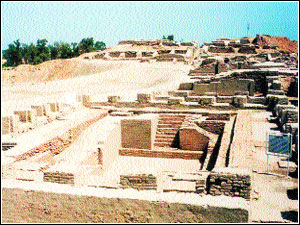 LAHORE, Sept 7: The Unesco has proposed to establish a new Executive Board for the preservation of Moenjodaro as the present arrangements have fallen short of expectations.
Archaeological ruins at Moenjodaro, one of the six archaeological sites in Pakistan on the World Heritage List (WHL), had largely been ignored by the National Fund for Moenjodaro (NFM) established in 2000.
The NFM had reportedly spent only a small part out of Rs60 million accumulated for its preservation till 2000. The funds on the conservation of Moenjodaro, reported to be Rs90 million, are yet to be spent on it.
The Unesco has recently convened a meeting of the federal archaeology director general, the federal secretary and the Sindh governor’s principal secretary in France.
It expressed its dissatisfaction on the NFM performance and proposed a four-member executive board comprising one representative each from the Unesco, the WHL, the federal archaeology department and the Sindh government to monitor the preservation work.
Unesco director (Islamabad) Ingeborg Berines told this reporter that Rs90 million would be spent on the conservation of Moenjodaro during the next 15 years. “Moenjodaro is not being maintained properly as it should have been,” she said.
Before enlisting it in the WHL in 1981, an authority for the preservation of Moenjodaro was established in 1974. One of the major achievements of the authority was the installation of 52 tubewells to lower down the water table as the site was threatened with waterlogging.
The authority was disbanded in 1997 on account of its poor performance and also a clash with the federal archaeology department.
No conservation work had been done on the site since the formation of the NFM. The NFM has reportedly yet to convene its first meeting to look into the matter regarding preservation of Moenjodaro.
The Moenjodaro, or mound of the dead, represents the metropolis of the Indus civilization, the third great ancient civilization in the human history.
The Indus civilization flourished from 2,500 BC to 1700 BC in the Indus valley and along the coastal plains. As of now, over a thousand sites in the vast area of almost half a million square miles have been recorded.
The discovery at Moenjodaro was made by R.D Banerji, an officer of the British Archaeological Survey in India in 1922, while excavating a Buddhist stupa.
The remains of this city are situated on the western bank of the river Indus, about 12 kilometres from Moenjodaro railway station, in Larkana district of Sindh.
The well-planned city, built mostly in baked brick buildings, with a public bath, college of priests, an elaborate drainage system and large state granary bears testimony that it was a metropolis with around 40,000 inhabitants.
Figures of animals like rhinoceros, tigers and elephants on seals were also recovered from the site.
At present, the crystallization of the salt is damaging the bricks and causing disintegration of the structures. The river Indus, flows hardly a kilometre away from the remains, poses a threat of its inundation.
Construction of spurs to keep the river Indus at a safe distance, lowering down of the water table with installation of tubewells and measures to conserve the structural remains have been suggested in a master plan on it.
The tubewells installed, under the Ground Water Control Scheme, are said to be not functioning. In consequence, the ground water has again risen to a dangerous level and salts in the structures are accumulating.
The drainage in the deep excavations in D K area and damp-proofing in some structures in H R area have yet to be addressed.— Zulqernain Tahir