



 0
0

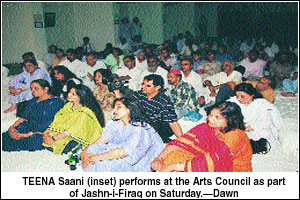 KARACHI: The inaugural session of the three-day seminar on the life and poetry of eminent poet Firaq Gorakhpuri (1896-1982) was held on Friday at the Pakistan Arts Council.
The keynote address by noted fiction writer Intezar Hussain was listened to with attention in the packed Manzer Akber Hall. He delved into the philosophical aspect of the great lyricist Firaq and the contribution he made to the making of a composite ‘Hind-Islami’ culture.
Apart from being an erudite critic, Firaq, Intezar said, was also the founder of ‘jadeed’ ghazal and the modern Urdu poets had not yet been able to liberate themselves from the charisma the master carried with him.
Sponsored jointly by the Irteqa Adbi Forum and WADA (Women and Development Association), this session was presided over by Dr Jameel Jalebi, later joined by Dr Aslam Farrukhi, M.H. Askari and Dr Mohammad Ali Siddiqui.
Fahmida Riaz presented the welcome address. Eulogising the role of poetry in the enrichment of culture in the subcontinent, she recalled her meeting with Firaq at his residence at Allahabad.
Firaq was a poet, a critic and also a Hindu in the truest sense, Intezar said and pointed out that cultural liberalism had evolved during centuries; Nazir Akberabadi a Muslim was “partly a Hindu and Raten Nath Sarshar, a Hindu “was partly a Muslim. Firaq, he thought, was the last Hindu in those years. With the rise of religious bigotry, the culture Muslim and the cultured Hindu both perished. Mir and Firaq also stood separated. ‘Urdu walas’ listened to Firaq attentively but ignored him. The old Indian family culture, its sanctity and the emotional relationship between young and old, the household— (ghar ghirasti) could not find their place in Urdu poetry with the exception of Nazeer Akberabadi and Anis.
Intezar referred to Hindu classics like Ramayan and others and said that traditionally, urdu fiction was different from Urdu ghazal; the Urdu ‘masnavis’ based on ‘dastaans’ carried the local colour.
Intezar reminded that when on the verge of Partition, when the final separation looked imminent, Jamiluddin Aali took to writing ‘doha’ an essentially Hindi poetic form, and Nasir Kazmi reflected in his ghazal the grief of Mirabai, and Ibne Insha imbibed ghazal with local colour.
A member of the presidium, Dr Mohammad Ali Siddiqui, praised the organisers of the event and was happy that at last the merit of a great ghazal writer had been acknowledged. He said Firaq had combined the Persian tradition with the Hindu tradition and was truly a ‘three dimensional poet’.
Dr Aslam Farrukhi said all poets were part of an international brotherhood. “Firaq’s poetry should be re-studied and evaluated the way it deserves”.
M.H. Askari narrated Firaq’s visit to Lahore in the early 50s and his encounter at the police station with a surprisingly cultured police officer.
Dr Jameel Jalebi recalled many interesting meetings and anecdotes about Firaq. At a time when the people in pakistan and India were coming closer, Jashn-i-Firaq was a very timely event and it should be made even more fascinating, he said.
He suggested that essays from Firaq and his interviews and talks should be published in book form to re-asses his place in Urdu literature.
Compering at the session was done by known poet and writer Saher Ansari. His comfortable and unassuming style kept to audience attentive.
A memorable aspect event the Jashn was the display of paintings and drawings done the quartets of Firaq by painters Naheed Raza, Aziz Mirza, Farrukh, Ghalib Baqer, Mansoor A and Moona Kidvai.
In the next session famous singer Teena Saani enthralled the audience with rendering of ghazals by Firaq. — Hasan Abidi






























