0
0

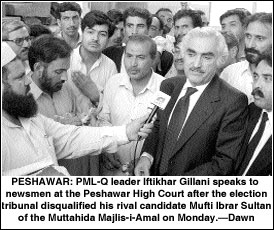 PESHAWAR, June 30: An election tribunal of the Peshawar High Court disqualified on Monday an MNA of Muttahida Majlis-i-Amal, Mufti Ibrar Sultan, and declared the sanad of Wafaqul Madaris not equivalent to graduation degree.
The tribunal, comprising Justice Tariq Pervaiz of the PHC, allowed an election petition of PML-Q leader Iftikhar Gillani, who was a rival candidate of Mufti Ibrar, and declared his seat NA-14 (Kohat) vacant, ordering re-election on it.
The petitioner had challenged the election on the ground that the sanad, Shahadat-i-Alamia Fil Uloom-i-Arabia Wal Islamia, possessed by the respondent was not equivalent to graduation, a condition mandatory for contesting the last year’s general elections under section 8-A of the Conduct of General Elections Order 2002.
Legal circles are attaching importance to the judgment as a constitutional petition on the same point, filed by advocate Aslam Khaki against 65 parliamentarians, including, has been pending before the Supreme Court of Pakistan.
In its short order, the tribunal observed: “Under section 67(B) read with section 68(B) of the Representation of Peoples Act the respondent No. 1 (Mufti Ibrar) was not qualified on the day of filing of nomination papers, therefore, he stands disqualified.”
“Under section 63(P) of the same Act, the petition is allowed to the extent that the election of respondent No.1 is declared void and re-election shall be held on the vacant seat. The registrar of the court shall send a copy to the Election Commission of Pakistan for necessary action,” the tribunal added.
Advocate Essa Khan, counsel for Mufti Ibrar, said they would prefer to file an appeal against this verdict and there was probability that the appeal would be clubbed with a petition of Aslam Khaki. However, he added, the final decision would be taken by the MMA leadership.
Mr Khan said there would be severe repercussions of the instant judgment as thousands of people had been provided employment on the basis of these sanads. He expressed astonishment that the NWFP advocate-general, who represented the provincial government, supported the contentions of the Attorney-General of Pakistan.
Advocate-General Barrister Jehanzeb Raheem told newsmen that neither the provincial government was a party in this case nor he was given any instructions by the government.
He added that the attorney-general and the advocate-general were asked to assist the court under section 27 (1) and (2) of the Civil Procedure Code and as interpretation of a federal statute was involved, he supported the views of the attorney-general.
The tribunal had reserved its judgment on June 23 after completion of arguments by both the parties and Attorney-General Makhdum Ali Khan.
The attorney-general had for the first time brought it on record that the sanads from Wafaqul Madaris and Tanzeemul Madaris, possessed by the parliamentarians, were not equivalent to graduation.
He claimed that the National Assembly had passed a resolution in 1973 for recognising the sanads of religious seminaries, but that was specifically for teaching purpose and that too for theology and not any other purpose.
He said the University Grants Commission (UGC) had overstepped its authority by declaring those sanads equivalent to graduation.
Iftikhar Gillani argued that the sanad of Shahadat-i-Alamia Fil Uloom-i-Arabia Wal Islamia possessed by the respondent, Mufti Ibrar, was equivalent to graduation only for teaching purpose and not for any other purpose.