



 0
0

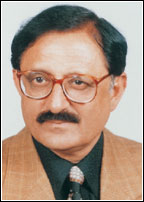
I am proud of Urdu’s literary assets — Hasan Akbar Kamal
 Born in Agra, the city of the Taj Mahal, on February 14, Valentine’s Day, if Hasan Akbar Kamal had a romantic streak in his temperament, it could easily be blamed on the popular saint or the exquisite building associated with passion. And Urdu poetry could hardly be thought of in isolation from love and its related sentiments.
“It was a serene moonlit night. Full moon, that is. And while strolling on the rooftop of our railway bungalow, I composed my first couplet. I was just 14 or 15 years old then and a class X student,” says Kamal in an interview with Dawn at his residence.
At home, in the street or marketplace, you must have heard this song sung by the Vital Signs group: Hum hein Pakistani, hum tau jeetein gay haan jeetein gay…. Few would have missed such popular songs as Kabhi tum idhar say guzar kay tau dekho; Hai tera karam, Maula; Koi Khushbu jaisi baat karo, written and published in book form under the title of Khushboo jaisi baat karo by Hasan Akbar Kamal and sung by popular vocalists such as Alamgir, Nayyara Noor, Tina Sani, Gulbahar Bano and Sajjad Ali.
Although TV songs added to the popularity of Kamal immensely, he was already an established poet, critic and educationist. His second collection of poetry, Khizan mera mausum, had earned him the coveted Adam Jee literary award in 1980. So, he is neither too proud of these lyric poems, nor is he apologetic for writing them. “If I had considered writing lyrics something below a genuine poet’s dignity, I wouldn’t have written them,” says Kamal. “If for nothing else, I see them as a means to practise and hone my craft.” However, he is opposed to poets and writers seeking short-cuts to popularity, and says: “Greatness and popularity are not synonymous. Some detergents, soaps, skin-whitening creams and hair-blackening products are more popular than Faiz, Abdullah Husain, Quratul Ain and Intezar Hussain,” he says to make his point.
His poems and ghazals have been appreciated by such literary stalwarts as Raees Amrohvi, Ahmed Nadeem Qasmi, Farman Fatehpuri, Mohsin Bhopali and Saleem Ahmed. His father being a railway employee, the family had to move home as he was periodically transferred from town to town. Having lived close to nature in towns of Bhawalpur, Khanpur, Naushki and Sukkur, references to natural phenomena are common in Kamal’s highly imaginative verses:
Kamal bad-i-khizan aurh kay hein khwabeeda/ Woh peir jin ko naee konpalon ki hasrat hai
The simple couplet that he wrote in the light of the full moon had given him the confidence that he could become a poet and he seriously pursued the career that afforded him joy, satisfaction and recognition. “I sent a ghazal to Lail-o-nahar, a prestigious literary magazine edited by Sufi Tabassum, who returned the piece of paper with a big and encircled ‘no’. Instead of being discouraged, I resolved that I’d strive and have my poems published in that very magazine.
 “And finally, after a year and a half of hard work, I succeeded in writing a ghazal that was good enough to find a place in Lail-o-nahar.”
After doing his master’s in English, he met Ahmed Nadeem Qasmi in his Lahore office in 1969 and sought his guidance for the publication of his first poetry collection. “Qasmi sahib said as he was leaving for his native village in Sargodha the following day, and he would see the manuscript on return. But at night he found time to read my poems and called me in the next morning. There a publisher was waiting for me in his office. Qasmi sahib sent me to an artist for helping him design the cover, and hence my first poetry book, beautifully printed, materialized without much hassle.”
Asked why he, like Faiz Ahmed Faiz, Firaq Gorakhpuri, Parveen Shakir, Shahida Hasan, etc, mastered and taught English, but chose to compose poetry in Urdu, he says: “I dream, cry and pray in Urdu. So, it is natural that I should choose to give expression to my feelings in Urdu.” He, however, admires English language and literature and other world literatures he read through English. “Through English, I learned how common truths and traditions, discussed by our poets and writers, found mention in other literatures,” he says and adds: “However, I’m not in awe of them. I am proud of the literary assets of Urdu and other local languages.”
Kamal kay mazameen establishes him as a critic. His essays in the book are as captivating as his poetry. The merit of the book is best described in Dr Farman Fatehpuri’s remarks: Kamal kay mazameen, ‘kamal kay (wonderful) mazameen hein’. The book may have a surprise for readers who do not know that prominent religious scholar Allama Talib Jauhari is a poet also and has already published Harf-i-Namu as his first collection of poetry, which has been critiqued by Kamal.
The books he has written are: Sukhan (poetry collection), Khizan mera mausam (poetry collection), Kamal kay mazameen (criticism), Jahan-i-Ishq (poetry), Chacha khairu (children’s novel), Mallah ka bhoot (children’s novel), Rustam Khan (children’s novel) and Adamkhoron ka jazeera (children’s novel). A collection of naats is in press.
Asked how he came to adopt teaching as a profession, he said: “I wished to study science to become a doctor. But I had had a fracture in my right hand and when I appeared in the high school examination, a writer was assigned to me who had very poor handwriting and was slow to take down what I dictated to him. That dashed my hopes as I obtained the third division in my high school examination. So, the next choice for me was teaching. Armed with a master’s in English, when I arrived in Karachi, Shanul Haq Haqqi asked me if I was interested in joining Pakistan Television as a producer. Since I had appeared in a test and interview for teacher at the Delhi College and was hopeful of getting the job, I politely declined the offer.” Prof Hasan Akbar Kamal began teaching at the college in 1970 and retired as head of the English department in 2006.
Prof Kamal is a respectful and obedient student as well as a respectable and loving teacher. When I first contacted him for an interview, he said he would not be available during the next couple of days as he was driving around his teacher visiting here from Multan. “My teacher from my college days, Prof Latifuzzaman Khan, is staying with me and I have to take him to places and people in the city. So, sorry, I won’t be available as long as he is in the city.”
Sad remains of a promising year
 Come year-end, thoughts and memories assail you, and for no reason at all, unless to torment yourself, you sit down to make a tally of gains and losses. And since man’s lot on earth is a cumulative loss, watching the last sunset behind Margalla hills’ western most tail tapering into the horizon fills you with a somber realization of failings and defeat. It is a relief though to know you are through with it. No further losses shall add to the last page of the calendar.
Some years back when near the end of December Parveen Shakir died in a road accident the last sunset had become murky with forebodings of much worse to come though only the light of a lamp had gone out and the days still blazed with relentless unconcern. Munir Niazi also made another December darker. It is a month of losses despite the great births that mark it. And thinking of those who are no more and with whose absence the going year is empty handed and the domain of poetry cold, loveless and docile one thinks of Ahmad Faraz. Death has this amazing function of turning throbbing realities into stories and images. I can see him lounging at Pashto poet Hashem Baber’s,
dipping his cigarette in his drink and fixing you with that sardonic gaze of his, and at SAFMA here not many months ago declaiming in favour of the lawyers’ movement; and years back, still very much a lady’s man in his fifties, shyly watching Tahira Syed twirl her gem studded fingers for the PTV cameraman montaging that memorable poet-singer series. Flashing images all now!
And the shocking termination of 2007 from which the country will continue to reel for only Heaven knows how long. Benazir killed in cold blood with her aspirations still beating in her wounded heart. There was no other way for the cowards to defeat this brave woman. The sun of 27th December watched this well orchestrated plot, its chilling execution and efficient clean washing of evidence within hours of the deed. Who is after the blood of the liberal, progressive and popular forces in this country? Do we need the United Nations to find that out for us? The sun set on that cataclysmic year with that knowledge crackling in the embers of its smouldering heart.
But the year that passes today into time’s dark oblivion like all the other years before shall keep record only of events featuring the bold and the beautiful, the celebrities that have risen to stardom of one or the other kind. Beside those that the tireless media has launched on the centre stage of society are the nameless whose decapitated heads police never misses to pick from the assorted limbs strewn around bombing sites. Who they were and why they chose self-destruction could make prime time melodrama, yet all they are credited with is a trunkless head they donate to the crime reporter’s story. But Islamabad’s Marriott and Mumbai’s Taj Mahal hotels make splashing headlines for days on end. Nations get ready to go to war but the battles lost by the victims’ families seldom find mention anywhere except misspelt lists of the dead and injured.
The dead indeed are fortunate for the prominent among them are mourned publicly; they are remembered and their sins are forgotten. The lesser souls too are relieved of the burden of the daily grind and their uneventful lives make no subject for the writer’s pen. They go under with the deficits of their living days for the accounting angel. But for the poor in their hundred million or more of this once promising land what was it like to be living in 2008? To be living in 2008 with children to feed and atta selling rupees 40 a kg, dahls crossing 100, veggies like apples and cherries from overseas, education, health and transport beyond honest budgets and men and women queued up in the open losing their dignity for a pound of sugar! On my morning walk, I saw this middle-aged man chasing after a small onion a motor cyclist had dropped from his grocery bag. Grabbing the onion, he sat down behind a clump of bushes, opened a paper parcel and virtually choked on the first big morsel of dry bread and onion. There are a couple of small hotels in the Faisal Market of F/7/1 where workers come for lunch. I have seen them chewing naan with sips of tea or dipping their bread in a flat saucer of gravy that the chef ladles out, on the house probably. Such must be the daily menu on the tables of over 60 million of our citizens. Daily wage earners who don’t get work sleep on empty stomachs. An aunt who has a black tongue when told how the poor were passing their days raised her hands towards the cool blue skies and cursed: May those who have stashed away their billions in foreign accounts never live to use that wealth.


























