



 0
0

‘Only the left can address Pakistan’s problems’
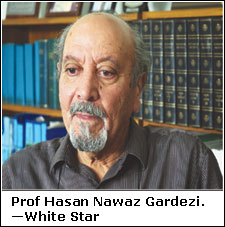 CONSIDERING the current crises Pakistan faces, Professor Hasan Nawaz Gardezi firmly believes that a transformation of the political system and reorientation of the country’s ideological moorings in a socialist direction is the only solution to the nation’s ills.
The scholar was talking to Dawn during a recent visit to Karachi. He was in the city to attend the launch of a book – Chains to Lose: Life and Struggles of a Revolutionary, the memoirs of Dada Amir Haider Khan – which has been edited by him.
Prof Gardezi, a sociologist who retired from a university teaching job in Canada in 1998 and once headed the Punjab University’s sociology department, was asked what prompted him to compile the book on Dada, a revered icon of the left.
“In 1977 or ’78, I took a sabbatical leave for a year and came to Quaid-i-Azam University. I was teaching anthropology and had some great students. They introduced me to Dada Amir Haider. A lot of students from the Rawalpindi/Islamabad area – intellectual types – were influenced by Dada. I had heard of Dada before, but had never met him.
“When I went to see him he showed me a manuscript which he had written in Mumbai’s Nasik Jail before 1942. In ’42 he was released. This manuscript was written during the two years he was in jail. It contained details of his childhood as well his travels on marine vessels. He jumped ship in 1922 and spent some time working in factories in America. It contains details up till the time he left America for Moscow in 1926.
“When I was returning to Canada after my sabbatical, Dada asked me to meet him before I left. He handed me the manuscript and asked me to deliver it to a friend of his in San Francisco, as he told me in this country (Pakistan), nobody would understand its worth. When I began to read the manuscript I realized that I was in the possession of a treasure. I asked him why he did not try and have it published. He told me if I was interested in publishing it I was more than welcome to go ahead.
“Not only did he ask his friend in San Francisco to return the manuscript to me, but he also arranged for a second manuscript, which contained details of his stay in Moscow up till 1946, to be given to me. That’s how I ended up compiling, editing and publishing his memoirs,” said the professor.
He added that his own political leanings also played a factor in compiling the book.
“I had had an interest in left politics since my student days. I helped found the Lahore Students’ Circle, as well as the Democratic Students’ Federation chapter in Multan. The politics was the same as Dada Sahib’s.”
Prof Gardezi was asked if the left had a future in Pakistan.“Definitely. In my mind, the problems Pakistan faces can only be addressed by the left philosophy. The governments of the last few years – either military or civilian – have failed to tackle these problems. The religious fanaticism that exists in our country can only be countered by a secular society. The left has always believed in a secular state. Secondly, poverty has always been our main problem. The only forces who genuinely want to do something for the uplift of the people belong to the left. That’s why Pakistan needs the left. The organization of the left is another question.”
He was also asked to comment on the dramatic rise of leftist forces in Latin America.
“The Latin Americans have discovered that an independent socialist (path) is the only solution to their problems. They had been under the tutelage of America for a long time. Exploitative capitalism had been imposed on them. It’s great that they now have new leadership. They’ve figured out that they have to cut themselves loose from America’s grip. They’ve realised they have to control their own resources.
“This model should also come to Pakistan as this is the only solution for us. We’ve been under American control since the nation was created. Our internal policy and economic policy is dictated by the World Bank and IMF. We are reaping the fruits of our external policy in the shape of Talibanization.
“We must free ourselves from America’s grip and formulate an independent socialist policy. Why socialism? Because the overwhelming majority of Pakistan’s population is poor. Only through a socialist policy can an equitable distribution of wealth and resources as well as provision of basic needs be ensured.”—QAM
An effort to encourage
Sir,
 A few days back I witnessed an extremely overwhelming effort demonstrated by the employees of the CDGK, which inspired me to pen this account in order to express my gratitude to them and draw their attention towards an important issue.
The streets of Gulshan-i-Iqbal, specifically the KDA area, pose a serious threat to pedestrians as far as road crossing is concerned due to the tremendous flow and speed of traffic coming from Jail Road and the Nipa flyover. Pedestrians have to wait for a long time for this vehicular tempest to settle down.
This serious issue has been temporarily resolved by a group of CDGK employees who are positioned right outside the Bait-ul-Mukarram mosque.
These men, attired in special uniforms, assist people in crossing the road from either side. In order to avoid accidents or collisions between vehicles, these men signal drivers to slow down when the pedestrians are about to cross.
Even though the effort is commendable, it must be kept in mind that the currently devised solution is only temporary in nature. The management of the CDGK must formulate a sustainable solution by placing traffic signals at appropriate points.
MUHAMMAD SHOAIB SHAKIR
F.B. Area
Criminal activities
Sir,
We want to bring into your kind knowledge that taking advantage of lawlessness in the city a group of land-grabbers, backed by a political party, has started occupying empty plots and bungalows at gunpoint in the vicinity of Shaheed-i-Millat Road.
These miscreants first grab the property by placing flags of their party there, place men with sophisticated guns, park different cars inside the property and pitch a tent outside the gate, after which they carry out activities such as robberies, extortion and kidnappings in the same area using the grabbed property as a base.
We request you to please highlight this matter to save the people of Karachi from these miscreants.
AN UNSECURED TAXPAYER
Karachi
Wedding celebration at 3am
Sir,
I live near Tipu Sultan Road. I was awakened recently by the sound of firing at about 3am.
Worried about our three children, my wife and I went to their room hoping that they were not awakened by the sound. All three of them were up, understandably a bit frightened. Then my daughter stated that she looked out of the window and saw fireworks. Someone must have been celebrating a wedding, we figured.
There are a few marriage gardens/halls near the Shaheed Road flyover, while there are also some gardens/halls near the Awami Markaz. There must have probably been a marriage party going on in one of them.
Is this not rude and criminal? I am sure that a few hundred people who live within a one kilometre radius of the marriage halls must have been awakened by this noise. Who does this? Who allows this to go on?
There must have been some policemen on duty near the marriage gardens (they should be). Did they take any effective action? There is a police station under the flyover. Did the staff deputed there hear what was going on?
If no corrective action is taken by anyone, I can expect another similar ‘celebration’ will take place tonight and tomorrow night!
NAME WITHELD
Karachi
Lighting required
Sir,
I would like to draw the attention of the city nazim to an important problem in my locality. I had earlier contacted CDGK officials, the Cantonment Board Faisal and the area MPA in this regard, but it was all in vain.
I shifted to Gulistan-i-Jauhar in February, 2008. The surroundings of my area are completely dark after Maghrib prayers as there are no electricity poles and after Isha prayers, it is impossible to walk on foot as dogs bark and chase pedestrians.
Secondly, many cases have been reported of looting ornaments and mobile sets at gunpoint. If some poles are erected and electricity is provided, this area will be illuminated and such mishaps may be reduced.
Since I have failed with all the offices concerned, I request our popular City Nazim, Mustafa Kamal, to kindly order the office concerned to take immediate action.
RAIS ZAIDI
Gulistan-i-Jauhar
Bills without connection
Sir,
Every month we receive a bill from the Karachi Water and Sewerage Board, which is of about the same amount for every flat in our apartment complex, even the unoccupied ones. The amazing thing is that we do not even have a water connection. I do not understand why they keep sending us these bills every month.
H. HAQ SHEIKH
Clifton
Sacrificial centres
Sir,
The CDGK should establish centralized sacrificial centres at the town and UC levels and impose a complete ban on carrying out sacrificial activity on roads and inside houses. Each year we have to witness disgusting roads, the smell of blood in the air and the resultant choking of gutters around the city.
Like all other civilized Muslim nations in the world, we can work on this formula as well and keep our city clean. This will not only beautify our city but will also act as a revenue generating factor for the CDGK.
ARSALAN AHMED FARUQI
Karachi
city@dawn.com
A part-time job
 With the festival of the sacrifice falling tomorrow, a friend seriously suggested to me that he and I should become part-time butchers for Eidul Azha, as we would make a neat Rs10,000 within the three days.
His offer made me understand just how come – from out of the blue – there is a huge influx of butchers going around from house to house selling their services in the city. Most of these guys are on a three-day money-making spree and have little or no knowledge of the butchery profession. But banking on the fact that due to the severe dearth of professional butchers, most people do not bother to check their butchery credentials, as they are in a haste to get the job done, they get to do the job.
A lot of people, to avoid the hassle, simply take a share in the bigger animals and let the various charities take care of the gory details.
Still, there are others who wait till the next day to hire professionals, who are available by the next afternoon, as these people want things to be done professionally. Even more professional would be to have temporary slaughterhouses set up by the local government so that all those wishing to offer their sacrifices (especially those who sacrifice their animals in public streets) should take their animals there and have the job done under one roof.
Maybe this way we will be spared the sight and smell of the rotting entrails, offal bags and dung spread all over the city in the post-Eid period.
As to my friend’s tempting and enticing offer I, being as careless as I am, would probably cut off my fingers if not my whole arm in the chopping process. So I better stick to the profession I am in and just offer my heartiest greetings to Karachians on this Eid.—Rizwan Ali
The festival of sacrifice
Eidul Azha is upon us and as usual, despite the city’s recent law and order situation and the rising prices of animals, the flurry to buy sacrificial animals of every size and variety is still quite visible. Bulls, cows, goats, lambs and of course camels have already encircled the city limits, where animal markets are set up. And so the haggling, cheating and profiteering has started, with the hide wars to be followed immediately after the festive occasion.
The biggest bakra and bhains mandi (goat and cattle market) is set up outside the city limits, just off the Super Highway. Here it has almost a carnival-like atmosphere as with only a couple of days left in Eid, thousands of people throng the place round the clock.
A friend who bought his animal a bit early this time says that prices for small animals such as goats and lambs start from Rs20,000 and for the smallest big animal from Rs55,000. There are of course prize bulls and cows of good breed and stock put on display simply to promote the cattle trade as the asking price seems exorbitant and at current rates runs into millions.
There are hilarious sights of buyers transporting lambs or goats on motorcycles or in rickshaws, with the tail of the animal poking out at one end and the face from the other with a bewildered look. Besides, there are occasional incidents of the bull or cow breaking his/her ropes loose and wreaking havoc in the neighbourhood as was once witnessed in the Karimabad area, where a bull got away and created traffic jams and much effort to grab the animal proved futile.
However, for people living in flats like me, the festival has other amusing aspects too. Whenever I return home late in the evening after work I usually get startled as I ascend the stairs of my flat, for my path is blocked by a huge goat. Perhaps the neighbours didn’t think it right to use their balcony as a temporary shelter. Or maybe it’s because animal theft has become rampant, as earlier people used to tie animals in the parking area without any fear.
But now people say thieves strike as soon as the night watchman catches a wink and the hapless residents really feel fleeced in the morning. With the prices of animals already touching the skies, there is likelihood that thieves may strike at your door. So better be watchful!—Syed Ali Anwer
Too close for comfort
It was a day like any other. We were driving from one part of the city to another. The only difference was that I had taken to counting the number of CNG stations along the residential area between Ship Owners’ College and Abdullah College. There were two CNG stations on that road alone and both were quite close to each other. I then counted two more stations in the Nazimabad area. Again, these stations were in close proximity. The question which arises in this context is: what is the point of constructing CNG stations so close to one another? Yes, the price hike of petrol has been such that most people have made the switch from petrol to gas in order to balance the monthly budget. And it also goes without saying that there is always a very long queue of vehicles at CNG stations, so one has to wait for a very long time to get filled up. It is logical that the increasing number of CNG stations would definitely spread out the load and make it more convenient for people to re-fuel their cars.
But really, if one stops to think about it, there is always the possibility that one station is (God forbid) afflicted with a disaster like a fire or bursting of a cylinder. If another station is close by, it is very likely that it will be affected too, thus creating a catastrophe for the residential areas close by. Moreover, noise pollution in the form of compressors and generators also creates a nuisance for those living near these stations. It is interesting to note that a petition had been filed in court against the construction of a CNG station right in the middle of a residential area, and a stay order was also given. However, it has been ruled that CNG stations can be constructed in residential areas, as long as the plot on which they are being constructed is commercial.
Disaster management of any type dictates that these stations should be at least some distance away from the residential areas and away from each other as well. It is quite alarming to see CNG stations springing up like mushrooms within residential areas, without anyone giving a thought to their long-term health hazards for the residents or a potential catastrophe, should one station come under any harm.
It is about time someone took up the responsibility of standardizing the minimum distance which must be maintained between two stations.—Hafsa Ahsan
Compiled by Syed Hassan Ali
karachian@dawn.com
Saving our highways
 THE two-and-a-half years old reconstructed I.J. Principal Road dividing the twin cities is the latest to fall victim to heavy freight traffic. Opened in July 2006 after prolonged widening and reconstructed works running into years, the road – prematurely dotted with hazardous large potholes and uneven surfaces – is now due for rehabilitation.
Kashmir Highway, the other heavy freight route through the capital city, has already been rehabilitated a couple of times in the past decade but the road is damaged again almost as soon as it is repaired.
Islamabad Highway, the third major artery through which freight-carrying traffic passes through the city, is currently undergoing widening and reconstruction works.
Millions of rupees have been spent in this way on rehabilitating these major freight routes in Islamabad, but the increasing heavy truck traffic in the past decade has proved too much a load for these roads to bear. A heavy truck is known to impose road wear costs hundreds of times greater than an automobile.
According to officials from the Islamabad Traffic Police and the Capital Development Authority, an estimated 10,000 freight-carrying trucks enter Islamabad every day through the Kashmir Highway. Many of these vehicles carry as much as 20 to 25 tons per axle whereas the permitted load is eight tons per axle.
In addition to higher levels of road-wear, heavy truck traffic on these highways causes congestion and accident-risk problems for other motorists and pedestrians. These problems have increased considerably on I.J. Principal Road since the recent diversion of all truck traffic from Kashmir Highway to I.J. Principal Road.
Besides, those living and working near these highways are also being exposed to higher levels of pollution emitted by the large number of trucks. Heavy diesel trucks produce high levels of particulate air pollutants which are particularly harmful to human health.
Studies conducted elsewhere have not only shown that truck traffic causes more pollution emissions (viz., hydrocarbons, carbon dioxide and nitrogen oxide) than rail and water transport, but that people living, working or attending schools close to highways with high truck traffic counts experience more chronic respiratory symptoms than those living, working or attending schools close to highways with low truck traffic counts.
The truck traffic problem is not confined to Islamabad. According to one report, numerous government studies regarding the state of roads in Pakistan have concluded that over 90 per cent of all vehicles carry more than the permitted tons per axle.
After the National Highway Authority introduced weighbridges on the motorways, it was found that over 67 per cent of all vehicles weighed were overloaded. Vehicles with a road damage factor of 100 times that of a correctly loaded truck were found on a daily basis.
This, the report said, confirmed the extensive damage being done to the country’s roads, running into billions of rupees per year in repair and maintenance costs.
As far as Islamabad is concerned, the introduction of long overdue weighbridges at the entry points of the three major freight-carrying highways in Islamabad, plus a stringent overload detection and prevention policy – which includes measures like fines for overloading – are necessary to help reduce the number of cases of overloading.
A wider solution, however, for Islamabad and for Pakistan in general, needs to be considered from the point of view of overall transport development, particularly freight transport.
In Europe and elsewhere, concerns over congestion, safety and environmental degradation caused by freight transport by road have led to greater development of the rail mode of transport, both for goods and passengers.
Despite its higher initial capital costs, rail transport’s major advantage is that it is a green system, i.e., the quantity of fuel used as well as the pollution generated per ton of goods is lower on the railroads than on the road.
According to at least one study, rail transport uses over three times less fuel per ton-km than road transport. This is important for our balance of payments since we import much of our fuels.
Not only is a train more fuel efficient, it also emits three times less pollutants and particulate matter than trucks. Besides, a train can also take as many as 200 trucks off the highway, thus reducing traffic congestion and potential accidents.
Moreover, a rail track allows significantly greater loads per axle than in road transport, leading to less wear and tear. Also, double stacking of containers on flat railway cars can double the capacity of trains to haul freight with minimal cost increases, especially over long distances.
Not only have we yet to develop the more advantageous rail transport for greater freight delivery but we have also not been keeping up with the international trend towards inter- or multi-modal transportation. The latter enhances the economic performance of a country’s transport chain by using rail transport for long distances and trucks for shorter distances and local pickup and delivery.


























