0
0

Pedestrians’ plight
 Sharea Faisal is a moving metaphor for life: never a dull moment – fraught with possibilities exciting and tragic. If traffic is sparse you can enjoy a good, relaxing drive with friends and family; and if it’s as clogged as a choked drain, it can turn the sanest of souls into a demented individual.
My two cherubic children study at a school that’s in PECHS Block 6. Despite the fact that my better half (who teaches at the same institution and is just as cherubic as our son and daughter) drives the clapped-out vehicle that we call a ‘car’; every morning I tag along with my children to school as their ‘moral support.’
Once they are in their respective classes, I walk all the way from the school to Sharea Faisal and have breakfast (maska bun and chai usually) at an Irani restaurant. Then I step out of the restaurant and do my favourite thing: climb the pedestrian bridge that spans the wide road to descend to its right side from where I catch an auto-rickshaw to reach the office.
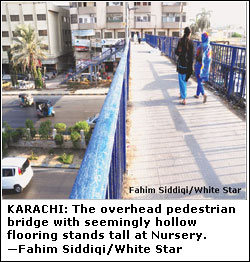
This pedestrian bridge is an imposing sight. Made of steel (or iron) it stands tall like the giant statue of Apollo at the entrance of the harbour of Rhodes. Once I reach its deck or flooring, I find it hauntingly amazing to see all sorts of vehicles dashing and whizzing from both sides of the road like there’s no tomorrow. It’s life at breakneck speed. I also see a variety of people walking across Sharea Faisal using the overpass – sales reps, beggars, newly-married couples, dating duos, jobless young men with files containing their CVs in their hands, lunatics etc.
But as much as I enjoy being there, there’s something frightening about the flooring of the structure. If you’re not a nimble-footed person and you tend to stomp rather than walk, like yours truly, you will feel certain hollowness beneath your feet. That’s exactly what I’ve felt lately.
The deck of the overpass seems to either have holes in it, covered by steel sheets, or is developing some kind of defect. The structure is not as strong as it appears and is getting ricketier by the day. If the observation is not off the mark – and I hope it is – this is dangerous and amounts to endangering the lives of many a citizen.
Thousands of vehicles pass by under the bridge and hundreds of Karachians reach across both sides of Sharea Faisal on foot via this pedestrian walkway on a daily basis. God forbid, if the structure collapses, even partially, it can cause irreparable damage. The authorities concerned must not let it happen. Sharea Faisal is a moving metaphor for life, not a symbol of bereavement.—Peerzada Salman
Of theatres
In times of despondency when extremism seems to surmount everything like an octopus, Ajoka Theatre’s recent brilliant performance, Bullah, reinstated the belief that there are many who not only want to stave off such misery but also seek and desire the world to be a better place – free of bigotry and inequality. The play received a standing ovation and a roaring response from an elated audience at the Arts Council theatre, reinforcing their condemnation of oppression and fanaticism.
The message of the play could not be better said than emphasising the life of Sufi Baba Bulleh Shah, the 16th century heretic who challenged religious hypocrisy in his times. The audience related to the agony of the Sufi who sang heartening kafis, his medium for social protest against the oppression of the masses in the streets of Kasur, the town in Punjab he grew up in.
Denounced by orthodoxy on many occasions, Bulleh Shah had become a symbol of humanism for the whole of Punjab as the poor yearned for his company and would seek relief under his guidance. Perhaps we live in a time and conditions no different than the people of that time. This makes one ponder if man has really made any progress in terms of equality and justice.
It is a pity that Ajoka Theatre returned to this city after a lapse of 10 years, when they should be visiting Karachi more often. They have been doing theatre in the most difficult of times, keeping afloat a sense of contribution and responsibility more than pure entertainment.
The overwhelmed audience, spilling on to the aisles of the Arts Council theatre to see the performance, was testimony to the fact that the people of Karachi would always welcome theatre which highlights burning issues with such indigenous ease.
—Sumera S. Naqvi
Where there’s a will
 In the country’s media capital, Karachians have learned to mistrust and fear even in periods of calm. While the failure of successive governments to deliver often comes under deliberation in talk shows on television channels and the subject is quite thoroughly taken up in all sorts of drawing-room discussions, it is unfortunate that we conveniently forget our duty towards our city.
And here one feels that the media will make things seem worse if it continues to overlook the role of people towards their society. It may be true that the country could never see the dawn of a true democracy and all the regimes constituted a bunch of dishonest, short-sighted and incompetent souls that had no real interest in resolving public issues. But, having said that, this appalling state of affairs doesn’t abdicate us of our responsibility as part of a community. We need to ask ourselves: do we really own our neighbourhoods?
By making this comment one doesn’t intend to downplay the efforts of NGOs and philanthropists working in their respective fields of concern. The objective is to point out the widespread apathy prevailing in our society.
For example, go to any part of the city and you’ll see uncountable numbers of garbage dumps and overflowing gutters. No doubt, municipalities are supposed to lift the garbage and unblock sewers, but how and where garbage should be thrown is very much in our own hands. Also, sewers are blocked mainly because there is little public concern over their periodic cleaning.
As part of the job being a reporter, one has the opportunity to visit different areas of the city. One of the most painful observations has been not the poverty of the masses and lack of basic facilities, but rather, the people’s indifference towards their surroundings. Many people had an understanding of the serious hazards the filth posed to their health, yet they lacked the willingness to do anything about it, believing that this was the government’s job, not realising that their children were the direct victims of filthy living conditions.
The reasons for public apathy are many and are debatable, but what is beyond doubt is the fact that if a group of individuals in each and every community starts owning its locality, things can really start improving.—Faiza Ilyas
Compiled by Syed Hassan Ali
karachian@dawn.com
Faulty phones
Sir,
 This is with reference to telephone numbers 506-4595, 506-4597, 507-4958 and 511-4567. We have been experiencing faults in our telephone lines for the last two years. We have approached the higher authorities but unfortunately, all the letters sent to the PTCL officials remain unheard.
After getting no response from the authorities concerned, we fixed the monthly payment of a lineman, who assured us that out of the four lines, at least one would work properly. A few days back I had an argument with the lineman and refused to pay him. God knows what fault he created in the lines as till date, none of our phones are working. Due to this negligence of the PTCL I have suffered huge losses, even though I have been regularly paying all my phone bills, regardless of the fact that they were working or not.
I hope someone can address this problem.
YASIR GULZAR
Karachi
Sir,
I am a resident of Gulistan-i-Jauhar. I was promised two PTCL connections within seven to 10 working days after going through the formalities. At last, the connections were given in a month’s time. After the unexplained delay, one of the numbers (466-0977) went out of order within a week’s time.
After several complaints a grumpy lineman turned up to fix the phone, constantly murmuring that this is not his work as other linemen are assigned to the area. However, the connection again went out of order in two days.
After a discussion with the relevant authority it was revealed that no action could be taken against the linemen as none of them were employed by the PTCL.
The irony of the matter is that the PTCL has no authority over linemen who are fiddling with its connections on a daily basis, a fact known to them.
To add to this the other number (466-0976) has also gone out of order and likewise remains unattended.
NAME WITHELD
Karachi
Pak Colony police
Sir,
The Pak Colony police have failed to control street crime in Old Golimar as armed robbers are still active and terrorising the general public.
Recently, a resident of Ali Mohammad Village, Mr Abdul Lateef Baloch, was robbed in his own street. Three motorcyclists appeared and deprived him of Rs35,000 in cash, a wrist-watch, cellphone and keys.
When he went to the Pak Colony police station to register an FIR, the SHO refused, saying that it was a routine occurrence.
The relevant authorities are asked to take note of such negligent behaviour on part of the police.
M. SALEEM BALOCH
Karachi
KCR revival
Sir,
In your editorial on Sunday, Sept 21, you have, once again, taken up the cause of re-starting the KCR. Your main thrust is the plea of the former mayor of Bogotá, that a signal-free highway would not solve Karachi’s traffic problem. Instead, the ex-mayor pleaded for the system which he had introduced in his country in his capacity as mayor.
I am afraid the ground realities prevailing in our country are quite different from the civilized world. Let me recall my own experience as a former resident of Gulshan-i-Iqbal when the late KCR was very much alive and running.
Being a sibling of an erstwhile railway man of the colonial era, I jumped into an empty, stationary railway wagon of the nearby station. To my utter surprise and heartbreak, when I had a look at the inside of the wagon, there wasn’t a piece of furniture such as seats, steel-bar hand holders etc., intact. These were either dilapidated or conspicuous by their absence.
It may be recalled that the former KCR was hardly a commuter-friendly choice. Its linkage to the city’s main and densely populated areas was far from satisfactory. Hence, its use by the common folks was minimal. Naturally, the railways sustained heavy revenue losses, ultimately resulting in its failure.
I am afraid the same fate is likely to befall the dreamy concept of reviving the past failed experiment of the KCR.
HAMID ALI QURESHI
Karachi
Widow’s request
Sir,
The federal ombudsman ordered, in my favour, that the recovery of a house may be made from Mirza Ahmed Ali Baig in 90 days. However, the HBFC succeeded in getting an order for the auction of the house from Banking Court No 4 and a notice appeared in a section of the press on 28/2/2006.
I approached the federal ombudsman, who assured me that the HBFC cannot take any action because the ombudsman’s decision is in my favour.
Thereafter, the federal ombudsman issued a notice to the HBFC for submission of money, which they deposited on 27/3/2006.
I requested the ombudsman to get the documents of my house provided to me by the HBFC, which were with the HBFC. I was then served with a letter requesting me to deposit Rs197,761 into a bank account.
Thereafter, I was informed by the HBFC staff that the documents have been handed over to one Mirza Sadiq Ali Baig.
Now, the HBFC authorities are reluctant to hand over the documents of my property and say that I could only get the documents by going to court.
Sir, I have no means to go to court because I am financially broken, whereas only I know how I had struggled to reach the federal ombudsman.
It is requested that my documents may be handed over to me from the HBFC.
SHAHJAHAN BEGUM
Karachi
city@dawn.com
Election Commission’s credibility at stake
 FOLLOWING the Feb 18, 2008 general elections scores of losing candidates challenged the elections of their rival candidates by presenting elections petitions to the chief election commissioner (CEC) in a hope that their disputes would be decided at the earliest. However, to their utter disappointment most of the election petitions are still pending before the concerned election tribunals.
The proceedings in these election petitions have been going on at snail’s pace as the presiding officers of the election tribunals, who are judges of the respective high courts, are engaged in their routine judicial functions and the winning candidates have also been using delaying tactics so as to delay the disposal of these petitions.
It has now become a routine practice that election petitions are filed after every general elections and most of them are lingering on before the tribunals and appellate forum. Thus the post-election disputes continue to persist till next such general elections.
Following the 2002 general elections scores of elections petitions were filed which remained pending for many years. Even if the petition was decided by a tribunal appeal was filed before the Supreme Court and the dispute continued.
In this regard the most famous case was that of Mufti Ibrar Sultan who was elected MNA from NA-14, Kohat in 2002 polls. His rival candidate Iftikhar Hussain Gillani had challenged his election through an election petition on the ground that he possessed sanad of a seminary which was not equivalent to graduation, which was prerequisite for contesting polls.
An election tribunal presided over by Justice Tariq Pervez Khan on June 30, 2003 accepted the election petition, de-seated Mufti Ibrar and ordered re-polling in that constituency. Mufti Ibrar filed an appeal before the Supreme Court which suspended the order of the tribunal and allowed him to continue till final disposal of the appeal. The appeal was still pending when the Feb 18 polls were held.
Article 225 of the Constitution provides that no election to a house or a provincial assembly shall be called in question except by an election petition presented to such tribunal and in such manner as may be determined by Act of Parliament. The mechanism of filing the election petition and the procedure of its hearing have been provided in the Representation of Peoples Act, 1976.
Under section 57 of the Act the CEC shall appoint as many election tribunals as may be necessary. The tribunal shall consist of a person who has been, or is, or at the time of his retirement as a district and sessions judge was qualified to be a judge of a high court.
The CEC appointed 30 election tribunals - 12 for Punjab, eight each for NWFP and Sindh and two for Baluchistan - on Feb 27 and 28. The tribunals in NWFP included: Justice Said Maroof Khan, Justice Hamid Farooq Durrani, Justice Muhammad Alam Khan, Justice Shaji Rahman Khan, Justice Ghulam Mohy-ud-Din Malik, Justice Syed Yahya Zahid Gilani, Justice Ziauddin Khattak and Justice Syed Musadiq Hussain Gilani.
Moreover, section 67 (1A) has made it mandatory on the election tribunal that it should proceed with the trial of the election petition on day to day basis and the decision thereof shall be taken within four months from its receipt.
Keeping in view the present circumstances it is next to impossible for the election tribunals to conduct day-to-day hearings. In the Peshawar High Court there are presently 12 judges functioning eight of whom are presiding officers of tribunals. Normally, election petitions are fixed for hearing on Monday and Friday, the days when the judges are performing as single-bench. Even on those days routine cases have also been fixed for hearing. On other days the judges normally work in division benches and the election petitions could not be fixed for hearing.
A preliminary report recently launched by the International Foundation for Electoral Systems (IFES) revealed that this mandatory provision of the Representation of People’s Act has not been implemented due to variety of reasons. The report is the result of a study conducted by foundation to study the post-election adjudicatory mechanisms for resolving challenges to election results in Pakistan.
According to the report a total of 265 petitions were filed before the CEC - 94 regarding National Assembly and 171 about provincial assemblies’ elections. Of these 265 petitions, 138 were filed regarding Punjab, 46 in Sindh, 38 in Balochistan and 37 in NWFP.
The study was led by Peter D. Lepsch, a consultant with the IFES. There are various findings put forward in the report which included: Based on current date trends and observations by IFES tribunal monitors it is anticipated that the vast majority of the election petitions filed will not be completed within the statutory prescribed timeframe.
The study preliminary findings indicate that the election tribunal mechanisms are marked by substantial delays at all levels.
It is added that consistent with anecdotal perceptions, initial findings point to considerable delays in the election tribunal process resulting from the use of current legal procedure of traditional trial practice. Notice requirements and customary adjournment practices currently function as built in delay mechanisms, the reports states.
The study reveals that the magnitude of these delays seriously impacts the credibility of the Election Commission of Pakistan and raises questions regarding the legitimacy of the election results generally.
The foundation observes that the lack of robust day-to-day scheduling of election tribunal hearings impairs the rights of candidates to due process and timely redress, which is critical to effective and legitimate election dispute resolution processes.
It is observed that the election tribunal process lacks vigorous prioritisation necessary to fully meet the international standards of effective remedy and fair hearings for challenging election results.
Dealing with pranksters
 IN addition to being traumatised by actual bomb blasts at the Marriott Hotel and the Police Lines, the twin cities have also been harassed by a spate of hoax bomb threats recently which diverted the law enforcing agencies into futile searches and wasted thousands of police and emergency services man hours.
Among the targets of these anonymous hoax calls were Islamabad Hotel (twice in recent weeks), Faisal Mosque, Habib Bank building, Geo Plaza, office of the Ministry of Women Development, office of the Rawalpindi Cantonment Board, a school in the Cantonment and more recently a Federal Government High School in Rawalpindi, with one caller even threatening to blow up Rawalpindi city.
With the hoax call menace assuming serious proportions, questions have naturally been raised about whether to adopt a tougher approach towards such pranksters and whether we need more stringent laws to punish those caught making such calls.
According to a senior lawyer based in Islamabad, there is no specific law here against people who make false bomb threat calls.
One teenaged hoax bomb caller who was traced and caught for making such a call to a school in Rawalpindi cantonment recently was booked under section 25-d of the Telegraph Act, 1885 and released on bail by a civil judge in Rawalpindi on a total surety of Rs110,000.
According to the above lawyer, section 25-d is a bailable offence pertaining to causing annoyance or intimidation or obnoxious calls for which the accused is liable to three years imprisonment or fine or both if found guilty.
In another case, a man who was caught and booked under section 25-d of the Telegraph Act and section 7 of the Anti-Terrorism Act, 1997 for making calls to Rescue 1122 threatening to bomb Rawalpindi city, had his original one-day physical remand extended by five days by a judge in an anti-terrorism court in Rawalpindi.
Says a parent whose child studies at the school in Rawalpindi cantonment which received the prank bomb threat call recently: Making hoax calls should be considered a serious offence. Just like real terrorist threats, these pranksters create an environment of fear by issuing false warnings of terrorist acts with the malicious intent of sending the police into a wild goose chase.
She believes these pranksters should be firmly punished.
However, according to a psychologist based in Islamabad, there is a big difference between people who actually plant bombs and people who make idle threats of planting bombs.
A person who actually plants a bomb is typically looking for revenge: they harbour deep hostility and rage, and their motivation may be abstract, like a grudge against the government and the desire to strike back.
Crank callers making bomb threats, on the other hand, tend to be young people who are idle and bored and looking for kicks. They make the threat, see the results of the fuss they create, especially on television news channels, and enjoy a great sense of excitement, power and self worth.
Even though their threats may not be real, should such crank callers be taught a lesson and be punished as a lesson to deter others?
In the opinion of a senior police officer: Yes, because the results of crank calls are a great deal of wasted time and money for everyone, especially the police and emergency services, as well as a lot of anxiety all round.
Each bomb threat call usually has the law enforcing agencies and ambulances rushing to the spot, evacuating people from the building, combing it and finally declaring the call a hoax, an exercise lasting two to four hours or even more, depending on the building.
In India, the Mumbai Police, fed up of wasting tens of thousands of police man hours investigating hoax bomb threats, recently started booking prank callers under a section of the Indian Penal Code pertaining to criminal intimidation which prevents the accused from getting a job in any government office.
On the other hand however, more specific and stringent laws against hoax bomb callers could instill fear among genuine callers who spot a suspicious package, bag, car or truck and will be reluctant to inform the police.
To facilitate police investigation on bomb threat calls, it is being suggested that it should be made mandatory for all offices, businesses and schools – public or private, big or small – to install the Calling Line Identification (CLI) software in their landline phones.
While the majority of bomb threat calls have proved to be false alarms, a real bomb threat can prove to have devastating results if handled incorrectly. Apart from damage to property and assets and loss of critical documentation, worst is loss of lives and injuries, especially through panic and confusion.
The twin cities and Islamabad in particular, therefore, need to have sufficient mobile bomb disposal units to deal with several emergencies simultaneously and they should all be well-trained and equipped with the latest bomb disposal paraphernalia.
Moreover, all offices, institutions and schools should be encouraged to develop emergency plans to handle bomb threats whether prank or real.
These plans should include how to back up records in the event that a bomb threat occurs, how to search and evacuate the location before the police arrive, and a hierarchy of who to contact in the event of a bomb threat.